First time you get handed a position paper assignment, it’s kind of unnerving, honestly. You’ve got to pick a side, back it up with real evidence, and somehow make the whole thing sound convincing. Where do you even start? If you’re prepping for a Model UN conference, working through a college assignment, or getting ready for some kind of policy debate — this is basically everything I wish someone had just explained to me the first time I sat down to do this.
By the end you’ll know what a position paper actually is, roughly how it’s put together, the mistakes that trip most people up, and a format you can just reuse whenever you need it again.
Okay, So What Is a Position Paper Anyway?
Think of it as a formal argument, written down. A regular essay lets you poke around a topic from a few angles. A position paper doesn’t really give you that luxury — you’re committing to something. Staking a claim and building a case around it with logic, credible sources, actual examples. It’s not really about informing anyone. It’s about persuading them.
You’ll run into these mostly in:
- Model United Nations (MUN)
- college and university coursework
- public policy discussions
- debate competitions
- research and advocacy work
Whoever ends up reading it — professor, judging panel, room full of delegates — the job is convincing them your position holds up once someone pokes at it.
Why This Is Worth Getting Good At
A decent position paper kind of trains a few things into you without you noticing. Makes you say your opinion plainly instead of hedging around it forever. Shows you can reason through something instead of just reacting to it emotionally. Proves you can actually back a claim up rather than just insisting it’s true. And — this one’s underrated — it makes you deal with the other side’s argument instead of pretending it isn’t there.
That last part matters more than people give it credit for. In academic settings and professional ones both, that kind of honesty tends to earn you credibility pretty fast, in my experience anyway.
Getting It Done, Piece by Piece
Breaking it into smaller chunks makes the whole thing a lot less overwhelming. Here’s roughly how I’d go about it, for what it’s worth.
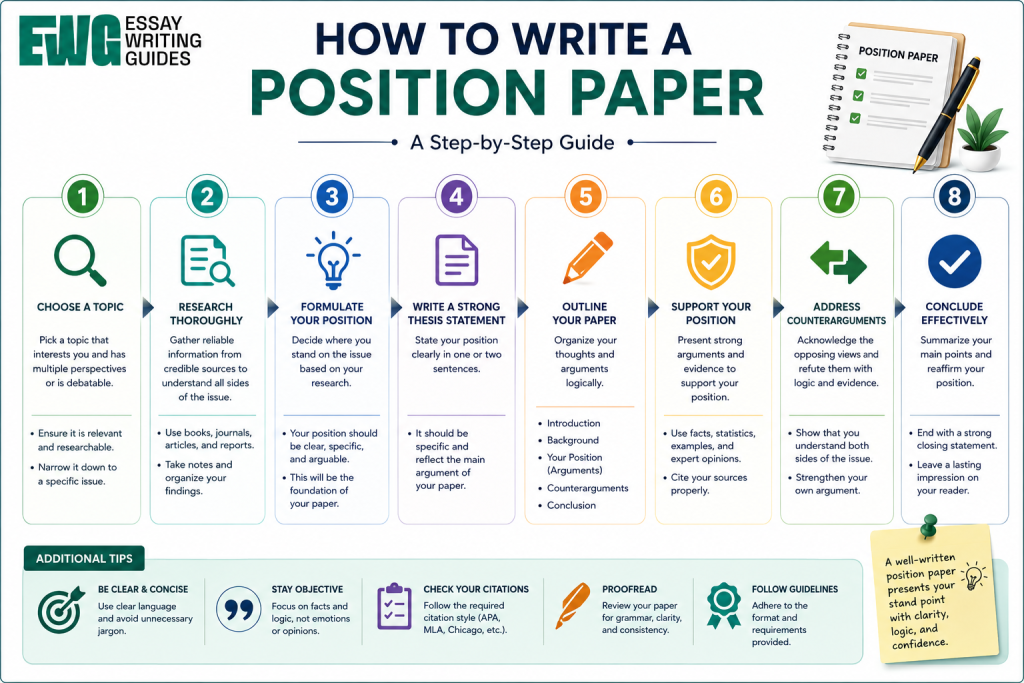
Start by actually understanding the topic. Sit with the prompt a minute — don’t just skim it. What issue are you being asked to address, who’s reading this, why does it even matter, and are there length or formatting rules hiding somewhere you need to follow? If the topic’s too broad, and a lot of them are, narrow it down till you’ve got one angle you can actually argue.
Take something like should schools require uniforms? On its own that’s still huge. Part of the early work is just figuring out which slice of that you’re actually going to fight for.
Pick a side. Actually commit to it. Sounds obvious but people waffle here way more than you’d expect. Ask yourself honestly — do you support it or oppose it? And more to the point, can you actually defend that with evidence, or are you just leaning that way because it feels right in the moment? Once you’ve picked, stay there. Nothing tanks a paper faster than a writer who sounds unsure of their own argument by paragraph four.
Something like this works okay as a starting point: “Schools should require uniforms because they improve discipline, reduce bullying, and create a more focused learning environment.”
Then — do the actual research. This is the step everyone tries to skip and it always shows later. Stick to sources you can trust: academic journals, government publications, books, university sites, peer-reviewed stuff, reputable news. Skip the random blog and forum posts, they’re not worth the risk.
Take notes while you go, and keep track of where things came from. Trust me on this one — future-you, trying to slap together a citation list at eleven at night the day before it’s due, is going to be furious at present-you if you don’t.
Nail down an actual thesis. It’s the backbone — one or two sentences saying your position and hinting at how you’re going to back it up.
Compare:
Weak: “School uniforms are interesting.”
Strong: “School uniforms should be mandatory because they reduce distractions, improve student safety, and encourage equality among students.”
See the gap? One says nothing at all. The other tells the reader exactly what you think and basically previews the whole argument in one line.
Sketch an outline before you dive in writing. I know it feels like an extra step nobody has time for, but skipping it almost always costs more time down the line. Something basic like:
- intro (background + thesis)
- argument 1
- argument 2
- argument 3
- counterargument
- rebuttal
- conclusion
Having that mapped out ahead of time keeps you from drifting off mid-paragraph, which — trust me — happens more than you’d think once you’re actually deep in it.
Write an intro that’s actually doing work. It’s got a few jobs at once — hook the reader, give them enough background to follow, explain why the issue matters, land on the thesis.
Something like this usually does it: “School uniforms have been debated for decades. While some believe uniforms limit individuality, others argue they promote discipline and equality. Schools should require uniforms because they create safer learning environments, reduce peer pressure, and improve academic focus.”
Give each argument its own paragraph — don’t cram three into one. Open with a clear topic sentence, then back it with stats, expert opinion, research, real examples, whatever fits.
Don’t dodge the other side. A paper pretending no counterargument exists isn’t persuasive, it’s just naive-looking. Bring it up honestly — say, some people argue uniforms suppress self-expression. Explain why someone might actually believe that before you push back on it. Little bit of respect here goes a long way, genuinely.
Then take it apart — respectfully. Once you’ve laid the counterargument out fairly, explain why your position still stands. Sure, uniforms limit clothing choices — but kids can still express themselves through academics, extracurriculars, their own achievements. Core of your argument survives just fine.
Close with a conclusion that actually lands. Restate the thesis, pull the key points together, leave the reader with something worth remembering. Don’t just repeat yourself here — reinforce what you already proved.
Something like: “School uniforms provide numerous educational and social benefits, including increased equality, improved discipline, and a stronger learning environment. While concerns about individuality are understandable, the overall advantages outweigh the drawbacks, making school uniforms a valuable policy for many educational institutions.”
The Format, Stripped All the Way Down
Strip everything else away and most position papers boil down to the same skeleton:
- title — name the issue
- intro — set it up, drop the thesis
- background — context for anyone unfamiliar
- supporting arguments — your evidence-backed reasons
- counterargument — other side, stated fairly
- rebuttal — why you still win
- conclusion — tie it back together
One Example, Quick, Start to Finish
Topic: should social media be regulated?
Position: governments should regulate social media platforms to reduce misinformation and protect user privacy.
Supporting arguments:
- cuts down the spread of false info
- protects personal data
- improves online safety
- pushes platforms toward more accountability
Counterargument: some worry regulation limits free speech.
Rebuttal: effective regulation targets harmful practices without shutting down lawful expression — it’s about balancing safety with the right to speak freely, not picking one over the other.
Stuff Worth Remembering
- pick one position, stick with it
- use sources that are current and credible
- back every claim with real evidence, not a hunch
- stay objective even when you feel strongly about it
- keep ideas organized, logically sequenced
- deal with opposing views fairly, not dismissively
- go back and revise for clarity and grammar
- follow whatever citation style you’ve been told to use
Mistakes That Quietly Wreck an Otherwise Good Paper
I’ve made most of these myself, honestly, at one point or another:
- picking a position then going wishy-washy on it halfway through
- leaning on emotional appeals instead of evidence
- ignoring the counterargument entirely
- citing sources that aren’t actually reliable
- dropping opinions in with nothing backing them
- letting paragraphs run way too long
- skipping the proofread — always regret this one
What Actually Separates a Good Paper From a Great One
Honestly? Comes down to research, organization, and how carefully you reason through your points. Don’t lean on opinion alone — pair it with hard evidence and clear logic. Keep it professional, use transitions that actually connect one idea to the next instead of just being there, and make sure every paragraph is pulling weight toward your thesis.
Before you submit — go through it once more. Check grammar, formatting, citations, whether the argument actually flows point to point or just kind of sits there. A tightly argued, well-supported paper beats one stuffed with unbacked claims. Every single time.