

You may be a senior secondary student, and I may be a professional writer for any publication.
Both of us can have common queries regarding the narrative essay outline.
If you know the basics, a narrative essay outline is like a short plan arranging your story into three parts.
There will be an introduction, setting the stage and hinting at why the story is important.
Then comes the body of the essay, moving through the story. It has the complication, the climax, and the resolution.
Finally, it ends with a conclusion or summary, reflecting on what the experience meant.
Outlining a narrative essay in the beginning always helps a writer to maintain a logical flow and finish the piece seamlessly.
So, in today’s blog, I will discuss the narrative essay outline with templates, a worked example, and word-count budgets.
Moreover, I will talk about what has changed in narrative essays for college applicants in the 2026-27 cycle.
| Quick Answer: The Narrative Essay Outline If you are a beginner or want to create a simple and quick essay, you can follow this skeleton. Introduction: It will have the event, the setting (time and place), and why it matters. Body (The Complications): What changed afterward, what things started going wrong, or what was exceptional. Body (The Climax Part): It is the hardest and most tense section of the essay. Body (The Resolution): Reaching a solution or how a conflict was dealt with. Conclusion: How the experience has changed you or what you have learned. |
Now, What Is A Narrative Essay Outline?

A narrative essay outline is like planning a document, and it is never the first draft.
Also, the outline or the structure will change based on whether your essay is about stories or arguments.
A Simple Definition
A narrative essay outline is a structured plan that has the setting, the turning points, and the reflections.
It is the best format when you are telling a story, usually about a personal experience.
Here, your challenge is to tell that story in a compelling manner.
So, how you begin the story and how you pace it will decide how impactful the final essay is.
How A Narrative Outline Differs From An Argumentative One
When you are writing an argumentative essay, each paragraph in the body of the essay supports a claim.
On the other hand, each body section of the essay helps to advance a story.
| Element | Narrative essay outline | Argumentative essay outline |
|---|---|---|
| Organising logic | Time and tension (what happened, then what) | Reasons ranked by strength |
| Opening | Hook, setting, stakes | Hook, background, thesis |
| Body units | Scenes and turning points | Claims with evidence |
| Voice | First person is encouraged | Usually more formal and impersonal |
| Ending | Reflection on meaning or change | Restated claim and implications |
Narrative Vs. Descriptive Essays
Narrative essays tell stories.
However, descriptive essays convey an in-depth description of a place, concept, or object.
In descriptive essays, there is no sequence of events and no change.
Why Is Making A Narrative Essay Outline Important?

I have heard many students claiming that they do not need an outline.
Apparently, they have everything in their “head.
However, even after so many years, I always prefer making an outline first.
It keeps the essay streamlined, and you have clarity over what you are going to write in each section.
Here are more details.
It Protects Pacing
You have to understand how many words you are going to write for different sections of your essay.
It decides whether it is going to live or die.
Without an outline, it is possible that you end up spending 300 words on the bus ride and just 40/50 words on the main experience.
This will ruin the entire article.
So, allocate words per section before drafting to prevent imbalance.
It Forces You To Find The Point
In a narrative essay, everything depends on how you tell the story and what you make of it.
Once you have an outline, you will write the “meaning” line first.
So, the whole essay will now revolve around it, and the reader will not have to discover the meaning/crux of the essay on the last page.
It Makes Revision Cheaper
Having a narrative essay outline makes revision cheaper.
You can easily move the bullet points.
However, moving a good 150-word paragraph can eat up your time.
So, do the experimentation and changes in the outlining stage.
The Core Narrative Essay Outline Structure
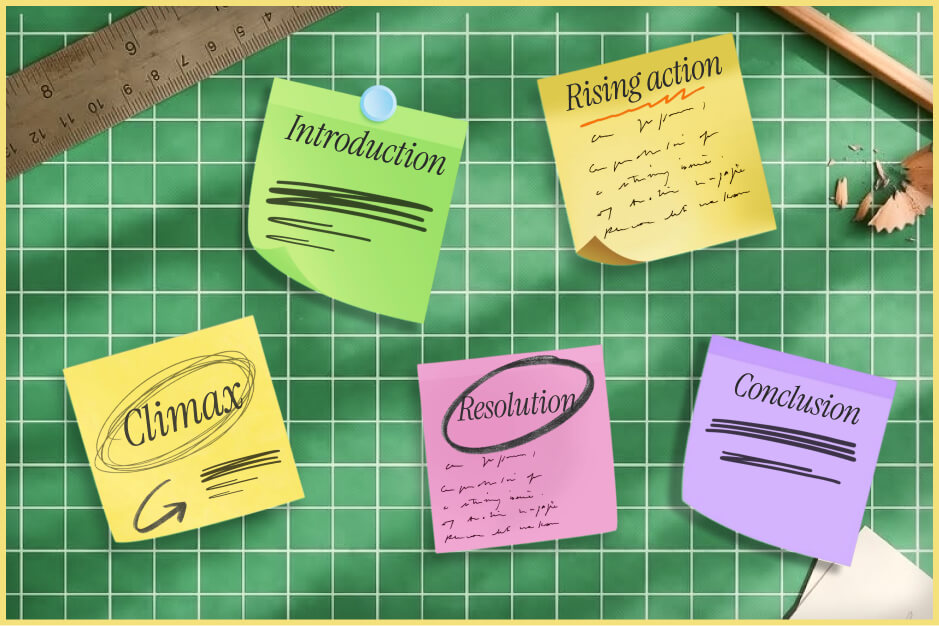
| Section | What It Does | Share of Words |
| Introduction | Hooks the ReaderNames the EventSets Time and PlaceSignals Significance | 10-15% |
| Rising Action | Describes what happened first and next. Builds tension. | 30-35% |
| Climax | Delivers the hardest or most revealing moment | 15-20% |
| Resolution | Shows how the conflict was handled | 10-15% |
| Conclusion | Reflects on change, lesson, or meaning | 15-20% |
Introduction
Suppose I am writing about an event.
I will add the setting (place and timing), the significance of the event, and a hook in the introduction.
For example,
“I started my first solo shift at my uncle’s bakery in July.
The oven alarm went off at 6:02 A, M and I had morning walkers gathered around the counter.”
Rising Action: What Happened First And Next
In this section, I will describe the things that happened next in chronological order.
It can go like, “Then came Mrs. Julie. My uncle had already told me about her.
She sits in her favorite chair near the window in the cafeteria every day.
She will have her coffee and plum cake and will knit for a while, sitting there before the clock hits 8 AM.
I knew she did not interact with others, and nobody has seen her sharing the table with anyone else in all these years.”
Climax: When Things Got Most Challenging
Here, you have to build the tension.
It does not have to be the loudest event.
It can be something as quiet as learning how to ask for help.
Furthermore, your climax can be the most impactful even if it is a single sentence.
I mark the climax in my outline with a star so I never bury it.
Resolution: How The Conflict Was Resolved
Resolution means what happened because of the conflict or the incident that took place.
The resolution section will be shorter.
If it is running longer than the climax part, make sure to check whether it has the reflection section or not.
If yes, move the reflection part to the conclusion section.
Conclusion: What Changed Or What You Learned
QuillBot and the Bucks County Community College (BCCC) Academic Support Center handout treat reflection as the closing move.
I also treat the conclusion in this way.
I mention how the event has affected me or what I have learned.
Furthermore, the BCC’s version revised in May 2024 labels the conclusion or the final steps as the “Meaning” and places it after situation, conflict, struggle, and outcome.
A Deeper Framework: Labov’s Model Behind Good Outlines
As we learned in school and most guidelines mention, we all pretty much follow the Ïntro, Body, Conclusion” structure.
However, I wanted to delve deeper and turned to sociolinguistics.
William Labov and Joshua Waletzky (1967) analysed how people tell stories about personal experience and identified recurring parts.
The parts map neatly onto an essay outline, and using them keeps me from skipping the “why are you telling me this?” moment.
Mapping Labov’s Parts To Your Outline
The table below translates the model into outline labels.
Gustav Freytag’s dramatic pyramid (1863) offers a similar rising-and-falling arc, which is why the climax sits near the middle of most narrative outlines.
| Labov element | Plain-English role | Outline label |
|---|---|---|
| Abstract | One-line summary of what the story is about | Hook / thesis-style teaser |
| Orientation | Who, when, where | Setting |
| Complicating action | The sequence of events that creates tension | Rising action and climax |
| Evaluation | Why the events matter | Stakes (intro) and meaning (conclusion) |
| Resolution | What finally happened | Resolution |
| Coda | Bridge back to the present | Final reflective sentence |
The “evaluation” element is the one students most often leave out.
I now write it into the outline twice, once as a hint in the introduction and once as a full reflection in the conclusion.
How To Write A Narrative Essay Outline In 7 Steps?
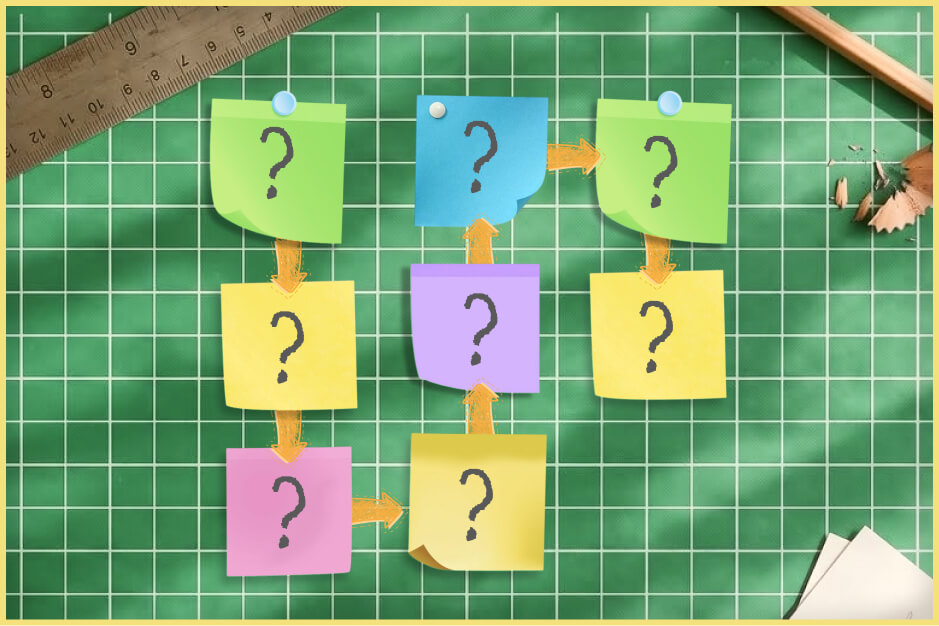
Here is a simple method that I follow.
Creating an outline for a 1000-word essay takes me roughly 15-20 minutes.
Step 1: Decode The Prompt
Suppose you are writing a narrative essay on “Your First Day of School.”
Here, the topic is specific, and you will narrate the experience in chronological order.
However, if the topic is “Write about what you learned on the first day of school,” the ending becomes open, and there will be changes in the structure.
In the second scenario especially, the reflection section will get more prominence.
Step 2: Choose A Story With Movement
If you can choose the topic on your own, go for one that surprises or teaches you something.
If everything proceeds seamlessly, the story will not have any rise or resolution.
Step 3: Write The One-Sentence Meaning
Before I get into the details of the events, I write a sentence that finishes, “This story shows that…”.
This makes the buildup easier and helps connect with the reflection part.
Step 4: List The Scenes In Rough Order
Brainstorm every moment that comes to mind.
Then cut anything that does not change the situation.
I aim for four to six scenes for a short essay.
Step 5: Assign Each Scene A Role
Label each scene as setup, rising action, climax, or resolution.
If two scenes play the same role, I merge or cut one.
Step 6: Add Sensory Detail And Dialogue Notes
Figurative language, dialogue, and suspense are welcome tools in narrative writing.
Under each scene, I jot one concrete sensory detail and, where useful, one line of dialogue.
These notes keep my draft showing rather than summarising.
Step 7: Budget Your Words And Check The Arc
Finally,y I assign a word count to each section (see the budgets below) and read the outline aloud.
If the tension does not rise, or the meaning line is not earned by the scenes, I fix the outline before drafting a single paragraph.
Narrative Essay Outline Template You Can Copy

Use whichever template matches your length.
Replace the bracketed prompts with your own material.
Short Template (Five Paragraphs)
| Title (optional): [working title] Paragraph 1, Introduction: Hook: [striking moment] | Setting: [when, where] | Stakes: [why it matters] Paragraph 2, Beginning: [what happened first, who was there, what I wanted] Paragraph 3, Complication and climax: [what went wrong, the hardest moment] ★ Paragraph 4, Resolution: [what I did, what happened as a result] Paragraph 5, Conclusion: [what changed in me, what I now do differently and final image] |
Extended Template (Seven To Ten Sections)
| Opening scene: a vivid moment in the middle of the action Orientation: who, when, where, and what I wanted Inciting incident: the event that disrupted normal Rising action (2–3 scenes): attempts, setbacks, rising stakes Climax: the turning point, with dialogue or physical detail Resolution: consequences and outcome Reflection: what I understood then versus what I understand now Coda: a brief image or sentence that links back to the opening |
Worked Example: Outline For “The 6:02 AM Oven Alarm”
Below is an illustrative outline for a narrative essay on “Write about an experience where you learned something about yourself.”
The story is a composite example I created for teaching, not a real student’s essay.
Notice how every section earns its place by serving the meaning line.
The Meaning Line
“This story shows that I stopped treating asking for help as failure.
Also, help comes from the most unexpected people/sources when you ask for it.
Moreover, we judge a person very quickly.”
The Outline
| Section | Content | Words (of 1000) |
|---|---|---|
| Introduction | Hook: the oven alarm blares at 6:02 AM while I stand alone in my uncle’s bakery. Setting: July, first solo opening shift. Stakes: an order for 200 rolls. | 100 |
| Beginning | I had promised my uncle I could handle it. Memory of refusing his offer to come in early. Dough proofing, confidence high. Mrs Julie visits the bakery, as my uncle had told me. She is supposed to be indifferent, and people think of her as someone reclusive. | 100 |
| Complication | The oven temperature climbs and the first tray scorches. The second tray follows. Smoke, and the counter is full of customers. | 250 |
| Climax ★ | . stare at the phone with my uncle’s number and nearly delete it, then press call. Uncle does not pick up the call, and I am clueless about what to do. Panic makes the situation worse. | 150 |
| Resolution | Mrs Julie gets up from her chair and comes to me for help. She makes the dough and teaches me how to put it perfectly in the oven. | 250 |
| Conclusion | Reflection: the call took four seconds; the pride I had been protecting cost an hour. Coda: now I ask for help first and apologise later. | 150 |
Why This Outline Will Work
The climax is small, but it can have the strongest buildup if you can show how Mrs Julie does not interact and follows a specific routine.
Also, the climax is more about an internal realization that we should not quickly judge a person and that asking for help is okay.
Furthermore, if you can see, I have budgeted the most words for the complication and resolution sections.
The climax is a small, internal decision rather than a dramatic explosion, which makes the essay believable.
The conclusion carries the evaluation promised in the introduction, and the word budget puts the most weight on the complication and the reflection, where the story actually changes.
Word-Count Budgets For Common Narrative Essay Lengths
| Essay length | Scenes | Intro/body/conclusion | Best use |
|---|---|---|---|
| 300–500 words | 2–3 | 50 / 300 / 100–150 | Short prompts, scholarship snippets |
| 650 words | 3–5 | 80 / 440 / 130 | Common App personal essay |
| 1,000 words | 4–6 | 120 / 700 / 180 | High school or first-year composition |
| 1,500–2,000 words | 6–8 | 200 / 1,200 / 400 | Extended class assignments |
Outline Variations Beyond Chronological Order
Chronological order is the safest default.
However, I prefer experimenting with the variations based on the topic.
In Medias Res (Start In The Middle)
I open the essay narrating the peak of the tension.
Then, I circle back.
It is like:
- Climax Teaser
- Orientation
- Rising Action
- Full Climax
- Resolution
- Reflection
So, as the name suggests, the middle of the story is gripping.
Braided Or Flashback Structure
It is like flashback movies.
I create an alternation between the past event and present reflection.
So, the outline goes like this.
- Present Frame
- Past Scene One
- Present Frame
- Past Scene Two
- Final Merge.
It works great for before, after, or now vs. then essays.
Vignette Or Montage Structure
I write three or four brief scenes linked by a repeated image or theme.
The plot is the same, but the scenes are different.
I choose this style when talking about habits, relationships, and places developed over time.
However, you have to keep a clear link back to the meaning line, or the essay reads as a collection of memories.
Narrative Essay Outlines For College Applications: 2026–27 Updates
If your narrative essay is headed to admissions officers, a few current facts shape how you outline.
I verified these in recent coverage of the Common App cycle.
Applicants should confirm final details on commonapp.org before submitting.
The Prompts And Word Limit Are Unchanged
According to reports on the Common App announcement, the seven personal statement prompts stay the same for 2026–27.
Which Prompts Applicants Chose
Crimson Education reports that the most popular prompt in 2025–26 was the “topic of your choice” option at 28% of applicants.
Furthermore, College Transitions adds that the personal growth prompt (number 5) came third at 20%.
These figures are a mid-cycle snapshot, not a final tally.
For outlining, the lesson is that personal growth stories are everywhere.
So your scenes must be specific enough to feel like yours.
Common Narrative Outline Mistakes And How I Fix Them
After reviewing many outlines, these are the problems I see most often.
Each one is easier to fix at the outline stage than in a finished draft.
| Mistake | Why it hurts | Fix |
|---|---|---|
| Starting too early (waking up, breakfast) | Burns words before tension appears | Begin at the first moment of change |
| No clear climax | Story feels flat | Star one scene and build to it |
| Summarising instead of scenes | Reader is told, not shown | Add one sensory detail per scene |
| Tacked-on moral | Reflection feels unearned | Write the meaning line first and test every scene against it |
| Too many events | No depth in any | Cut to four to six scenes |
| Resolution longer than climax | Deflates tension | Move reflection to the conclusion |
So, are you ready to draft your first narrative essay outline?
What are the other aspects you want me to discuss? Comment in the section below.
Additional Reading:
- Essay Outline You Can Use for Almost Every Essay!
- How To Write A Narrative Essay? – Guidelines And Tips To Follow
- How To Use AI For Studying? Using AI As Your Personal Interactive Tutor
