Quick Answer

An argumentative essay is an essay that takes a debatable position.
Then, it defends its position with three elements.

• Evidence
• Reasoning
• A Fair Response to Opposing Views

Also, a strong argumentative essay will have a specific thesis, evidence-backed body paragraphs, and a counterargument with a rebuttal.
Finally, it has a conclusion at the end explaining why the position it has taken matters.
Do you know why most argumentative essays fail?
They fail because of poor logic, not grammar.
If you claim something in your argumentative essay and there is no reasoning behind it, or the evidence ignores the other side, it will not hold up.
Hi, in today’s blog, I will discuss how to write an argumentative essay.
I will further discuss how to avoid the major problems or logical weaknesses in argumentative essays using the Toulmin Model and research on persuasion.
I have also shared a worked example.
Most importantly, I have covered how writing an argumentative essay has changed with the use of AI in student writing.
What Is An Argumentative Essay?
Suppose you want to talk about “Schools should teach AI tools instead of banning them.”
You now have an argument.
If you now want to establish this argument through a thesis, evidence-backed body, counterargument, rebuttal, and conclusion in an essay, it is argumentative.
However, suppose the topic of your article is “Water boils at 100°C at sea level.”
This is a proven fact, and therefore you have nothing to argue.
How To Structure An Argumentative Essay? The Four Parts
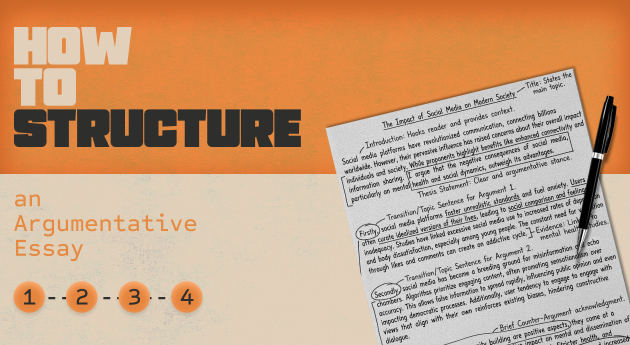
Usually, an argumentative essay has a four-part skeleton.
The length of the article may change.
However, you have to write each part with clarity.
1. Introduction And Thesis
You must open the article with context.
Then, you can narrow it down to a debate.
Next, you can write two sentences establishing your thesis.
Here, I use an easy formula.
“Although [opposing view], [your position] because [reason 1] and [reason 2].”
2. Body Paragraphs: Claims, Evidence And Reasoning
Every paragraph in the body of your argumentative essay must have a reason.
You can start with a topic sentence.
Then, add evidence with citation and explain why the evidence supports your claim.
Now, most students miss this explanation step, and that is why they score poorly on tests.
3. Counterargument And Rebuttal
Be fair when you state the strongest opposition point.
Then, strengthen your argument with evidence or logic.
You cannot take a weak view as the opposition or weaken it unnecessarily.
If the counterargument is weak, then your argumentative essay will also lose credibility and acceptance.
4. Conclusion
Write fresh words to restate your thesis.
Then, summarize your argument in two to three sentences and end with an implication.
You must state what the users can do differently after reading this essay.
Also, you must not introduce new evidence in the conclusion statement.
Different Models And Types Of Argumentative Essay
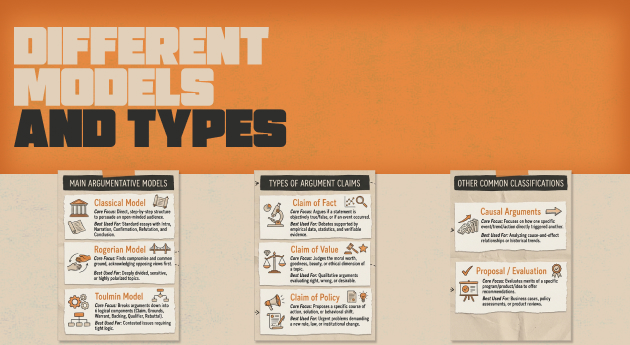
| Category | Type / Model | Core Focus & Description | Best Used For / Structure |
| Main Argumentative Models | Classical Model | Uses a direct, step-by-step structure to persuade an open-minded audience. | Standard essays include Intro, Narration, Confirmation, Refutation, and Conclusion. |
| Rogerian Model | Focuses on finding compromise and common ground by acknowledging opposing views first. | Deeply divided, sensitive, or highly polarized topics. | |
| Toulmin Model | Breaks arguments down into six logical components to deconstruct complex points. | Contested issues requiring tight logic (Claim, Grounds, Warrant, Backing, Qualifier, Rebuttal). | |
| Types of Argument Claims | Claim of Fact | Argues whether a statement is objectively true or false, or if an event occurred. | Debates supported by empirical data, statistics, and verifiable evidence. |
| Claim of Value | Judges the moral worth, goodness, beauty, or ethical dimension of a topic. | Qualitative arguments evaluating whether a practice is right, wrong, or desirable. | |
| Claim of Policy | Proposes a specific course of action, solution, or behavioral shift. | Urgent problems demanding a new rule, law, or institutional change. | |
| Other Common Classifications | Causal Arguments | Focuses on how one specific event, trend, or action directly triggered another. | Analyzing cause-and-effect relationships or historical trends. |
| Proposal / Evaluation | Evaluates the merits of a specific program, product, or idea to offer recommendations. | Business cases, policy assessments, or product reviews. | |
| For and Against / Opinion | Presents balanced or one-sided arguments weighing pros and cons. | Societal debates, school essays, and exploring two sides of an issue. |
How To Test Your Logic With The Toulmin Model For Argumentative Essays?
Stephen Toulmin, a British Philosopher, introduced his argument framework in The Uses of Argument” (1958).
In this, he splits an argument into six parts.
These are:
- Claim
- Grounds
- Warrant
- Qualifier
- Backing
- Rebuttal
The first three components are essential.
The last three components are optional, but they are essential to strengthen the argument.
Moreover, many writers miss the warrant part, and that is where arguments break.
A Breakdown Of The Toulmin Model With A Hypothetical Example
| Element | Job | Hypothetical Example |
| Claim | Your position | Schools should teach responsible AI use in writing classes rather than ban it. |
| Grounds | Evidence | In a fall 2025 Pew survey, 54% of US teens said they use AI chatbots for schoolwork. |
| Warrant | Why the evidence supports the claim | Rules that ignore common behavior rarely shape it; instruction can. |
| Backing | Support for the warrant | Pew found only 18% of teens call using ChatGPT to write essays acceptable, so students already accept limits that teaching can build on. |
| Qualifier | Limits on the claim | In most classroom settings, though not timed exams. |
| Rebuttal | Answer to an objection | Critics fear skill loss; assignments graded on disclosed process address that. |
Step-By-Step Checklist
- Pick a debatable topic and test it by asking whether a smart person could disagree.
- Draft a thesis using the “Although… because…” formula.
- Gather three to five credible sources, favoring studies, government data, and academic publishers.
- Outline one reason per body paragraph.
- Run your argument through the Toulmin table to find missing warrants.
- Write the counterargument and rebuttal.
- Revise for logic first, then style, then citations.
What Research Says About Counterarguments

Psychologists have tested whether acknowledging the other side helps.
Daniel O’Keefe’s meta-analysis pooled 107 studies with 20,111 participants and found that two-sided arguments generally persuade better than one-sided ones.
The catch is that you must refute the opposing view, not just mention it.
| Message type | What it does | Persuasiveness |
|---|---|---|
| Two-sided, refutational | Presents the opposing view, then answers it. | Highest |
| One-sided | Presents only your side. | Middle |
| Two-sided, non-refutational | Mentions the opposing view, leaves it unanswered. | Lowest |
[Ranking reported in [Allen et al. (1990)](https://asu.elsevierpure.com/en/publications/testing-a-model-of-message-sidedness-three-replications), consistent with the earlier meta-analysis it tested.]
Writing educators Gerald Graff and Cathy Birkenstein make the same point from a teaching angle.
Their book They Say / I Say frames academic writing as “entering a conversation”: summarize what others say, then state your own position against it.
In practice, your counterargument paragraph is the “they say.”
Worked Example: One Body Paragraph, Annotated
Here is a hypothetical student paragraph.
Banning AI tools in writing classes will not stop students from using them.
A fall 2025 Pew Research Center survey found that 54% of US teens use AI chatbots for schoolwork.
So a ban mostly pushes use out of sight.
Teaching responsible use, including how to verify claims and disclose assistance, lets teachers shape behavior they cannot prevent.
Critics worry that AI weakens writing skills, but assignments that grade drafts, notes, and revisions reward the thinking that tools cannot replace.
- Topic sentence: states the reason in plain terms.
- Evidence: one statistic, dated and sourced.
- Reasoning: the “so” clause links the data to the thesis (the warrant).
- Rebuttal: names the objection and answers it in the same paragraph.
2026 Update: Argumentative Writing In The AI Era
AI use has become a central issue for essay writers.
Pew Research Center reported in January 2025 that 26% of US teens had used ChatGPT for schoolwork, double the 13% from 2023, while only 18% said using it to write essays was acceptable.
A later Pew survey, fielded in fall 2025 and summarized by Government Technology, found 54% of teens using chatbots for schoolwork.
It was about one in 10 doing all or most of it that way, and 59% saying AI cheating is a regular part of student life.
The takeaway for writers: instructors are paying closer attention to authorship.
Keep your notes and drafts, cite every source, and follow your school’s AI policy.
Using AI Without Weakening Your Argument
- Ask a tool to suggest counterarguments, then research and answer them yourself.
- Verify every statistic at its original source before citing it.
- Never submit generated text as your own writing.
- Disclose assistance when your course requires it.
Common Mistakes And How To Fix Them
| Mistake | Why it hurts | Fix |
| Thesis is a fact or a vague opinion | Nothing to debate or prove | Take a specific, arguable position. |
| Evidence without explanation | Reader must guess the link | Add a “this shows that…” sentence. |
| Straw man counterargument | Looks unfair and weakens trust | Present the strongest opposing point. |
| Mention opposition, never refute it | Research ranks this lowest | Follow every counterpoint with a rebuttal. |
| Unverified statistics | Damages credibility | Cite the original study or dataset. |
Summing Up
The length of your argumentative essay depends on the assignment.
Follow your rubric, and focus on covering your thesis, evidence, and counterargument fully.
You need at least one strong counterargument, answered with a rebuttal.
However, if your essay is longer, it can address two or three counterarguments.
Also, before you use “I” in your argumentative essay, confirm the same with your instructor’s guidelines.
Many allow it sparingly, but a confident thesis usually works without it.