It is funny to think now that the previous publication I worked with had AI blocked on their official network.
I don’t know what the point was behind doing so.
That is something like a taboo that I have already tried to break in my how to use AI for studying guide.
If you are citing ChatGPT properly, there should be no gray area.
Now, the question is how to cite ChatGPT.
APA, MLA, and Chicago all now have new guidance after 2023.
For example, the APA Style wants you to clearly mention in the method section if and when you have used ChatGPT or other AI tools in your research work.
Hi, in today’s blog, I have discussed how the current formats for citing ChatGPT work.
Also, checking every AI-supplied source is as important as formatting your own citation correctly.
| Quick Answer: How To Cite ChatGPT Correctly? How to cite ChatGPT depends on the style guide you will use. For example, APA lists OpenAI (ChatGPT) as an author and favors a shareable link to it. However, MLA does not consider AI an author, and your prompt or a description of your prompt is treated as the title. It also asks you to share the specific link or a generic link to the tool. Again, Chicago usually asks for a footnote or in-text mention rather than a bibliography entry. Also, style guides keep updating the rules of citing ChatGPT at regular intervals. So, before you submit your paper, confirm the format against the official APA, MLA, or Chicago site and your course requirements. |
Do You Need To Cite ChatGPT? Citation Vs. Disclosure
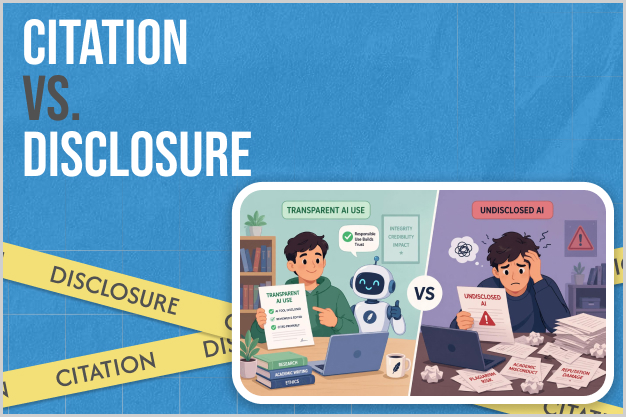
Citing and disclosing ChatGPT or AI for your paper are related but different.
A disclosure means how you have used AI in the process.
On the other hand, citation means that you are crediting specific AI output you have used in your work.
Now, whether you will give a disclosure or citation will depend on the final paper, as your instructor says.
When Is Disclosure Enough?
If we consider the current approach of APA, disclosure works fine when you have used AI for minor tasks in your paper.
For example, if you have used ChatGPT for spelling check, you can simply publish a disclosure: “Spelling was checked using ChatGPT (OpenAI, 2026).”
MLA also has suggested that it would not be reasonable to expect citation of AI in a paper when it has been used for something like accepting an autocorrect suggestion.
Moreover, in the Chicago Style, you can acknowledge the use of AI in the writing.
When Do You Need Citation?
The major style guides agree on one core rule.
You have to cite the tool whenever you paraphrase, quote, or incorporate content it generated.
Here, I am quoting Murdoch University’s APA guide.
“• When AI is used in research or assignment preparation, it must be properly credited both in-text and in the reference list.
• If you use an AI tool in any way to help with your research or assignment, disclose how you used it in the introduction or method section.
This includes using AI for editing or grammar enhancement purposes.”
Again, the McMaster University Research Guide mentions this regarding citation and disclosure according to the MLA guidelines.
“MLA (Modern Language Association) recommends that you “cite a generative AI tool whenever you paraphrase, quote, or incorporate into your own work any content (whether text, image, data, or other) that was created by it” (MLA Style Center).
Moreover, if you use an AI tool for practical purposes such as editing your writing or translating text, you should acknowledge its use in your work.”
When Do You Have To Cite The Original Source Instead?
Suppose ChatGPT has pointed you to a book, article, or website.
You have picked the information from the original source, and ChatGPT has functioned just as a hint or guide.
In such cases, you do not need to cite ChatGPT.
You can mention the original source.
APA-based guidance from Royal Roads University similarly suggests citing material published elsewhere as a secondary source.
Your Instructor Has The Final Say Regarding The Citation And Disclosure
The policies of citations and disclosure change from one school or course to another.
I was going through a recent study called “AI in Higher Education: Widespread Use, Unclear Rules.”
This report mentions a poll where 53% of the students state that their institutions discourage or prohibit the use of AI.
Now, if your school or college allows it, ask the authorities whether they want citations or disclosures to be fine.
Some institutions even ask for the complete transcript of the AI interaction or use in a paper.
How To Cite ChatGPT In APA Style?
APA was the first to publish formal guidance about how to cite ChatGPT or AI.
Also, it has recently updated the format once.
Here, you must know both versions because many instructors and publications still refer to the older instructions.
The Original 2023 Approach
In the APA Style Blog in 2023, Timothy McAdoo said that ChatGPT output is not a personal communication because no person is communicating.
So, quoting ChatGPT is similar to “sharing an algorithm’s output.”
As a result, the author of the algorithm gets all the credit.
The Updated Format (September 2025 Onward)
In September 2025, APA has acknowledged that using AI in the writing process is no longer unusual.
Earlier, you only cited the AI tool.
However, today, ChatGPT has a new sharing option.
It provides a unique link for each chat.
So, creating an APA-style reference for each chat has become easier.
You can now use the author-date-title-source format.
It will go like this.
AI Company Name. (year, month day). Title of chat in italics [Description, such as Generative AI chat]. Tool Name/Model. URL of the chat.
Parenthetical citation: (AI Company Name, year)
Narrative citation: AI Company Name (year).
What If The Tool Has No Shareable Link?
You can use the general URL of the tool and put the full prompt and response in an appendix.
Also, have a look at the table below to know how to cite ChatGPT in different situations.
| Situation | In-Text Citation | Notes |
| Short paraphrase of ChatGPT output | (OpenAI, 2026) | Add reference list entry |
| Long response you quote or analyze | OpenAI, 2026See Appendix A for the full transcript | Put full text in an appendix if no shareable link. |
| Narrative style | OpenAI (2026) generated the following summary | Same reference entry. |
| Minor help, such as a spelling check | Statement in text, such as “Spelling was checked using ChatGPT (OpenAI, 2026)” | General reference to the tool |
However, remember that ChatGPT can offer different answers for the same prompt.
So, keep a screenshot of your original query and answer handy.
Hand it over to your instructor or teacher when needed.
How To Cite ChatGPT In MLA Style (9th Edition)?
MLA differs in philosophy from APA.
When I read its revised and updated handbook, I found out that the guidance remains almost the same.
However, now you can add a shareable and stable link to the AI conversation.
Also, if the tool does not allow you to share a stable link, you can add a general link to it.
The Core Elements
MLA does not treat the AI tool as an author.
So the Author element is omitted (McMaster Libraries).
Instead, you begin with a description of the prompt in quotation marks, followed by the word “prompt,” then build the rest of the entry.
- The AI tool (as the container, in italics)
- The version
- Also. The company (as publisher)
- The date
- The location, which is a shareable link if available or the tool’s URL.
Works Cited Example
A 2026 handout from Texas Christian University’s writing center models this pattern:
“Describe the symbolism of the ruined statue in Ozymandias” prompt. ChatGPT, model GPT-4o, OpenAI, 8 Jan. 2026, chat.openai.com/chat.
In-Text Citations
Follow standard MLA practice.
You have to cite by the first element of the Works Cited entry.
For the example above, that would be a short form of the prompt in parentheses.
You can also introduce the source in your sentence, as in “According to OpenAI’s ChatGPT, ….”.
Quoting, Paraphrasing And Secondary Sources
MLA’s guidance covers quoted text, paraphrases, AI-generated images, and creative works such as AI-written poems (SNHU Library summary).
For an AI-generated image, an MLA-style caption uses a description of the prompt, the tool name, version, developer, and date (UCD Library).
If the AI cites sources, check them first and cite the original when possible.
How To Cite ChatGPT In Chicago Style (17th And 18th Editions)

Chicago is most conservative in its approach to how to cite ChatGPT.
In its 18th edition guidelines (sec. 14.112 / Mar 2025 updates), you can just mention the name of the AI tool.
For example, you can write that the recipe for this cake is generated by ChatGPT.
If you need a formal citation in your writing, you can use a numbered footnote.
In the footnote, the “URL” would be replaced by the URL copied from the Share button provided by OpenAI.
Also, the style will be “Text generated by ChatGPT, OpenAI, January 10, 2026, URL.”
Author-Date System
In author-date style, any information not in the sentence goes in a parenthetical reference.
For example (ChatGPT, March 7, 2023), as a Western Technical College guide summarizes Chicago’s advice.
When It Does Go In The Bibliography
If an AI conversation must appear in a bibliography or reference list, Chicago says to cite it under the developer’s name rather than the tool’s name.
Also, you have to include a publicly available URL.
The College of DuPage guide gives this example:
Google. Response to “How many copyeditors does it take to fix a book-length manuscript?”
Gemini 1.0, February 10, 2024. https://g.co/gemini/share/cccc26abdc19.
Side-By-Side Comparison Of APA, MLA, And Chicago
| Question | APA | MLA | Chicago |
|---|---|---|---|
| Is AI an author? | No tool author. The company (OpenAI) is the author. |
No author element | Tool treated as author in notes. Developer used if in bibliography. |
| Prompt shown? | In text or appendix. | Yes, as the entry title | In text or in the note |
| Date used | Date of the chat. | Date of the chat | Date generated |
| Link | Shareable chat link preferred. General URL plus appendix otherwise |
Shareable link or tool URL | Public URL when available |
| Bibliography entry? | Yes | Yes (Works Cited) | Usually no, unless a public URL exists |
| Disclosure of use | Describe in method or intro | Acknowledge in text | Make clear in text or preface. |
Other Styles: Harvard And IEEE
Does your course follow any other style than APA, MLA, or Chicago?
You can follow the basic principles.
However, remember that the details will change based on the style of your department or institution.
For example, the referencing style of Harvard is similar to the structure of APA.
So, in this case, the AI company is seen as the author.
On the other hand, the Institute of Electrical and Electronics Engineers (IEEE) has a different approach from APA, MLA, and Chicago.
It has not published an official statement yet.
However, I was checking a University of Michigan Library Guide.
The format goes like this.
“[#] Name of Company, Name of Tool, Version (if known), Accessed: Month Day, Year. [Online]. Available: URL”
Also, you can follow this example if you want to include the model or the subject of the interaction.
“[1] OpenAI, ChatGPT. (GPT-5.3). “Solid State Physics Explained.”
OpenAI. Accessed: Sep. 26, 2026. [Online]. Prompt: “What is solid state physics? Explain it to someone with no physics background.” Available: https://chat.openai.com.”
Worked Examples: Four Illustrative Scenarios
The scenarios below are illustrative composites, written to show how the rules apply in practice.
They are not real students.
Scenario 1: Paraphrasing An Explanation (APA)
A psychology student asks ChatGPT to explain the testing effect, then paraphrases the answer.
Her sentence ends with (OpenAI, 2026), and her reference list includes an entry with the chat’s shareable link.
In her method section, she adds a sentence explaining that she used ChatGPT to brainstorm explanations.
She then verifies the concept against her textbook and cites the textbook for the claim itself.
Scenario 2: Quoting A Sentence In A Literature Essay (MLA)
An English student wants to include one sentence ChatGPT produced about symbolism to critique it.
He introduces it in prose (“According to OpenAI’s ChatGPT…”), adds a short parenthetical, and lists a Works Cited entry that begins with a quoted description of his prompt.
Because the point of the passage is analysis of the AI’s output, quoting is appropriate.
Scenario 3: Footnoting A Brainstormed Timeline (Chicago)
A history student used ChatGPT to generate a draft timeline, then edited it against primary sources.
He adds a footnote saying the timeline was generated by ChatGPT, names the company and date, and notes that it was “edited for style and accuracy.”
He does not add a bibliography entry because no public link exists.
Scenario 4: ChatGPT Suggests A Journal Article (Any Style)
A nursing student asks for sources.
ChatGPT supplies five references.
She searches each in her library database, finds that only three exist, and discards the others.
She reads the three, then cites those articles directly.
Also, she does not cite ChatGPT in her references, though she may disclose that she used it to find leads.
| Scenario | What to Cite | What to Disclose |
|---|---|---|
| Paraphrase (APA) | ChatGPT chat plus any original source | How ChatGPT was used |
| Quote (MLA) | ChatGPT prompt entry | Context for the quote |
| Timeline (Chicago) | Footnote only | Edited by author |
| Source suggestions | Verified original articles | Use of AI for source discovery, if required. |
Why Verification Matters: The Data On Fabricated Citations
Formatting a ChatGPT citation correctly does nothing if the references ChatGPT gave you are invented.
Research and recent news show this is a persistent and growing problem, not a relic of early chatbots.
What The Studies Found
Researchers have measured fabricated references repeatedly across models and fields.
The figures below are from different studies with different methods.
So they are not directly comparable, but together they show the scale.
| Study | What Was Tested | Finding |
|---|---|---|
| Walters & Wilder (2023), as summarized in an arXiv review | 42 multidisciplinary topics | 55% of GPT-3.5 and 18% of GPT-4 citations were entirely fabricated (Source) |
| Deakin University (reported by Tech.co) | 176 citations on three psychiatric conditions | 19.9% fabricated56.2% fabricated or erroneous |
| GhostCite (2026) | 13 LLMs across research domains | Hallucination rates from about 14.23% to about 94.93% |
| GPT-5 orthopaedic study (2026) | 350 queries, 2,736 references | 7.13% fabricated |
The GPT-5 result shows improvement over earlier models.
However, it still means roughly one in fourteen references in that study did not exist.
Rates also depend heavily on the field and on how you prompt.
Recent News: Fake References In Published Research
Fake references in published research have become a serious problem in the scholarly literature.
Retraction Watch reported in May 2026 on an analysis finding that one in 277 PubMed-indexed papers in 2026 contained fabricated references.
The same article noted an earlier World Bank paper on obesity trends with at least 14 fake references.
Research integrity scholar Mohammad Hosseini told Retraction Watch the study was “the tip of the iceberg.”
He also added that AI citations that are inaccurate or incomplete but not wholly invented are a bigger problem.
A separate arXiv audit of papers from major language-technology conferences found papers with hallucinated references rising more than tenfold from 2024 to 2025, from 0.28% to 2.59%.
If professional researchers are missing fake references, students should assume AI-supplied references are unverified until proven otherwise.
A 5-Step Verification Routine I Follow To Cite ChatGPT
| Steps | Things I Do | Note |
| First | Search the Exact Title | I look for the exact title in my library database or Google Scholar. |
| Second | Match the Details | I ensure that the authors, journal, year, volume, and pages agree with the real record. |
| Third | Check the DOI | I paste the link into doi.org. Fake DOIs often lead to unrelated papers or nowhere. The Deakin study found that when ChatGPT gave a DOI for a fabricated citation, 64% of those DOIs led to unrelated papers. |
| Fourth | Read the Source | I read the source material to confirm it actually says what the AI claimed. |
| Fifth | Cite the Original | When I find the real source, I cite it and not the chatbot. |
Common Mistakes When Citing ChatGPT
Most citation errors fall into a handful of patterns, and nearly all are avoidable with a little care.
| Mistake | Why it is a problem | Fix |
|---|---|---|
| Citing ChatGPT as a personal communication in APA | APA says there is no person communicating. | Use the AI-source format with OpenAI as author. |
| Listing “ChatGPT” as the author in APA | The company, not the tool, is the author in APA. | Use OpenAI as the author. |
| Leaving out the date or version | Output changes between versions | Record date, model, and link at the time you use it. |
| Citing ChatGPT for a fact it took from another source | You credit the wrong source | Find and cite the original. |
| Including references you never verified | Fabricated sources can count as misconduct | Run the 5-step routine. |
| Not saving the chat | Readers and instructors cannot check it. | Save a shareable link or screenshot. |
| Citing AI when your instructor forbids it | Citation does not excuse a policy violation. | Check the syllabus first. |
Copy-And-Paste Disclosure Statements
Many instructors want a short statement of AI use in addition to, or instead of, a formal citation.
These templates are starting points, and you have to adjust them to your assignment and policy.
For Brainstorming Or Outlining
“I used ChatGPT (OpenAI, GPT-5) to brainstorm possible topics and outline structure.
All research, analysis, and writing in this paper are my own.”
For Editing And Feedback
“I used ChatGPT to give feedback on clarity and flow in my draft.
I reviewed every suggestion and made all final decisions.”
For Quoted Or Paraphrased AI Output
“The summary in the second paragraph of Section 2 was generated by ChatGPT on [date] in response to the prompt [prompt].
The full chat is in Appendix A. I verified the claims against [sources].”
A similar disclosure example appears in the Chicago guidance summarized by the University of Florida.
It suggests noting that the author reviewed and edited AI-generated content.
Key Takeaways
The ethical practices of how to cite ChatGPT come down to three habits.
1. Follow your assigned style.
2. Be transparent about how you have used AI.
3. Then, verify the source and data before you cite ChatGPT or the actual source in your paper.
Summing up the style guides once again.
- APA names the company as the author and prefers a shareable link.
- MLA builds the entry around your prompt.
- Chicago usually uses a note or in-text mention.
- Cite when you quote, paraphrase, or incorporate AI output.
- Also, cite the original source when AI only led you to it.
- Save the date, model, and a shareable link or screenshot every time.
- Fabricated references remain common in AI output, including in newer models. So verify every source.
- Your instructor’s policy overrides any general rule.
Limitations On The Guidelines Of How To Cite ChatGPT
Style guidance keeps changing.
Also, library guides often differ or lag behind the updates regarding the usage of the updates or model versions.
Furthermore, study results on fabricated citations are standalone findings, and they do not portray a congruent picture.
For me, what works best is consulting AI to find the real sources and then studying and referencing them in the actual paper.