Ever paused mid-sentence, hand hovering over the keyboard, not sure whether it’s “canceled” or “cancelled”? You’re not the only one — not even close. One version’s got a single L, the other doubles it, and somehow both keep showing up everywhere — books, newspapers, random articles online. So which is it, actually?
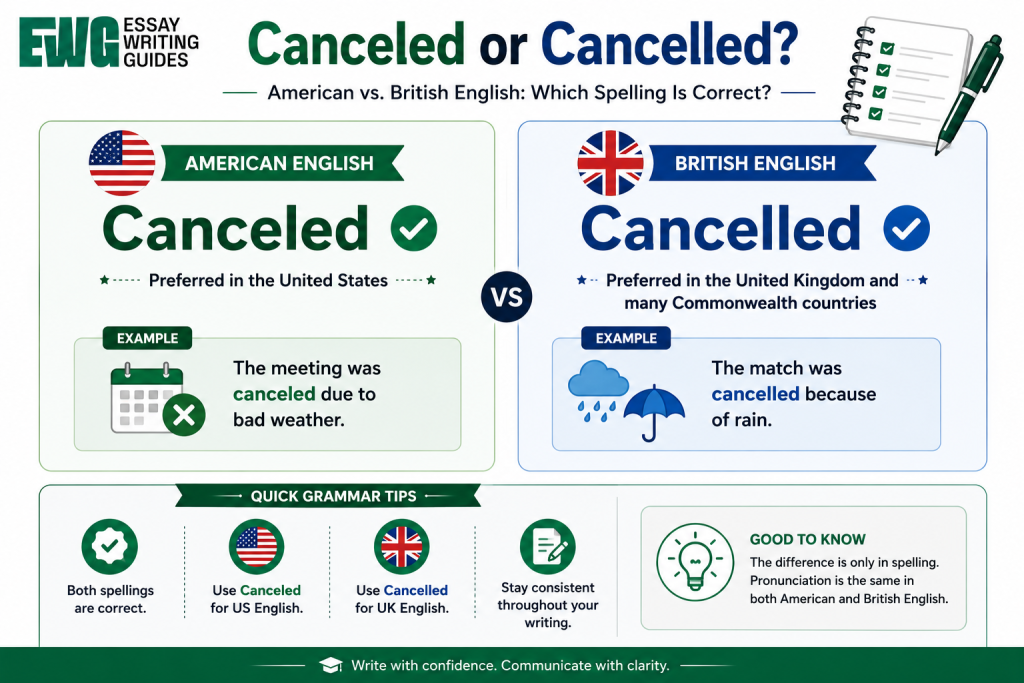
Short version: both. Neither one’s wrong. The real split isn’t about correctness at all, it’s about which flavor of English you’re writing in. Americans mostly go with “canceled.” Everyone else — British English, and a bunch of other English-speaking countries too — tends to double that L.
Knowing which one to reach for isn’t just some pedantic detail either. It actually helps your writing feel more confident, more consistent, less like you’re second-guessing yourself mid-paragraph.
So What’s the Actual Difference Here?
Meaning-wise? Nothing. Zero. “Canceled” and “cancelled” mean the exact same thing — both are just the past tense of “cancel,” which means calling something off, stopping it, killing it before it happens.
The only real difference is where you happen to be writing from.
| American English | British English |
|---|---|
| Canceled | Cancelled |
| Canceling | Cancelling |
| Traveler | Traveller |
| Traveled | Travelled |
Writing for Americans, go with canceled. Writing for the UK, Australia, Canada — often, anyway — New Zealand, or anywhere else that leans British on spelling, cancelled’s your safer call.
Why Are There Even Two Versions of This Word?
This isn’t some one-off quirk with “cancel” specifically. It’s part of a much bigger split between American and British English as a whole.
American English has a habit of trimming things down — fewer doubled consonants where it can get away with it. A lot of that traces straight back to Noah Webster, the guy who basically spent his career pushing for spelling that was simpler and more standardized than what Britain was doing at the time.
Which is how we ended up with stuff like:
- canceled instead of cancelled
- labeled instead of labelled
- modeled instead of modelled
- traveled instead of travelled
British English does the opposite, generally — doubling that final L before adding endings like -ed or -ing, at least when the stress pattern and spelling rules line up that way.
Point is, neither one’s “wrong.” They’re just following different rulebooks that developed on opposite sides of an ocean.
When Should You Actually Use “Canceled”?
If you’re writing American English — this one’s yours.
A few examples, just to make it concrete:
- The flight was canceled because of severe weather.
- Our meeting was canceled at the last minute.
- She canceled her subscription yesterday.
- The event has been canceled indefinitely.
You’ll see this spelling constantly across the US — newspapers, businesses, universities, government sites, all of it.
And “Cancelled”?
Same idea, just flipped for British English.
- The football match was cancelled due to heavy rain.
- My train was cancelled this morning.
- They cancelled the reservation without notice.
- The concert has been cancelled until further notice.
You’ll run into this version constantly in the UK, Australia, New Zealand, and a good chunk of the Commonwealth too.
Is One Actually More Correct Than the Other?
No. Genuinely — no. Both are grammatically fine, full stop.
What actually matters is sticking with one. Bouncing back and forth between canceled and cancelled in the same article just reads as sloppy — unless, of course, you’re quoting a source that happens to use the other one, in which case that’s fair game.
Which Spelling Wins, Popularity-Wise?
Globally, cancelled is slightly ahead, mostly because so many countries default to British spelling conventions overall.
But — and this matters — if your readers are mostly American, canceled is still the standard. Stick with that.
Honestly, for anyone running a site with an international audience, this really just comes down to knowing who you’re writing for and picking a lane. Then not wandering out of it halfway through a page.
Seeing Both in Action
American English:
- My appointment was canceled yesterday.
- The airline canceled all afternoon flights.
- We canceled our vacation plans.
British English:
- My appointment was cancelled yesterday.
- The airline cancelled all afternoon flights.
- We cancelled our holiday plans.
Meaning’s identical either way. Only the spelling moves.
What About “Canceling” and “Cancelling”?
Same exact rule carries over here too.
American English: canceling
British English: cancelling
Like:
- She is canceling her membership. (US)
- She is cancelling her membership. (UK)
Both fine. Just depends which regional style you’re following.
A Couple Mistakes Worth Dodging
Mixing your spellings mid-piece. Pick a lane, stay in it.
Wrong: “The meeting was canceled, and the next appointment was cancelled.”
Right (American): “The meeting was canceled, and the next appointment was canceled.”
Right (British): “The meeting was cancelled, and the next appointment was cancelled.”
Using the wrong style for your audience, too. Writing for a U.S. site or business — American spelling. Writing for UK readers — British spelling. Not complicated, just easy to forget mid-draft.
Quick Side-by-Side
| Feature | Canceled | Cancelled |
|---|---|---|
| Correct? | Yes | Yes |
| Variant | American | British |
| Meaning | Same | Same |
| Grammar | Past tense of “cancel” | Past tense of “cancel” |
| Preferred In | United States | UK, Australia, New Zealand, much of the Commonwealth |
Questions People Actually Ask
Is “canceled” grammatically correct? Yes — standard American English.
Is “cancelled” wrong, then? Not remotely. Standard British English.
So which one should I use? Whichever matches your audience. Canceled for American readers, cancelled for British ones.
Why do Americans just use the one L? American English tends to simplify certain spellings compared to British English — same reason you get canceled, traveled, and labeled all with a single L over here.
Bottom Line
This was never really a right-versus-wrong argument. It’s regional, plain and simple. Both spellings are legit, both sit in every major dictionary, both get used by millions of people every day without anyone blinking.
Writing for Americans? Canceled. Writing for the UK or anywhere else that follows British conventions? Cancelled. Whichever one you land on — just don’t switch mid-piece. Consistency’s really the only rule that actually matters here.