| Quick Answer If you want to write a personal statement, you can start by choosing a clear angle. Then, you can prove it with your specific experiences and moments in your life. Next, you can reflect on what that experience has taught you. Also, if your essay or writing assignment needs any specific format, you have to follow it. For example, UCAS (Universities and Colleges Admissions Service) now needs three structured questions within 4000 characters for its free-form essays. On the other hand, when you are making a personal statement, the Common App needs you to write a 250- 650-word essay. The writing has to be verifiably your own. |
Key Takeaways On How To Write A Personal Statement
- UCAS has replaced the single how to write a personal statement.
- It now has a three-question format for 2026 entry, within a 4000-character total.
- The Common App’s seven prompts and 650-word limit are unchanged for 2026-27.
- You must add specific detail and honest reflection, as those beat the list of achievements.
- You can use AI for proofreading and brainstorming, but not for drafting.
What Is A Personal Statement And How To Make One?
A personal statement is a short first-person piece of content or writing that you submit with your application.
This statement explains the following aspects.
- Who You Are.
- What Motivates You.
- Why You Are Suitable for a Specific Course, Program, or School.
Also, this is the part of the application you have complete control over.
So, the course/program/institutional authority will assess your motivation, communication, and character beyond grades from the personal statement you make.
How Much Weight Does Your Personal Statement Essay Carry?
I was going through the National Association for College Admission Counseling (NACAC) State of College Admission survey.
The Virginia Tech College Essay Presentation 2025 has summed up how the colleges prioritize the essay or writing samples.
| Importance in Admission Decisions | Share of Colleges |
| Considerable | 18.9% |
| Moderate | 37.3% |
| Limited | 26.5% |
| No Importance | 17.3% |
So, if you do the simple maths, you will find around 56.2% of colleges put moderate or considerable importance on the essay.
The essay cannot cover up weak grades if you want admission to competitive schools.
However, when there are many applicants with similar grades and credentials, the essay helps determine why a particular one is different.
What Do Admissions Readers Look For In A Personal Statement?
When an admissions officer reads your essay, they look for four things.
- Clear Motivation
- Concrete Evidence
- Honest Reflection
- And A Recognizable Voice
Also, I was going through some College Advisor tips for different research work.
I came across this quote by Grant R. from Harvard University on tips for writing good college essays, including personal statements.
“Be yourself!
I think many times people try to present themselves trying to sound too impressive, but the most powerful essays show who you are as a person.
Likable, hardworking individuals are most compelling.”
Which Personal Statement Format Will Be The Best For You In 2026?
The best personal statement format for you will depend on your requirements.
You have to be sure about the format before you start writing, as the main formats are very different from each other in design and length.
| Application | Format | Length | 2026 note |
| UCAS (UK undergraduate) | Three structured questions | 4,000 characters total; 350 minimum per answer | Replaced the single essay from the 2026-entry cycle |
| Common App (US first-year) | One essay, one of seven prompts | 250 to 650 words | Prompts confirmed unchanged on February 27, 2026 |
| Graduate and professional | Free-form or school-set prompts | Set by each school | AI policies vary by programme. |
The Three UCAS Questions You Need To Answer In A Personal Statement
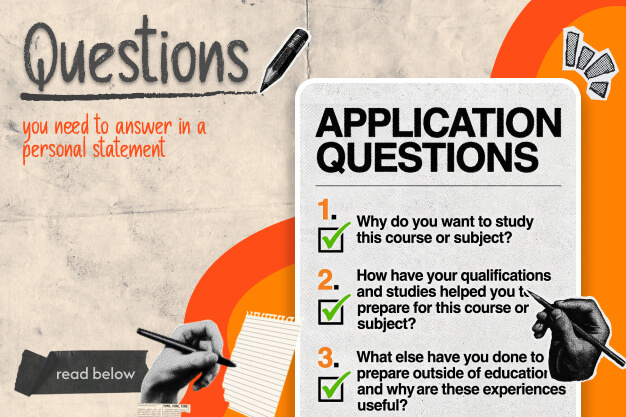
For 2026 entry, a UCAS applicant needs to answer these three questions.
- “Why do you want to study this course or subject?
- How have your qualifications and studies helped you to prepare for this course or subject?
- What else have you done to prepare outside of education, and why are these experiences useful?”
You have to answer each question in at least 350 characters.
Also, the combined limit for answering all these questions will be 4000 characters, including spaces.
Furthermore, in the “UCAS Similarity Detection Service – guidance for applicants,” we can read, “A personal statement of 4,000 characters will contain approximately 600 words.”
The tutor or the admissions officer will read the answers together.
So, you must repeat the examples in them.
The Seven Common App Prompts
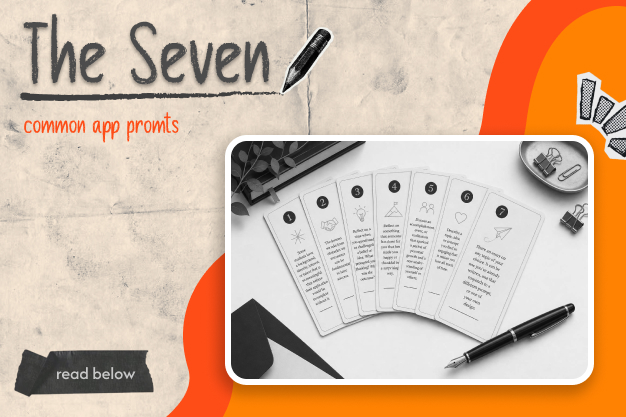
The prompts cover the following elements.
- Background or Identity
- Setbacks
- Challenging a Brief
- Gratitude
- Personal Growth
- A Captivating Topic
- An Open Choice
The prompt does not matter as much as a story.
Also, “The most popular Common App essay prompt is Topic of your choice, chosen by 28% of applicants in the 2025-26 cycle.”
Furthermore, the additional information section is capped at 300 words.
A Practical Length Budget
There are no official rules about how to split the word count among the sections of a personal statement essay.
However, this is a feasible model to budget the length for each section.
| Format | Section | Suggested share |
|---|---|---|
| UCAS (4,000 characters) | Question 1: motivation for the subject | About 1,200 characters |
| UCAS (4,000 characters) | Question 2: how your studies prepared you | About 1,700 characters |
| UCAS (4,000 characters) | Question 3: preparation outside education | About 1,100 characters |
| Common App (650 words) | Opening moment, development, reflection, close | About 100, 300, 150 and 100 words |
Irrespective of the split format you follow, you must keep most words for the evidence and reflection parts.
Do not invest many words in the introduction section.
The admissions readers will focus on what you did and what you achieved, and not the number of times you have called yourself “Passionate” or “Sincere.”
How To Write A Personal Statement? A Step-By-Step Guide
You can follow these six steps to write a submission-ready personal statement.
Step 1: Build An Evidence Bank Before Drafting Your Essay
You can list the following elements to build an evidence bank.
- Projects
- Books
- Setbacks
- Responsibilities
- Conversations
For each, you have to note what happened, what you did, and what you learned.
You can get specifics from these raw materials for separating memorable statements from generic ones.
Step 2: Choose One Central Angle
Write a single sentence and strategize that well to capture your argument.
For example, you can write,
“I am drawn to marine biology because of X, and I have tested that interest through Y.”
You must cut down details that do not support the central angle.
For the Common App, one or two well-developed moments beat a tour of your résumé.
Step 3: Open With A Specific Moment, Not A Quote
You must avoid starting your personal essay with a dictionary definition or quotation.
Instead, you must start with a scene, question, or observation only you could write.
Also, avoid openers such as “Since I was young.”
Step 4: Build Each Paragraph With PEEL
PEEL stands for the following elements.
- Point
- Evidence
- Explain
- Link.
It is a method that the “UCAS Personal Statements for 2026 Entry” recommends.
You can then link every paragraph back to the central angle of your personal statement.
Let’s compare these examples.
| Weak (Tells What You Did) | Strong (Shows What You Did with Evidence) |
| I am passionate about biology and love research. | Counting 212 oyster larvae under a microscope at my school’s marine club taught me why sample size changes a conclusion. |
Step 5: Show Reflection, Not Just Achievement
One of the most common mistakes of writing a personal statement is writing about achievements and not your growth.
You have to answer “So What” after every example.
This section explains what has changed in your thinking and why it matters for the school or the course you are seeking admission to.
Step 6: Revise In Three Passes
The sixth step has three stages.
In the first stage, you revise the content and check whether every paragraph earns its place or not.
The second stage is revising the voice by reading aloud and replacing anything you don’t want to mention.
Finally, proofread for errors.
Share the draft with one or two trusted readers.
However, do the changes and edits on your own to maintain your unique voice.
Examples Of How To Write A Personal Statement
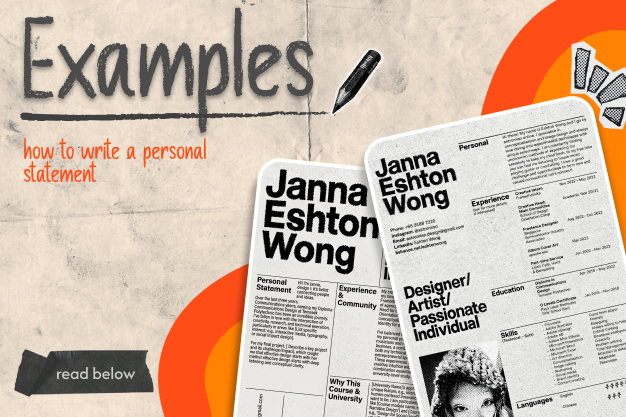
Here, I have shared three examples of how to write a personal statement.
These are for undergraduate students, graduate school students, and professionals looking for career transitions.
Example 1: Undergraduate Admission (The Narrative Approach)
This format works for college students who want to focus on their personal growth journeys.
The Hook
Our dinner table was a graveyard for broken electronics for as long as I can remember.
My brothers called it junk, but for me, those were puzzles.
So, by the age of 12, I had successfully rewired a discarded radio.
I was in total awe as I listened to static transforming into a local broadcast.
This early fascination with how things work under the hood naturally evolved into a passion for software engineering.
The Body (The Pivot And Evidence)
In high school, my curiosity about hardware shifted to software.
During my summer internship at XYZ Solutions, I developed an automated script.
The script reduced data entry time for a local NGO by 40%.
This experience taught me that coding is not just about logic.
It is a tool for community problem-solving.
My academic coursework in advanced mathematics and computer science has provided me with a robust theoretical foundation.
However, I am eager to transition from building small-scale scripts to engineering scalable software.
The Conclusion (Looking Ahead)
Your university’s collaborative ecosystem is the ideal environment for my goals.
I am particularly drawn to the undergraduate research opportunities in your AI and Robotics Lab.
With a solid technical foundation, I am ready to contribute to your campus community and leverage technology to solve real-world challenges.
Example 2: Graduate School (The Academic And Research Approach)
This format works for the Master’s and PHD applicants who want to focus on research niches and specific faculty.
Introduction: The Core Research Question
My interest in behavioral economics comes from a paradox I observed during my undergraduate studies at XYZ University.
It was about why consumers consistently make choices that contradict traditional rational-choice models.
Also, this question motivated my undergraduate thesis, which analyzed the impact of choice overload on consumer retirement savings decisions.
The Body Paragraph
Building on this research, I spent two years as a Research Assistant at the XYZ Institute.
There, I co-authored a study on “nudge theory” in public health campaigns.
It was recently published in the XYZ Journal.
This role refined my quantitative skills, specifically in executing complex data regressions using R and Python.
However, it also revealed the limitations of my current statistical training and highlighted the need for advanced doctoral studies.
Conclusion: Alignment With The Program
The Ph.D. program in Economics at your institution offers the precise intersection of experimental methodology and behavioral theory that I seek.
I am particularly excited about the prospect of working under (Name of the Professor), whose pioneering work on consumer heuristics directly aligns with my research objectives.
I am confident that my background in empirical research will allow me to make meaningful contributions to your department’s ongoing projects.
Example 3: Professional/Career Transition (The Transferable Skills Approach)
This format is for MBA applicants or professionals who want to change their industries.
| Statement Section | Example Text | Key Strategy |
| The Catalyst | “After five years as a Senior Nurse at XYZ Hospital, I realized that the systemic inefficiencies of healthcare delivery cannot be fixed solely at the bedside.” | Establish authority: Start with your current expertise and explain the exact moment you realized you needed a change. |
| The Transferable Skills | Managing high-stress triage environments taught me how to optimize scarce resources under extreme pressure. I led a cross-functional team to redesign our patient intake workflow, which successfully cut ER wait times by 15%. | Quantify achievements: Use hard metrics and show how skills from your old field apply directly to your new one. |
| The Future Goal | An MBA will bridge the gap between my clinical background and corporate strategy. My goal is to pivot into healthcare consulting, ensuring that administrative decisions prioritize both fiscal health and patient care. | Bridge the gap: Clearly connect the degree or role you are pursuing to your ultimate long-term career destination. |
Core Framework To Write Your Personal Statement
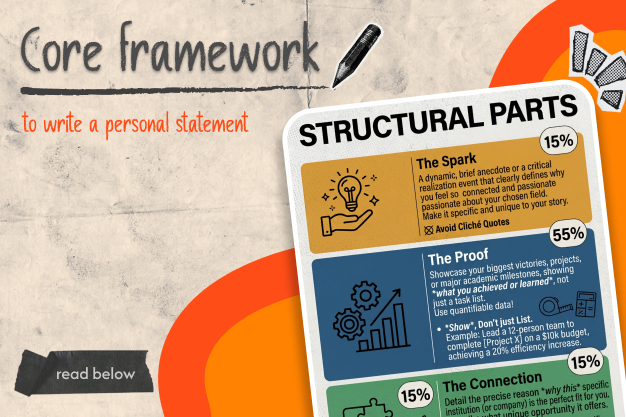
Regardless of the above-mentioned groups you belong to, you can follow a simple 4-part structure.
It is foolproof.
| Structural Parts | Budget | Note |
| The Spark | 15% | An opening anecdote or realization that explains why you care about this specific field. Avoid cliché quotes. |
| The Proof | 55% | Showcase your biggest wins, projects, or academic milestones. Do not just list what you did. Explain what you learned or achieved (use numbers where possible). |
| The Connection | 15% | Explain exactly why you want this specific institution or job. Mention unique courses, professors, company values, or specific projects. |
| The Vision | 15% | Conclude with a strong, forward-looking statement of what you plan to achieve after you graduate or land the role. |
Can You Use AI To Write A Personal Statement?
You can use AI as an aid for writing your personal statement.
It cannot draft or author your personal statement.
Also, despite differences or uneven policies, scrutiny is getting stricter across organizations in the USA and UK.
What The Latest Data And Expert Opinions Show
| Evidence | Finding |
|---|---|
| Kaplan Survey of 200+ US admissions officers, Nov 2025 | 50% unfavorable toward AI in essays26% neutral14% favorableAI can strip essays of personal voice |
| Cornell-linked study reported by NBC News | High AI content in essays was associated with a 22% drop in admission odds |
| Kaplan Law School survey, 2024 | 1% of law schools allow AI-written essays45% prohibit it54% have no policy |
| UCAS similarity checks | Every statement is tested for similarity against a library of previous statements. |
“In elite college admissions, there’s no courtroom standard of ‘innocent until proven guilty.’ Students will not get the benefit of the doubt.”
Jayson Weingarten, former University of Pennsylvania admissions officer and current senior admissions consultant at Ivy Coach.
Also, Ethan Sawyer, the founder of College Essay Guy, says that there is a bigger worry than the students getting caught.
The more serious concern is about how students hand over their thoughts to a machine.
Moreover, Cornell University plans to require applicants to disclose AI support from fall 2027.
Safe Uses Versus Risky Uses Of AI To Write A Personal Statement
| Generally acceptable | Risky or prohibited |
|---|---|
| Brainstorming questions about your experiences | Generating paragraphs or a full draft |
| Grammar and spelling checks on your own writing | Rewriting your draft into a “more polished” voice. |
| Researching programmes or colleges | Translating an essay or repurposing one written for another school |
Many organizations such as Northwestern University have made the personal statement essay optional.
It now requires applicants to write “supplemental essays.”
I see this as a direct impact of the increasing use of AI in college applications.
I completely agree with what AJ Alvero, assistant research professor and computational sociologist at Cornell University, has said in a statement.
“College admissions offices across the country have been responding pre-emptively to AI usage in many different ways, including explicit bans against using the technology.”
Having said that, detectors are imperfect.
Also, as the Higher Education Policy Institute (HEPI) has rightly pointed out, tools such as Turnitin are unreliable.
The bigger risk is human.
Readers notice generic phrasing and a lack of lived detail.
Keep your notes and draft history as proof of authorship.
Common Personal Statement Mistakes And How To Fix Them
| Mistake | Why It Hurts | Fix |
| Listing achievements | Reads like a résumé in paragraph form. | Pick two or three moments and explain what they taught you. |
| Cliché opening | Blends into thousands of other essays. | Open with a specific scene only you could write. |
| Topic too broad | Cannot be covered in 650 words. | Narrow to one angle with concrete evidence. |
| Writing what you think they want | Sounds generic and insincere. | Write about what genuinely matters to you. |
| Repeating examples across UCAS answers | Wastes limited characters. | Assign each example to one question only. |
| No second reader | Typos and unclear logic slip through. | Ask a strong writer and someone who knows you well. |
Final Checklist Before You Submit
Run through these checks on your last draft:
- Does it answer the exact prompt or question, within the length limit?
- Does every paragraph contain a specific example and a reflection?
- Could any sentence appear in someone else’s statement unchanged? If so, rewrite it.
- Have you read it aloud and fixed anything that does not sound like you?
- Can you prove the work is yours through notes and earlier drafts?
A strong personal statement is specific, reflective, and unmistakably yours.
Know your format, gather evidence, commit to one angle, show growth, and revise until the voice sounds like you.
Do that, and you will have a statement no tool can replace, and no reader will mistake for anyone else’s.