| Quick Answer: Turnitin is more reliable and well-documented as an AI detector, and it has wide acceptance in academic institutions. However, Turnitin does not have a free service, and it does not offer a standalone student or private account. ZeroGPT, on the other hand, is more accessible to writers because it is free and offers instant results. However, independent tests show that ZeroGPT has a higher false positive rate in AI detection than Turnitin. Having said that, none of these tools offer scores that can be used alone as proof of AI writing. That is why students using AI for studying and writing must keep the drafts handy. They should also provide proper citations and a disclosure statement. |
ZeroGPT Vs. Turnitin: Key Takeaways
- Turnitin is more conservative and institution-only; ZeroGPT is free but flags human writing more often in independent tests.
- Vendor claims of about 98% accuracy are not matched by independent results for either tool.
- Turnitin scores under 20% are especially unreliable.
- Non-native English writers face a higher documented risk because AI detectors assess the probability of word use.
- Use of rich vocabulary often helps bypass AI, and thus vocabulary gets priority over authenticity.
ZeroGPT Vs Turnitin: At A Glance
| Feature | ZeroGPT | Turnitin |
|---|---|---|
| Access | Free web tool | Institutions only can use Turnitin. There is no personal subscription model. |
| Claimed accuracy | About 98% | About 98%, with under 1% false positives above 20% AI text. |
| Independent findings | 67–85% accuracy14–33% false positives (Source: Fastio) | False positives from 1.3% to 15%, depending on the test |
| Languages | Advertises all languages | English, Spanish, Japanese |
| Output | Percentage plus verdict label | Sentence highlights.Asterisk for 1–19% AI detection scores. |
| Best for | Quick personal spot checks | Instructor review inside a school system. |
How Each Detector Works
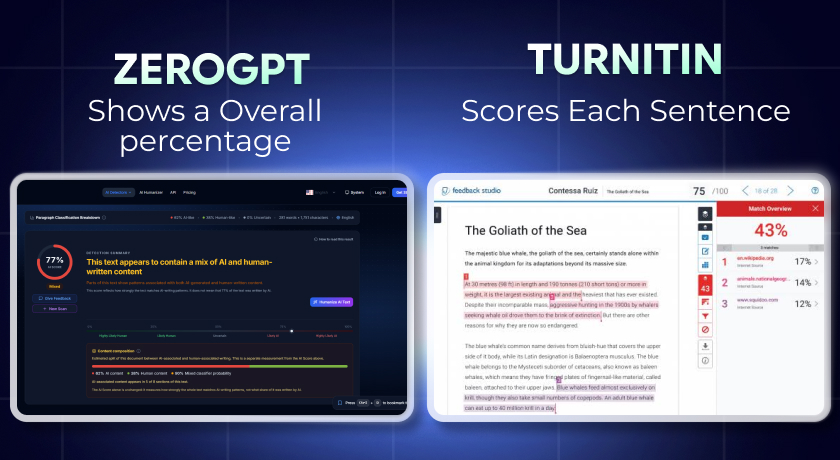
One problem I have faced perennially with ZeroGPT is that it flags the so-called generic sentences.
For example, in the beginning of this article, I have written,
“Turnitin is more reliable and well-documented as an AI detector, and it has wide acceptance in academic institutions.
However, Turnitin does not have a free service, and it does not offer a standalone student or private account.”
Despite being entirely human-written, ZeroGPT is flagging it as AI-written.
This is because I am stating common facts here.
However, as a writer, my aim will be to present the facts in as straightforward a manner as possible.
As a writer, I will not tweak the sentences just because ZeroGPT is flagging them.
Turnitin, on the other hand, is more thorough, but even with this, I only get probabilities in scores.
I have found the Turnitin Similarity checker more powerful than the AI detector.
Nevertheless, here is a breakdown of how ZeroGPT and Turnitin work.
ZeroGPT
ZeroGPT works on DeepAnalyse technology, and when you assess the text, it will show you a percentage and a label like,
“Your Text contains mixed signals, with some parts generated by AI/GPT.”
However, ZeroGPT lacks accuracy even when checking the same text.
The next time I checked the same two lines as above, it returned a 0% score.
This lack of reliability in the ZeroGPT score is further flagged in an October 2026 test.
MPG One submitted 28 texts to ZeroGPT.
16 of those texts were AI-written, and ZeroGPT could detect only 10 of them.
So, its claim of an accuracy rate of 98% does not hold up here.
Furthermore, the same report highlights that ZeroGPT could not detect disguised AI.
Turnitin
The scoring method of Turnitin is more comprehensive than ZeroGPT.
It assesses each sentence of a writing and scores individual score with a 0 (human-written) and 1 (machine-written).
After checking all the sentences, Turnitin offers a page-wise aggregate score.
If the score is between 1 and 19%, Turnitin will add an asterisk sign to show that the score is only a probability and not absolute proof.
The first model of Turnitin was launched in April 2023, and an upgrade came in December 2023.
Furthermore, the AI-bypasser detector of Turnitin for English texts came in August 2025.
Also, Turnitin only assesses the “Qualifying Text.”
“Qualifying text (prose sentences contained in long-form writing format) means individual sentences contained in paragraphs that make up a longer piece of written work, such as an essay, a dissertation, or an article, etc.
The model does not reliably detect AI-generated text in the form of non-prose, such as poetry, scripts, or code, nor does it detect short-form/unconventional writing such as bullet points, tables, or annotated bibliographies.
This means that a document containing several different writing types would result in a disparity between the percentage and the highlights.”
Moreover, the submissions have to be at least 300 words.
Accuracy And False Positives Of ZeroGPT Vs. Turnitin
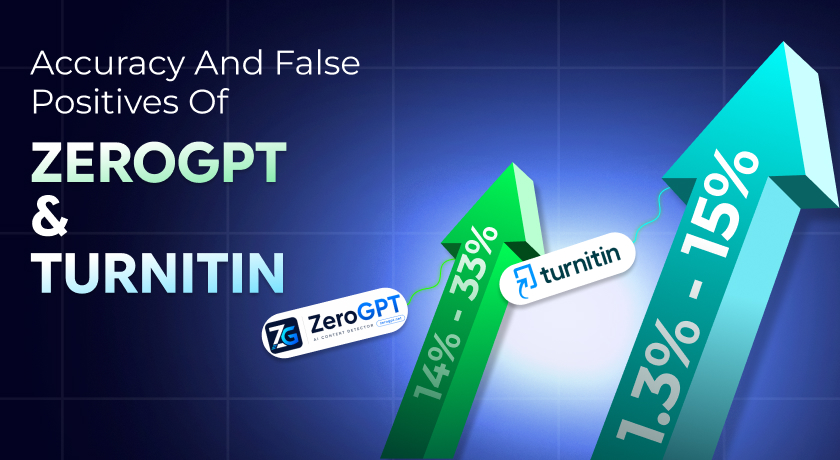
Accuracy claims are easy to make and hard to verify, so independent numbers matter more than homepages. Reported false positive rates vary a lot with the sample.
| Source | Tool | False positive rate |
|---|---|---|
| 160-text benchmark (Fast.io) | ZeroGPT | 20.5% |
| Aggregated 2026 tests (Fast.io) | ZeroGPT | 14.6% to 33% |
| JustDone benchmark (Fritz) | Turnitin | 1.3% |
| 320-essay classroom test | Turnitin | 15% |
| Turnitin’s own claim (above 20% AI) | Turnitin | Under 1% |
What Testing Says About ZeroGPT
ZeroGPT markets roughly 98% accuracy.
However, in a Fast.io assessment, a 2026 benchmark of 160 texts measured 73.8% accuracy, and technical or academic prose was flagged most often.
Furthermore, a small October 2026 test conducted by MPG One found no false flags on 12 human samples, which shows how much results swing with the sample.
What Testing Says About Turnitin
Turnitin shows an asterisk instead of a score between 1% and 19% because its own testing found more false positives there. The 15% figure comes from a smaller classroom test.
On the other hand, the 1.3% figure comes from a larger benchmark.
Also, while the percentage looks small, the scale of the papers tested matters.
Washington State University’s memo counted 148,547 assessments in Fall 2024.
So, even a 1% error rate implies almost 1,485 wrongful flags.
What Experts Say
Annie Chechitelli, the Chief Product Officer of Turnitin, has acknowledged the difference between lab testing and real-world results.
Furthermore, the University of Wisconsin–Whitewater’s teaching center warns that scores under 20% can come from ordinary human writing, especially formal, concise, or multilingual prose.
The study notes, “Treat the AI score as a conversation starter, not a verdict.”
Furthermore, there are two more updates that you need to note before using Turnitin, especially for academic reasons.
Curtin University disabled Turnitin’s AI detection from January 1, 2026, while keeping text matching, and Vanderbilt did the same in 2023.
Features, Limits And Practical Differences Between ZeroGPT And Turnitin
It is not just about the accuracy.
ZeroGPT and Turnitin are also very different in terms of how you reach them and what they return.
Access And Cost
You will get unlimited free use on ZeroGPT.
That is why it is a more popular tool for quick checks.
Turnitin is an institutional product, and you cannot run a document on it outside a licensed school.
AI Reports And Consistency
Turnitin does not assess the headers, quotations, and reference lists.
So, its percentage describes only the prose part.
Furthermore, it asks students to keep the formats for all the submissions the same to make them comparable.
On the other hand, as I have mentioned at the beginning of this article, ZeroGPT can give different scores for the same text if you check it twice.
So, relying solely on the ZeroGPT score becomes risky even for usual essay submission.
Honestly, I always cross-check the essays on Copyleaks.
Who Gets Flagged Unfairly?
Fairness is the sharpest concern when using any AI detector.
Liang et al. (Patterns, 2023) tested seven detectors on 91 TOEFL essays and found an average 61.3% false positive rate, with over 91% of essays flagged by at least one tool.
Turnitin answered with an evaluation of 800,000 documents, concluding that its detector shows no statistically significant bias against English language learners at 300 words or more.
That rebuttal covers only Turnitin, and shorter texts remain riskier.
For example, a multilingual student submits a formal 280-word reflection.
Short, polished prose is exactly where detectors are least dependable, so any score should prompt a conversation about drafts, not a penalty.
Why A High Score Is Not Proof
Irrespective of the AI detector tool used, the report is a statistical estimate.
Furthermore, the AI indicator and the similarity check features of Turnitin work differently on documents, and the scores will be different.
Also, base rates matter because when most submissions are human-written, even a low false positive rate produces many wrongful flags at scale.
Moreover, formal, technical, and non-native English prose is flagged more often, and a score alone cannot carry an accusation.
Which AI Detector Should You Use?
You must choose an AI detector among these two based on the stakes.
Both tools make high accuracy claims that are often challenged by independent studies.
For Educators
Use Turnitin if your institution licenses it, treat scores under 20% as inconclusive, and pair any flag with drafts, version history, and a conversation.
Do not use ZeroGPT output as disciplinary evidence.
Also, if any human-written article is flagged as AI, initiate conversations and check drafts for confirmation.
For Students And Writers
Use ZeroGPT only as a rough first look and expect false alarms on polished writing.
Keep drafts and version history, the strongest defense against a false accusation.
Also, show evidence of how AI detectors work on probability and burstiness.
For Institutions
Institutions weighing detectors should note that Curtin and Vanderbilt both switched off Turnitin’s AI detection over reliability concerns.
Ask any vendor for independent false positive data by genre and language, and set a policy under which a score can start a conversation but never end one.
What to Do After A High AI Score
Whether you are the writer or the reviewer, these steps keep the process fair.
- Check the length and type of text, since very short, formal, or list-heavy writing is least reliable.
- Gather drafts, notes, timestamps, and version history that show how the work developed.
- Compare the result with a second tool, remembering that detectors often disagree.
- Discuss the work with the writer, asking about sources, choices, and process.
- Decide on the full body of evidence, not the percentage alone.
Furthermore, as fair academic practice and if your organization allows the use of AI, provide proper citations and write the disclosure statement properly.