Quick Answer
Yes, Turnitin has a native AI detection system that can detect AI-generated text from any tool, including ChatGPT.
It assesses texts based on two core factors, such as perplexity and burstiness.
It scans how predictable the word choices are based on its statistical footprint, and the more predictable the word choice is, the higher the AI score is.
Also, Turnitin checks the variations in sentence length and construction to suggest a score.
Having said that, the report from Turnitin and any AI detector is an estimate, with chances of false positives and false negatives.
That is why Turnitin adds an asterisk to documents scoring less than 20%.
Moreover, Turnitin is very particular that the score it provides for AI detection should not be the only basis for action against a student.
From my guide on how to use AI for studying to how AI detectors work, you will always see that I have focused on Turnitin.
It is because Turnitin has been the default academic-integrity tool at many institutions for years.
Also, after being popular as a plagiarism checker, its AI detector has been a part of the product since 2023.
Here is more about how Turnitin detects ChatGPT, what it actually does, and what its published numbers say about its reliability.
I have also mentioned some independent research reports here so that you know where to exercise maximum caution.
Does Turnitin Detect ChatGPT: The Key Takeaways
- Turnitin scores prose in submitted documents, and it will check the “prose sentences contained in long-form writing format” or Qualifying Text only.
- The prose needs to have at least 300 words, and it has to be written in English, Spanish, or Japanese.
- Furthermore, Turnitin can only detect paraphrasing or AI bypassing for the prose written in English.
- Turnitin itself reports a document-level false-positive rate score under 1% above the 20% threshold.
- The same false-positive score is 4% at the sentence level.
How Does Turnitin Detect ChatGPT?
Turnitin does not check the output of ChatGPT against a database.
It looks at the writing you have submitted and checks which sentences “Look” like they are machine-generated.
Once again, it will check the perplexity and burstiness factors.
If the choice of your words is simple and predictable according to the statistical footprints of the tool, it will be assessed as “machine-generated.”
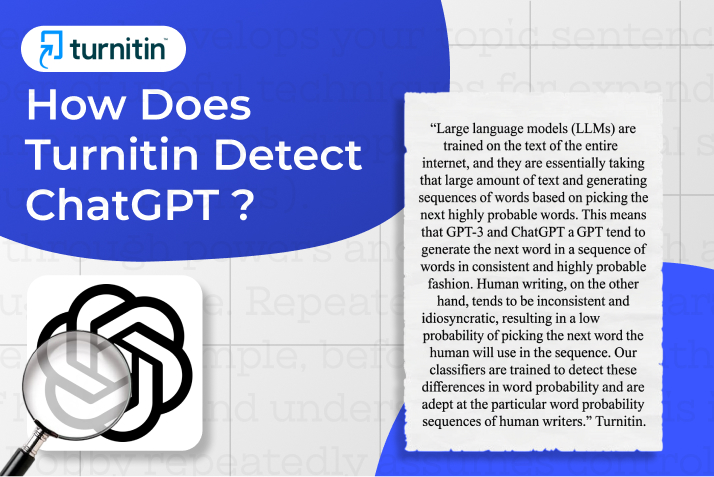
On the other hand, if the writing is formulaic with little variation in sentence structure and construction, the tool will give it a high AI score for the lack of burstiness.
Sentence-Level Scoring
Srinakharinwirot University (SWU), in its university library training deck, explains easily how Turnitin detects AI.
It reads every sentence and offers a score of 0 (human) to 1(AI).
Then, the document percentage aggregates those sentence results.
Once again, Turnitin assesses prose in long-form writing and presents the result as a likelihood.
Layers Added Over Time
The original AIW-1 model of Turnitin launched in April 2023.
It was followed by AIW-2, and by August 2025, Turnitin had an AI bypasser detector for its English-language text.
This bypasser detection, launched on 27th August 2025, was aimed at detecting AI text altered by “humanizer tools.”
This is an important advancement if you want to know whether AI detectors can detect paraphrasing or not.
Does Turnitin Detect Writing By Newer ChatGPT Models?
The product-team post of Turnitin clearly mentions that it does not have specific training on GPT-5.
However, early internal tests on AI-generated GPT-5 text have indicated that it could identify content from that model.
Regarding the addition of the AI-bypasser tool in 2025, it clearly mentions,
“With this update, we can also detect content generated by GPT-5.
While our AI writing detection capabilities are not specifically trained on GPT-5, our early internal tests on 100% AI-generated content from GPT-5 indicate that our AI writing detection capabilities can identify content likely generated by this LLM.”
Turnitin Features At A Glance
Let’s have a quick look at the features of Turnitin to understand how it works to detect ChatGPT.
I have sourced and cross-checked these figures against the help documentation page of Turnitin and its chief product officer’s update.
| Feature | Detail |
|---|---|
| Launched | April 2023 |
| Minimum length | At least 300 words of long-form prose |
| Maximum length | 30,000 words |
| Languages | English, Spanish, Japanese |
| Paraphrase and bypasser detection | English only |
| Low-score display | Asterisk shown for scores under 20% because they are less reliable. |
Does Turnitin Detect ChatGPT Accurately? Checking How Accurate The Score Is
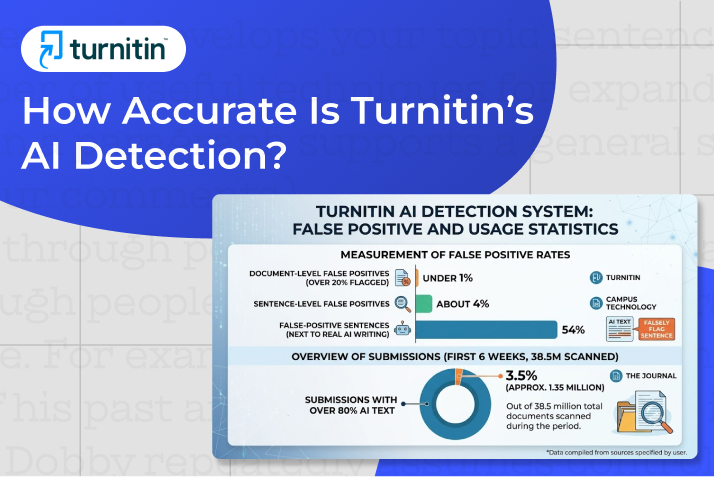
The figures Turnitin publishes for the accuracy rate are impressive.
However, some independent studies have raised the question about the accuracy of Turnitin.
| Measure | Figure | Source |
|---|---|---|
| Document-level false positives when over 20% is flagged | Under 1% | Turnitin |
| Sentence-level false positives | About 4% | |
| False-positive sentences next to real AI writing | 54% | Campus Technology |
| Submissions with over 80% AI text in first six weeks (38.5M scanned). | 3.5% | THE Journal |
Now, the 54% score here needs further mention.
According to Turnitin, most false-positive sentences in the text sit right beside genuine AI writing.
Now, this is something alarming for mixed documents.
More Independent Research Findings On The Accuracy Of Turnitin
In a 2023 study that tested 14 tools, including Turnitin, Weber-Wulff and colleagues concluded the available detectors were “neither accurate nor reliable.”
Also, a summary of the paper reports that no tool exceeded 80% accuracy.
That study used 2023-era tools, and Turnitin has updated its models since.
So, it is evidence of risk rather than of present-day performance.
Where Turnitin Is Most Likely To Struggle?
- Turnitin struggles in the AI detection of mixed documents where human and AI documents sit side-by-side.
- If a text is heavily edited or paraphrased, Turnitin may falter on accuracy.
- Turnitin can really impact the confidence of non-native writers, as they have restricted vocabulary.
So, Turnitin, while prioritizing vocabulary over authenticity, can falsely flag innocent students.
- A Stanford study found seven other detectors misclassified 61.3% of non-native TOEFL essays as AI.
Though Turnitin was not among them, the finding is a reminder to read scores cautiously for English-language learners.
And The Bottom Line On Accuracy Of Turnitin Detecting AI Text
Turnitin is a powerful screening tool for AI detection in fully English text.
Also, its published false-positive rates are low for documents with large AI shares.
However, it has limitations in assessing short, mixed, or lightly flagged work, which is where the real disputes arise.
Also, as Turnitin itself admits, the score is a probability, and it needs human follow-up.
So, if you are a student, you must keep your drafts, links to the AI usage, and a clear explanation ready to address red flags.
Moreover, if your organization permits the use of AI, cite ChatGPT properly in your work and add a proper disclosure statement about how you have used it.
In addition, if you are an educator, you must focus more on the follow-up to figure out actual AI usage when the tool score flags an alarm.
How To Read A Turnitin AI Report
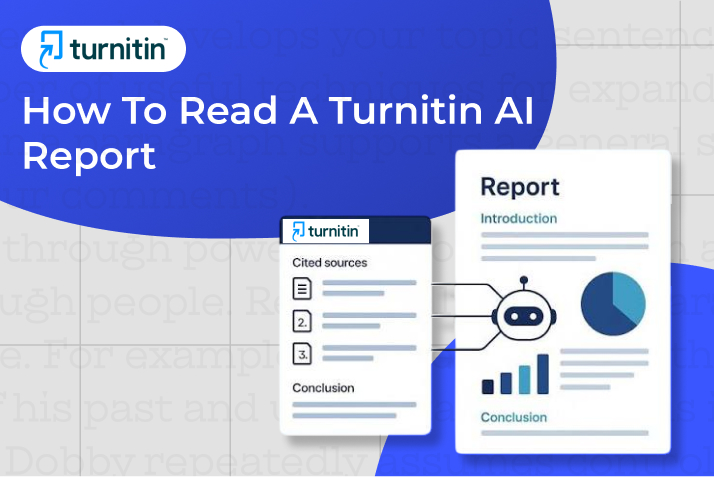
Know how to read and interpret a Turnitin Report.
The Percentage And The Asterisk
The headline number is the share of qualifying prose that the model judges likely AI-written.
It is separate from the similarity score.
So, a high similarity percentage says nothing about AI use and vice versa.
When the figure falls between 1% and 19%, Turnitin shows an asterisk instead of a number, signalling lower reliability.
Colour-Coded Highlights
Highlighted sentences show where the model sees likely AI text.
In the training deck cited earlier, cyan marks AI-generated or bypassed text and purple marks text judged both AI-generated and AI-paraphrased.
Highlights are most useful as prompts for questions, such as asking a student to talk through a highlighted paragraph.
How Widely It Is Used
The same independent review reports that Turnitin scanned more than 200 million papers in the detector’s first year.
Roughly 11% of them showed at least 20% AI content, and it serves more than 16,000 institutions.
Treat those totals as reviewer-reported figures rather than audited statistics.
The scale explains why even a small error rate can affect many students in absolute terms.
What Turnitin Cannot See
Turnitin can only scan or analyze the text submitted.
It cannot detect if a student has used ChatGPT or any other AI tool for brainstorming and then has written every sentence personally.
The submitted document may not contain a single piece of machine-written content.
Still, the ideation part is done by an AI tool completely.
For example, two students ask ChatGPT for an essay outline.
One pastes the generated paragraphs into a document.
The other uses the outline as a checklist and writes the essay from their own notes.
Turnitin sees two very different documents, even though both students “used ChatGPT.”
The policy of the institution or instructor will decide the use.
It is not something the score can answer.
Turnitin’s release notes also state that bibliographies are excluded from AI processing.
This is why disclosure matters more than detection avoidance.
If Turnitin Flags Your Human-Written Work
Is Turnitin flagging your human-written work as AI?
Flagging or giving an AI percentage score is the beginning of a review process.
Here are the things you must do as a teacher and a student.
For Students
- Stay calm. A score is a starting point for a review, not a ruling.
- Collect drafts, notes, browser history, and document version history that show your process.
- Check the course’s AI policy and explain exactly how, if at all, you used AI tools.
- For a self-check before submission, run your text on an AI detector.
- It will show which passages might draw attention, so you can be ready to explain them.
For Educators
Turnitin’s guidance says the AI score should not be the “sole basis for adverse actions against a student.”
Combine it with drafting evidence, a conversation about the content, and the course’s published rules.
Does Turnitin Detect ChatGPT? Frequently Asked Questions (FAQs)
Here are the frequently asked questions and answers about Turnitin detecting ChatGPT.
Does Turnitin Detect ChatGPT If The Text Is Paraphrased?
Yes, Turnitin can detect ChatGPT if the text is paraphrased for texts in the English language.
Since August 2025, Turnitin has added paraphrase and bypasser detection features to its AI detection tool.
However, accuracy varies, and results remain probabilities.
Does Turnitin Detect ChatGPT Inside Canvas?
Yes, Turnitin can detect ChatGPT inside Canvas when schools connect Turnitin to Canvas and enable AI writing detection.
Canvas alone cannot detect ChatGPT or AI text as an LLM.
What Percentage Of AI Score Is Safe?
Turnitin does not set any safe percentage for AI score of a text.
It marks anything under 20% with an asterisk to show lower reliability, and each institution decides how to respond.
Does Turnitin Check Text Shorter Than 300 Words?
No, Turnitin does not check text shorter than 300 words.
Also, the text has to be in a prose form to get qualified for assessment.