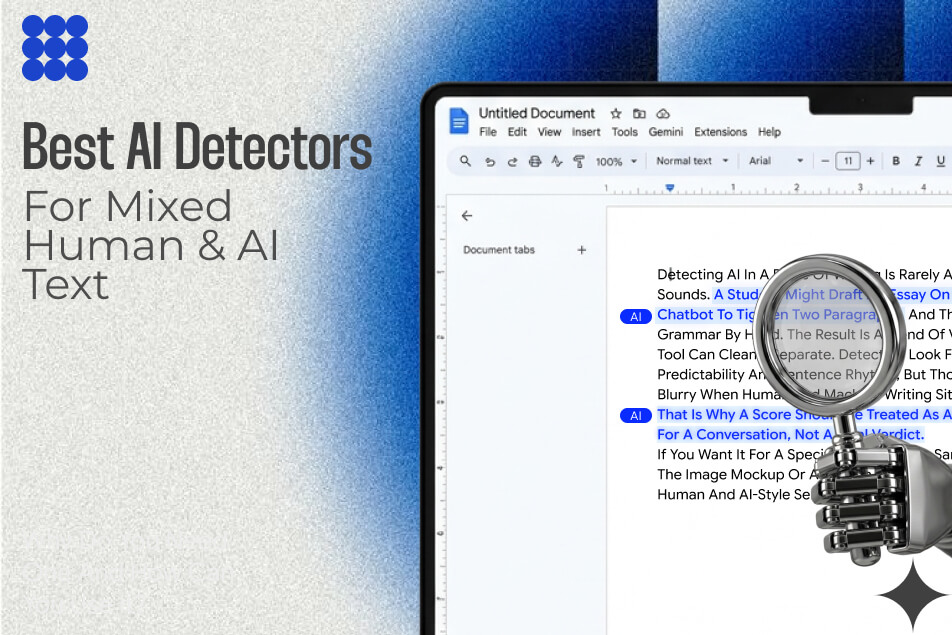
| Quick Answer: If you need an AI detector for mixed human and AI text, you can start with GPTZero, Pangram, and Copyleaks. These AI detectors work for sentence-level mixed text reports. However, for academic and research purposes, Turnitin is one of the most reliable choices. It is the tool that many instructors use for AI detection. However, no AI detection tool is beyond question, as AI detectors work on the core principles of perplexity and burstiness and they flag a probability and no absolute result. The detection becomes more inconsistent for human and AI-mixed texts. |
Most AI detectors test the straightforward cases.
These AI detectors assess a raw ChatGPT essay and a clean human essay.
However, the real submissions are messier, and they are not straightforward human-written or AI-written pieces.
For example, a student writes an argumentative essay or narrative essay and then asks an AI tool to tighten two paragraphs of the same essay.
Then, they fix the grammar by hand.
Again, in a different scenario, a freelancer uses AI to create an outline and then drafts a human essay.
These two are examples of mixed texts, and for these, AI detectors become more inconsistent.
Nevertheless, in this article, I will discuss the AI detector tools I have used for assessing mixed human and AI text and the ones you can use.
I will also discuss what independent studies say about each AI detector and how to run your own test so you are not relying on a vendor’s accuracy claim.
However, to begin with, I will highlight why an AI detector for mixed human and AI text faces more challenges.
Why Mixed Human And AI Text Breaks AI Detectors?
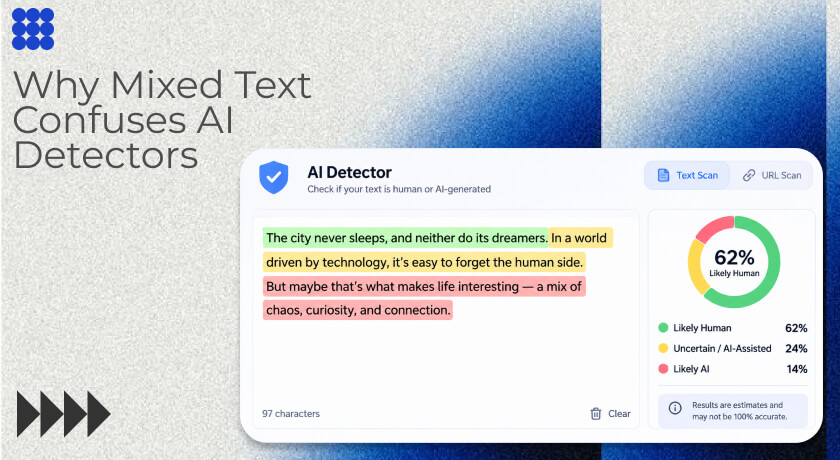
AI detectors score how predictable a passage looks, and mixing human and AI writing blurs the signal.
Dupple has summarized a 2026 arXiv study by Karr and colleagues and found that lightly AI-edited abstracts were flagged 38% to 80% of the time.
At the same time, 9% to 15% of unedited human abstracts were flagged as AI-written.
Moreover, the summary states that AI detectors could flag fewer than 4% of AI rewrites run through a humanizer.
Percentages Are Often Wrong Even When The Direction Is Right
Here, I want to refer to the study reported by Times Higher Education in June 2026.
In this report, researcher Lucky Atamhenwan fed 81 essays into Turnitin, from fully human to fully AI.
Turnitin did not flag that the articles were completely human-written.
However, for the essays with around 15 to 40% AI words, Turnitin gave a score higher than the actual percentage.
Again, for essays with 15% to 40% AI words, its score was often higher than the true share, and for essays with 70% to 100% AI words, it was consistently lower.
Turnitin, however, came with a response to defend this result.
Turnitin’s Josh Johnston responded that the sample was small and artificially mixed, and that a flag should be “a kick-off to a conversation.”
Nevertheless, the practical lesson is that you must treat the AI percentage for mixed text as an estimate and not a measurement.
Different Situations, Different Difficulties
The technical report of Pangram separates two cases.
In heterogeneous text, the piece is either fully human-written or AI-generated.
On the other hand, in a homogeneous text, an AI edits a human draft.
The second case is what most students and writers actually produce, and Pangram labels it “AI-assisted” rather than guessing.
False Flags Are More
Here, Turnitin can be a classic example because of the data we can find.
The false-positive rate reported by Turnitin at the document level is less than 1% for papers with at least 20% AI writing.
However, the same false-positive rate was 4% at the sentence level, and it says that the errors are more likely to happen in mixed documents.
The transition between human and AI text makes it difficult for the detector.
Here, the length of the text also plays a crucial role, as Turnitin raised the submission length to at least 300 words for a qualifying text.
Even GPTZero finds that the accuracy of AI detection improves with longer inputs.
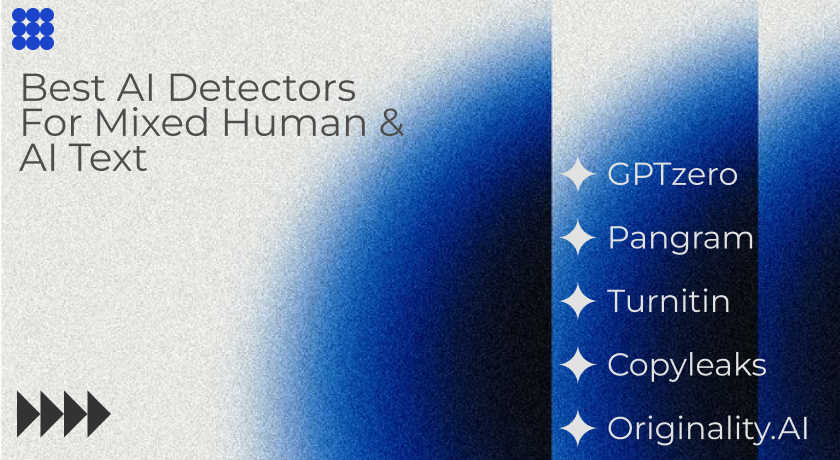
The AI Detector(S) For Mixed Human And AI Text You Must Try
| Detector | How it Reports Mixed Text | Best for | Main Caution |
|---|---|---|---|
| GPTZero | Human/mixed/AI label plus sentence highlights. | Quick checksGoogle Docs | Its 96.5% mixed-document figure is self-reported. |
| Pangram | Token-level split. HumanAI-AssistedAI-Generated | Heavily edited drafts. | Pangram 4 is new. So, independent tests are thin. |
| Turnitin | Percentage ScoresAsterisk below 20% | Predicting what an instructor sees. | Institutional access only. Percentages drift on mixed essays. |
| Copyleaks | Sentence HighlightsAI LogicAI Source Match | AI and plagiarism in one report. | Grammarly’s test says it missed a mixed sample. |
| Originality.ai | Single document scoreNo mixed label | Publishers auditing freelancers | 3.8% false positives in Epoch AI’s test |
GPTZero
GPTZero scans a document you upload or the text you paste and labels it as “Human,” “Mixed,” or “AI-Written.”
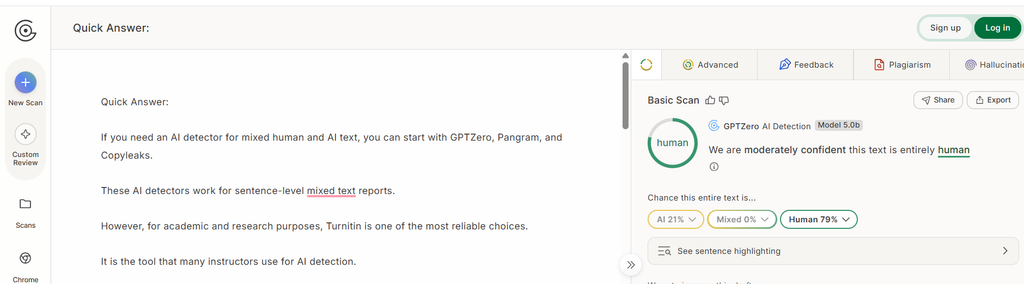
For example, when I pasted the draft of this article into GPTZero, it found it “Human.”
However, when I pasted a few specific sections of the article into GPTZero, it offered a mixed score, as you can see in the screenshot below.
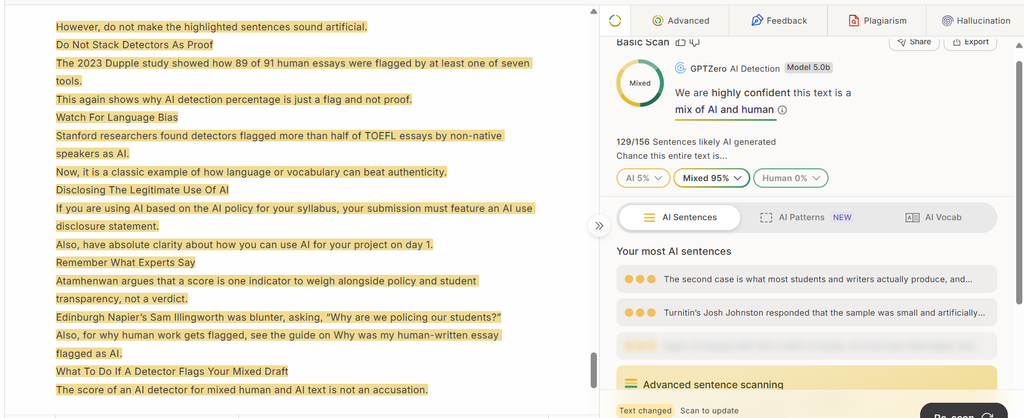
It also colors each sentence by AI confidence, including inside Google Docs through its Chrome extension.
GPTZero claims an accuracy percentage of 96.5% on mixed documents.
However, in Epoch AI’s testing, it missed about 11% of AI text written to imitate a specific author, when “Mixed” verdicts were not counted as detections, though it flagged none of 495 human passages.
Pangram
Pangram 4, launched on July 29, 2026, predicts for each token whether it is human, AI-assisted, or AI-generated.
It also adds a separate mixed-authorship check.
This way of functioning targets the homogeneous case, where AI polishes a human draft.
Pangram says it identified AI involvement in humanized text 98.83% of the time across 13 humanizers.
Because the model is new, and Epoch AI tested an earlier version (3.3.2), treat these as vendor claims until more independent results appear.
Turnitin
Turnitin shows a percentage and highlights flagged sentences, using separate colours for AI-generated and AI-paraphrased text.
Scores between 1% and 19% appear only as an asterisk because false positives are more likely there.
However, you can only use Turnitin through a school license.
So, use this AI detector as the benchmark for what your instructor may see.
Also, to understand the efficacy of the Turnitin tool, you must understand how Turnitin detects ChatGPT.
Copyleaks
Copyleaks highlights AI text sentence by sentence, explains flags with AI Logic, and pairs the result with plagiarism and AI Source Match checks.
The tool also separates human and AI writing even when blended.
Yet Grammarly’s 2026 comparison rated it 4 out of 5 and noted it missed the mixed sample.
However, that is one sample, not a verdict, which is why you should run your own test.
Also, if you are planning to choose between Turnitin and Copyleaks, read the detailed comparison.
Originality.ai
Originality.ai returns no “Mixed” label.
So it suits publishers auditing freelance drafts more than writers checking a blend.
In Epoch AI’s test, it flagged 19 of 495 human passages (3.8%) as AI, all written before ChatGPT existed.
A July 2026 MPG One retest found it the most accurate of three tools on clearly AI-written text, at 88% to 90%, but also called it over-sensitive.
How To Test A Detector On Mixed Text Yourself
A five-sample test takes under an hour and tells you more than any vendor page.
Use at least 400 words per sample to clear minimum-length rules, and run each sample through two or three tools.
| Sample | Setup | Your score (fill in) |
|---|---|---|
| A. Human only | Your own writing, no AI help | Add result |
| B. AI only | Raw chatbot output from one prompt | Add result |
| C. 50/50 interleaved | Alternate human and AI paragraphs | Add result |
| D. AI-polished | Your draft, then one “improve the flow” pass | Add result |
| E. Old human text | Something you wrote before 2022 | Add result |
Record both the document score and which sentences were highlighted.
If a tool scores sample E as AI, you have learned something important about its false positives.
If it rates sample D as fully human, you have learned something about its misses.
How To Read A Mixed-Text Score? Interpreting It In The Right Way
Grow a habit of the following practices so that you do not get confused about the mixed AI scores.
Compare Highlights And Not Just Percentages
Turnitin notes that a document with several writing types can show a gap between the percentage and the highlights.
Check your text in another tool and find out whether the same sentences are getting highlighted or not.
Also, read the sentences and make manual changes to them if feasible to make them less predictable.
However, do not make the highlighted sentences sound artificial.
Do Not Stack Detectors As Proof
The 2023 Dupple study showed how 89 of 91 human essays were flagged by at least one of seven tools.
This again shows why AI detection percentage is just a flag and not proof.
Watch For Language Bias
Stanford researchers found detectors flagged more than half of TOEFL essays by non-native speakers as AI.
Now, it is a classic example of how language or vocabulary can beat authenticity.
Disclosing The Legitimate Use Of AI
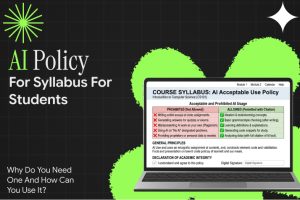
If you are using AI based on the AI policy for your syllabus, your submission must feature an AI use disclosure statement.
Also, have absolute clarity about how you can use AI for your project on day 1.
Remember What Experts Say
Atamhenwan argues that a score is one indicator to weigh alongside policy and student transparency, not a verdict.
Edinburgh Napier’s Sam Illingworth was blunter, asking, “Why are we policing our students?”
Also, for why human work gets flagged, see the guide on Why was my human-written essay flagged as AI.
What To Do If A Detector Flags Your Mixed Draft
The score of an AI detector for mixed human and AI text is not an accusation.
However, if it flags a higher AI score, it calls for a calm, organised and ethical response.
Here is a step-by-step smart approach you can follow.
- Re-run the same text through a second tool and compare the highlighted sentences, not the percentages.
- Gather process evidence, including version history, outlines, notes, and any chatbot logs showing what you asked for.
- Check your institution’s AI policy and disclose any permitted assistance in writing.
- Rewrite flagged passages from your own notes, adding your own examples and specifics, rather than running them through a paraphraser.
- Finally, ask for a conversation. Turnitin’s own framing is that a flag should open a discussion. So bring your evidence to it.
Overall, the best mixed-text detector is the one that highlights the flag at a sentence level so that you can verify it against your own draft.
Read the sentence and think about whether you can change it to appear more human.
Also, you must use at least two tools for the detection score.
A single tool score cannot decide anything on its own.