Quick Answer:
AI detectors neither can see nor can detect who has written a text.
They assess and score writing based on how statistically predictable your writing is.
If you are following a formulaic structure and similar phrases repeatedly, the AI score of your text can be high.
Lack of variation in sentence length and watermarks are other reasons for your writing getting flagged as AI-written.
Because plain, formulaic human writing can look like machine text, detectors offer false-positive results.
So, several universities have stopped treating their scores as evidence.
What Do AI Detectors Actually Measure? The Core Mathematical Metrics
An AI detector cannot search the web or compare your essay with a database like a plagiarism checker can.
In fact, an AI detector does not search the web or compare your essay with a database.
So, in this way, it is very different from plagiarism checkers, which check the authenticity of the content.
The AI detector tests how the words you have written match the statistical profile of machine-generated text.
It means the unique, measurable mathematical footprints and linguistic regularities left behind by Large Language Models (LLMs) when they produce text.
However, the tools also check burstiness or sentence-to-sentence variations, and token probability distribution.
Token-probability distribution means that every detector has a probability calculation of where the chosen words fall on the model’s spectrum from “most likely” to “least likely”.
Also, there is this Uniform Information Density (UID) and Surprisal factor that determines how an AI detector scores your writing.
However, burstiness and perplexity are at the core of the mathematics for most AI detector tools.
So, I will discuss these two in detail.
Perplexity: Are Your Words Predictable?
Perplexity measures how much the AI tool is surprised or anxious after the sequence of words in a sentence.
If the perplexity factor is low in your writing and you have mostly used common word sequences, it will “Look” like a machine-written piece.
Also, probably that is why non-native writers face the most difficulties with AI detection results.
Furthermore, if you are following a formulaic or rigid structure for your essay, the AI detection percentage will be higher.
Perplexity Example
• Machine Text: The storm raged outside. So, we decided to stay inside.
• The Math: log P(Inside/Stay) = Very small number
• Result: Low total perplexity score (e.g., 12).
The detector knows a machine wrote this because the model is entirely unsurprised by its own logic.
• Human Text: The storm raged outside. So, we decided to put the kettle on.
• The Math: log P(put/decided to) = Large Number
• Result: High total perplexity score (e.g., 85).
The detector flags this as human because a machine’s probability matrix wouldn’t naturally drift toward “kettle” in this sequence.
Burstiness: How Much Your Sentences Vary
Burstiness captures variation in sentence length and structure.
People mix short and long sentences; models tend to keep a steadier rhythm.
GPTZero has popularised the signal, and it remains common across detectors.
CASRAI’s guide adds that repeated editing passes can smooth out the unevenness detectors look for.
That is why heavily polished human drafts sometimes read as “too uniform.”
Burstiness Example
Machine-Generated Paragraph (Low Burstiness)
“The storm raged outside, and we decided to stay inside.
We built a warm fire in the fireplace.
The dog slept peacefully on the rug. We drank hot cocoa and listened to the rain.”
• Sentence lengths: 11 words, 7 words, 7 words, and 9 words.
• Standard Deviation: 1.5 (Almost flatline variance).
• Linguistic Structure: Strictly Subject-Verb-Object (We decided, We built, The dog slept, We drank).
Human-Written Paragraph (High Burstiness)
“The storm raged outside, and we decided to put the kettle on.
Safe.
Snug by the crackling hearth while the wind whipped the windowpanes, we watched the dog doze off, completely oblivious to the chaos brewing right past the glass.”
• Sentence lengths: 12 words, 1 word, and 26 words.
• Standard Deviation: 10.4 (Massive spikes and drops).
• Linguistic Structure: Drastic shifts from simple fragments (“Safe.”) to complex, nested clauses.
The Four Methods Behind Modern AI Detectors
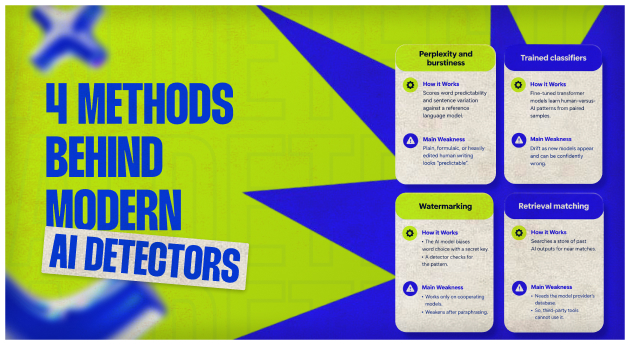
After discussing why my human-written article is getting detected as AI, I thought of elaborating on the methods AI detectors use.
Along with the mathematical core principles of perplexity and burstiness, they also follow several other methods.
Also, each method has its own limitation.
| Method | How it Works | Main Weakness |
|---|---|---|
| Perplexity and burstiness | Scores word predictability and sentence variation against a reference language model | Plain, formulaic, or heavily edited human writing looks “predictable” |
| Trained classifiers | Fine-tuned transformer models learn human-versus-AI patterns from paired samples. | Drift as new models appear and can be confidently wrong. |
| Watermarking | The AI model biases word choice with a secret key. A detector checks for the pattern. | Works only on cooperating models. Weakens after paraphrasing. |
| Retrieval matching | Searches a store of past AI outputs for near matches | Needs the model provider’s database. So, third-party tools cannot use it. |
Trained Classifiers: The Engine In Most Commercial Tools
The strongest detectors are themselves transformer models, usually fine-tuned BERT or RoBERTa variants trained on millions of paired samples.
OpenAI’s retired classifier worked this way.
A language model fine-tuned on human and AI text about the same topics.
Because a classifier weighs many features at once, its reasoning is hard to explain.
Moreover, OpenAI warned it could label human writing as AI with high confidence.
Watermarking: A Signal Planted At Generation Time
Google DeepMind’s SynthID-Text, published in Nature in 2024, nudges word choices during generation so a detector holding the key can spot the pattern later.
Google built it into Gemini.
The limits are real, and the signal weakens when text is paraphrased, translated, or heavily edited.
Also, a text from a model that does not watermark carries nothing to detect.
Retrieval Matching: Checking Against Past Outputs
Researchers proposed storing what an API has generated and searching for near matches.
Some researchers found that retrieval is an effective method for AI detection.
However, in the study conducted, the researchers mention that to test their protection system, they evaluated it against a dataset containing 15 million texts.
The texts were produced by a fine-tuned T5-XXL model.
Their findings show that the system successfully identifies between 80% and 97% of rewritten AI content across various conditions.
Also, it has mistakenly flagged human writing as AI-generated only 1% of the time.
Additionally, they have made our code, data, and models publicly available as open-source resources.
So, the limitation is that only a model provider can maintain such a database.
Inside Turnitin: How It Scores An Essay
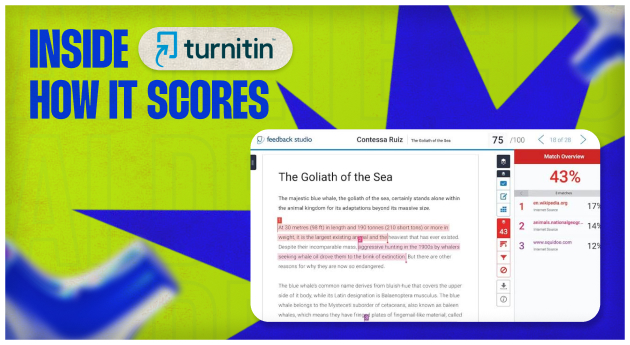
Turnitin’s AI indicator is the detector most students meet.
Its documentation says it reports the share of qualifying prose sentences its model judges to be AI-generated, and that it works only on English text.
Sentence-Level Scoring And The 20% Rule
The model scores each sentence, and the document percentage aggregates those scores.
Turnitin found a higher rate of false positives at low scores.
So, it now shows an asterisk instead of a number below 20% and raised its minimum submission from 150 to 300 words.
What Turnitin Says About Its Own Accuracy
Turnitin reports a document-level false positive rate under 1% when more than 20% of a paper is flagged.
Also, the rate of flagging is about 4% at the sentence level.
Furthermore, it says 54% of falsely flagged sentences sit right beside genuinely AI-written ones.
In 2023, its chief product officer acknowledged that real-world use was producing different results from lab testing.
Inside Copyleaks: How My Go-To Detector Scores An Essay
Copyleaks began as a plagiarism checker and later added AI detection.
Its FAQ says the report examines each paragraph and sentence.
Then, it highlights suspected AI passages with a confidence level and keeps the AI percentage independent of the similarity score.
It also says its models learned from crawled and user-submitted content collected since 2015.
Length matters here too.
The same FAQ lists minimums of 255 characters on its web platform and 350 on the browser extension.
So, it suggests testing about 350 words, and admits accuracy is lower for creative writing and for languages other than English.
AI Logic: AI Phrases And AI Source Match
Copyleaks’ AI Logic layers two tools.
AI Phrases flags wording that appears more often in AI text than in human writing.
Also, AI Source Match checks whether text matches AI-generated content already published elsewhere.
A university IT notice says Source Match joined the scan on August 1, 2025.
Also, a November 2024 update took place to raise the number of positive results, and instructors can set sensitivity levels, with Level 2 as the default.
What Copyleaks Says About Its Own Accuracy
Copyleaks claims 99.1% accuracy on English text and a 0.2% false positive rate.
It also says AI text is more likely to register as human than the reverse.
The FAQ, last updated July 1, 2024, also warns that AI-powered rewriting or translation features in other tools can trigger a flag.
However, false positives keep happening, especially for non-native English speakers, and sometimes there are false negatives also if you are changing the format.
Break the same sentence into bullets or in a table, the tool will not detect it anymore.
Turnitin Vs Copyleaks: A Side-By-Side Comparison
| Feature | Turnitin | Copyleaks |
|---|---|---|
| Core Approach | Sentence-level model aggregating into a total document percentage. | Analyses paragraphs, sentences, AI phrases, and AI source matches. |
| What You See | Instructor-facing percentage (shows an asterisk if below 20%). | AI percentage with confidence-highlighted text. Some LMS versions allow adjustable sensitivity. |
| Minimum Text | 300 words | 255 characters on platform (350 words suggested). |
| Languages | English only (according to its help page). | Around 30 languages claimed, though English is its strongest. |
| Vendor Error Claim | Under 1% per document above 20% AI; ~4% per sentence. | 0.2% overall false positive rate. |
| Plagiarism Pairing | Provides a separate similarity score. | Provides a separate similarity score within the same report. |
| Known Caution | Higher false positives at lower scores; disabled by some universities. | AI rewriting tools trigger flags. Independent testing found high false positive rates. |
How Accurate Are AI Detectors? The Independent Evidence
The tool claims and independent tests tell different stories.
Here are the most prominent figures for citations.
| Source | Year | Finding |
|---|---|---|
| OpenAI AI Text Classifier | 2023 | Caught 26% of AI text and wrongly flagged 9% of human text Withdrawn July 20, 2023, for low accuracy |
| Weber-Wulff et al (14 tools) | 2023 | Every tool scored below 80% accuracy, and only five exceeded 70% Results worsened after paraphrasing or translation |
| Liang et al., Stanford | 2023 | Average false positive rate of 61.3% on non-native TOEFL essays 89 of 91 were flagged by at least one of seven detectors |
| Krishna et al. | 2023 | Paraphrasing cut DetectGPT’s detection rate from 70.3% to 4.6% at a fixed 1% false positive rate |
| Turnitin (self-reported) | 2023 | Under 1% false positives per document above 20% AI About 4% per sentence |
| WSU Provost memo | 2026 | 33% of AI-related integrity hearings (2023-2025) ended “not responsible” where detection was the only evidence |
The Non-Native Writer Problem
Stanford researchers tested seven detectors.
They were near-perfect on U.S. eighth-grade essays but flagged 61.22% of TOEFL essays as AI.
The authors traced the bias to perplexity.
Their same paper showed that a simple prompt for fancier vocabulary could mitigate the bias and also let AI text slip past.
So, detectors may reward vocabulary rather than authorship.
The Paraphrasing Problem
Detectors flag plain human prose, yet lightly rewritten AI text often escapes.
WSU’s provost calls the contest between detectors and “humanizer” tools a cat-and-mouse game.
What Experts Say About AI Detectors
| Expert / Institution | Core Stance on AI Detectors | Key Warning / Takeaway |
|---|---|---|
| James Zou (Stanford) | Advises against relying on them in educational settings. | Highly unreliable for evaluating non-native English speakers. |
| Weixin Liang (Stanford) | Highlights that detectors inherently discriminate against certain authors. | Penalises non-native authors with limited word choice. |
| Debora Weber-Wulff & co-authors | Concludes that the tools are neither accurate nor reliable. | They heavily lean toward misclassifying AI output as human text. |
| Turnitin | Views its own reports strictly as conversation starters. | Reports are data points, never final determinations of misconduct. |
| General Research Consensus | Detector scores must be treated as a lead for conversation, never a verdict. | They should never be used as a final judgment on academic integrity. |
2026 Updates: Institutions Are Stepping Back From The Use Of AI Detectors
The trend of not using AI detectors started at Vanderbilt in 2023.
The trend continues in 2026.
| Institution | Action | Date |
|---|---|---|
| Vanderbilt University | Disabled Turnitin’s AI detection tool | Aug 16, 2023 |
| University of Waterloo | Discontinued Turnitin AI detection (secondary report) | Sep 2025 |
| Curtin University | Disabled the AI writing detection feature on all campuses | Jan 1, 2026 |
| Washington State University | Cancelled its Turnitin AI detection contract | Feb 11, 2026 |
WSU’s memo shows the arithmetic.
Turnitin analysed 148,547 assessments in Fall 2024.
So, even a 1% false positive rate implies almost 1,485 wrongly flagged papers.
WSU still bars any detector from serving as the sole basis for a misconduct case.
What This Means For Writers
Once you know the mechanics, you will understand the importance of maintaining the authenticity and uniqueness in your writing.
What To Do If My Essay Is Flagged?
You have to keep your version history ready.
Request the full report about the sections of your writing that are getting flagged.
Then, present evidence of not using AI or a disclosure of how you have used AI.
Using Another Detector As A Second Opinion
The limitations of AI detectors are also clear in how different tools show different AI percentages for the same writing.
Even honestly, when I was checking the essaywritingguides.com AI text detector, I found that sometimes it is showing false-positive results, and that is at least 3 out of 10 times.
So, if you are confident about the ethical use of AI in your studies or drafting essays, defeat the AI score with evidence.
You can even cite AI in your essay in APA, MLA, Chicago, and other styles to declare proper usage according to the policies of your institution or guide.
Frequently Asked Questions
Here are the frequently asked questions and answers about how AI detectors work.
1. Can An AI Detector Prove I Used AI?
No, AI detectors cannot prove that you have used AI in your writing.
It only gives you a score based on a statistical estimate.
That is why many colleges now “snub” Turnitin for fear of the tool wrongly accusing students.
Also, Washington State University (WSU) shares a stronger report on the cancellation of Turnitin AI Detection software and the Use of AI Detectors for Academic Integrity.
In its declaration on 11th February 2026 from the Office of the Provost, it says,
“As of February 2026, WSU has cancelled its contract with Turnitin for its AI Detection software.”
The report also highlighted,
“Between 2023-2025, 33% of all Academic Integrity Hearing Board cases related to
allegations of inappropriate AI use led to a finding of not responsible because AI
detection was submitted independent of any other supporting evidence.”
2. Can AI Detectors Check For Plagiarism?
No, AI detectors cannot check for plagiarism.
Also, AI detectors do not look for anything or try to do source matching like plagiarism checkers.
In this context, we can refer to the WSU declaration from the Office of the Provost.
The University has cancelled its contract with the Turnitin AI detector, but the agreement with the plagiarism checker is still on.
3. Which AI Detector Is Most Accurate?
No independent test has crowned a specific AI detector as the best.
Most of the AI detection tool furnish figures from internal benchmarks.
In fact, some independent studies, including the “Testing of Detection Tools for AI-Generated Text” report, suggest that no AI detection tool is accurate above 80%.