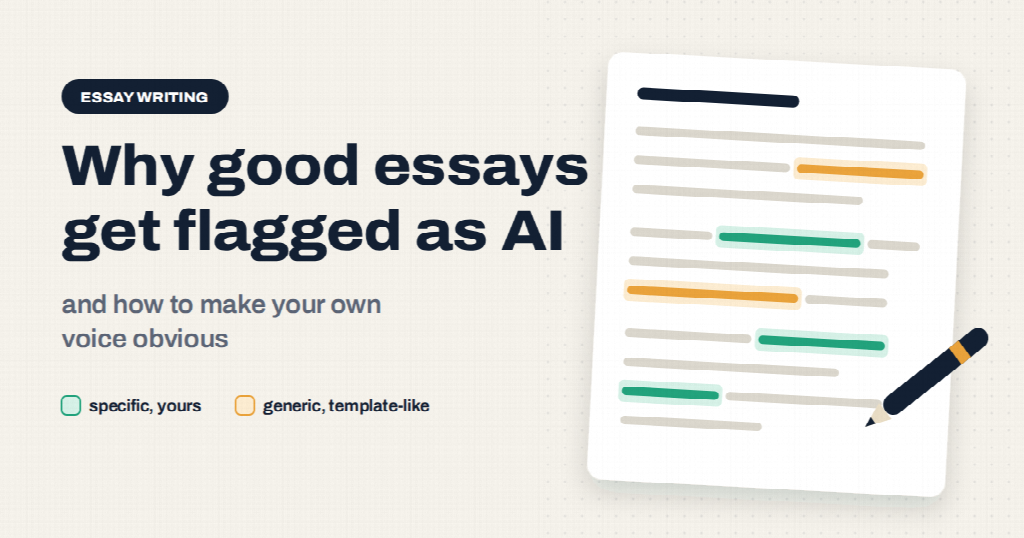
You wrote every word yourself. You followed the structure your teacher taught you: a clear thesis, three body paragraphs, smooth transitions and a conclusion that ties everything together. Then an AI detector labels your essay “likely AI”.
This happens more often than most students expect, and it is rarely because the essay is bad. Usually it is because the essay is tidy in exactly the way a language model is tidy. The good news is that the fix is not a trick. The habits that make an essay read as unmistakably yours are the same habits that earn better marks.
This guide explains what AI detectors actually look at, why a well-drilled essay structure can resemble machine writing, what you can change in the way you draft, and how to protect yourself if your work is ever questioned.
What an AI detector is actually measuring
An AI detector does not know who wrote your essay, and it does not compare your text against a database the way a plagiarism checker does. It looks at statistical patterns in the writing itself and estimates how closely they match text produced by language models.
The exact signals vary from tool to tool, but most detectors pay attention to some version of these:
- Predictability: how expected each word is, given the words before it. Language models tend to pick the most likely next word. People wander.
- Uniformity: whether sentences and paragraphs are similar in length and rhythm.
- Generic phrasing: stock openers and transitions that could appear in any essay on any topic.
- Low specificity: claims with no names, numbers, dates or details attached.
The result is a score or a label, and it is a signal, not proof. Two essays with the same score can have been written in completely different ways.
Why the essay structure you were taught can look machine-made
Most of us learned to write essays from a template. A signposted introduction. Three body paragraphs of roughly equal length, each opening with a topic sentence. Transitions such as “Furthermore”, “Moreover” and “In conclusion”. A final paragraph that restates the thesis.
By the standards of a marking rubric, that is a well-organised essay. By the standards of a statistical model, it is uniform sentence length, predictable framing and very little that is specific, which is close to the profile of generated text. A competent, entirely human essay written this way can land in a detector’s “uncertain” range, and sometimes above it.
Three other things push in the same direction:
- Heavy polishing with grammar tools. When a tool rewrites whole sentences for “clarity”, it smooths out the variation that marks human writing.
- Formal or technical registers. Academic language is more predictable by design.
- Writing in a second language. Non-native writers often use a narrower vocabulary and simpler sentence patterns. In a 2023 Stanford study, seven detectors classified more than half of 91 TOEFL essays written by non-native English speakers as AI-generated (61.22% on average), and 89 of the 91 essays were flagged by at least one detector.
Short answers are the riskiest text to check
The less text a detector has, the less evidence it has, and the easier it is to misread. That is why short answers, exam responses and reflective paragraphs are the riskiest things you can run through any detector.
Some tools publish how large that effect is. AI Detector Checker, for example, reports its sealed-test results on its AI detector for essays page: human texts of 100 to 149 words received a wrong AI signal about 2.4 times in every 100, while texts of 150 words or more were wrongly flagged about 2 times in every 1,000. That is more than a tenfold difference caused by length alone.
Two practical rules follow:
- If you want feedback from a detector, check the longest continuous stretch of prose you wrote, not a single paragraph.
- Never treat a result on a short text as a finding, whether it says “human” or “AI”.
Seven ways to make your own voice visible
None of these is about fooling software. Each one also makes the essay better for a human reader, which is the point.
1. Replace general claims with specifics only you would write
Generated essays are evenly good and evenly vague. Yours can be concrete: the page number of the passage you are discussing, the date of the event, a statistic with its source, the example your lecturer used in last week’s seminar. “Social media has many effects on teenagers” could come from anyone. “In our class survey, 19 of 27 students said they check their phone within five minutes of waking up” could only come from you.
2. Let sentence length follow your thinking
Say simple things simply. Give complicated ideas the long sentence they need. Real writing varies because thinking varies, and a paragraph in which every sentence runs to about twenty words reads as if it were produced to a pattern.
3. Cut stock transitions
“Furthermore”, “Moreover” and “In today’s fast-paced world” add nothing a reader needs. Replace them with the actual logical link: “That explains why prices rose, but not why they stayed high for two years.” A transition that could only appear in your essay is doing real work.
4. Give each paragraph the weight its idea deserves
No rule says body paragraphs must be the same length. If your second point is the strongest, spend more words on it. Uneven effort is a natural feature of human writing: the section you struggled with reads differently from the one that came easily.
5. Show your reasoning, including your doubts
Language models hedge in a generic way (“While there are many perspectives on this issue…”). People disagree with specific things. Name the counter-argument, say who makes it, and explain where you think it goes wrong. Admitting what your evidence cannot show is a mark of a real writer.
6. Build on your course material
Refer to the reading list, the lecture and the discussion in class. A model writing from general knowledge cannot know what your tutor said on Tuesday. You can, and markers reward it.
7. Use grammar tools to fix errors, not to rewrite paragraphs
Accept spelling and punctuation corrections. Be wary of one-click rewrites that turn your sentences into someone else’s. If a suggestion changes your meaning or your tone, reject it.
Keep a paper trail while you write
If your authorship is ever questioned, a score will not settle it. Your drafting history will. Make it easy to show:
- Write in Google Docs or Word with version history on, and avoid pasting the whole essay in from somewhere else at the end.
- Keep your outline, notes and early drafts, even the messy ones.
- Save a list of the sources you read, with the dates you accessed them.
- Be ready to talk through your argument. A five-minute conversation about why you made a point tells a teacher more than any detector can.
Should you check your own essay before you submit it?
It is your essay, so checking it is your call. If you do, a few rules keep the result useful:
- Read the band, not just the number. Many tools sort results into three bands, such as “likely human”, “uncertain” and “likely AI”.
- Treat “uncertain” as what it is: mixed evidence. It is a common result for formal, well-structured writing, and it does not mean “probably AI”.
- Don’t rewrite a good essay just to push a number down. If a revision makes the essay more specific and more clearly argued, make it. If it only makes the essay worse to please a tool, skip it.
- Avoid “humanizer” tools. They reword text to disguise where it came from, they often change your meaning, and many academic integrity policies treat that kind of disguise as misconduct in its own right.
What to do if your essay is flagged anyway
Stay calm and stay factual.
- Ask to see the full report, not just the headline percentage.
- Gather your evidence: version history, notes, outline and sources.
- Ask for a meeting, and offer to explain your argument and how you wrote it.
- Read your institution’s policy on AI and on AI-detection tools. Detector makers say the same thing: Turnitin’s own guidance states that an AI writing score should not be used as the sole basis for adverse actions against a student.
- If English is not your first language, say so. The research above is directly relevant to your case.