Your human-written essay is getting flagged as AI because AI detectors cannot identify who wrote the text.
These tools estimate the “predictability” part of it.
If it has a plain format or is short and formulaic, there are high chances of AI detection.
Once again, if you are writing the text in a second language, the AI score of your writing in these tools will go up.
Also, very few people talk about how the topic or niche matters.
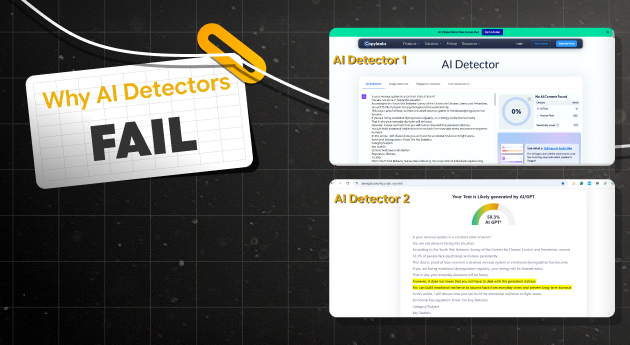
During my years of experience as a writer, I have always seen my travel and lifestyle articles with granular details getting high AI scores on detectors such as ChatGPT.
When I checked the same content in Copyleaks, the score was 0%.
At the same time, I have seen that business, finance, and legal articles usually register low AI scores in these detectors.
Recently, a Stanford-led study has shown how seven detectors flagged an average of 61.3% of human-written TOEFL essays as AI.
As a result, many universities are now turning off AI detectors.
So, when a tool is flagging your text as AI-written, it is a probability and not proof.
Do you want a more detailed answer on “Why was my human-written essay flagged as AI?”
Here is the entire discussion.
Key Takeaways
- AI detectors score patterns when they assess any writing.
- So, these tools check patterns such as sentence variation and predictability.
- Since there is no assessment of authorship, false positive results are common.
- Non-native English writers face the biggest problem in AI detection.
- Short submissions and formulaic structure make them more prone to a high AI detection rate.
- AI detection results differ from one tool to another.
- If an AI tool is flagging the predictability, do a human review of the same, and it does not mean that a piece is AI-written.
- Drafts, version history, and notes are your best defence.
How AI Detectors Decide Your Essay “Looks Like AI”
Now, this is a fight I have every fortnight with my SEO specialist and publisher.
For some strange reason, they fail to understand that AI detectors cannot see the writing process.
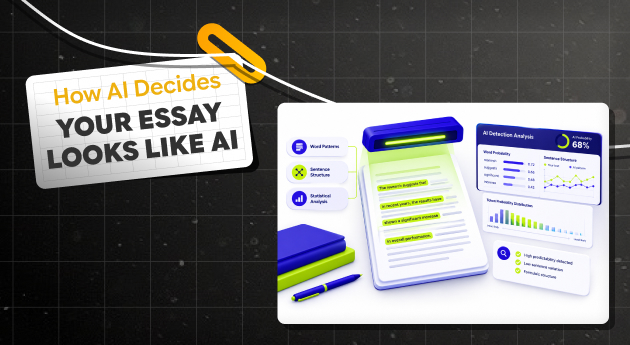
These tools can only see the finished text and compare its statistical fingerprint with patterns learned from human and machine writing.
So, there is a gap that needs a proper understanding to avoid wasting time on false flags.
It is like, “I am sharing the document where I have written the entire piece.
There is revision history. Why don’t you just check?”
Nevertheless, for a deeper understanding of why my human-written essay was flagged as AI, here are the details about how AI detectors work.
What Does An AI Score Actually Measure?
Most AI detectors rely on the following signals to assess the AI percentage of a piece of writing.
- Perplexity, meaning the predictability of each word.
- Burstiness, meaning the variation in structure and sentence length.
For example, let’s consider Turnitin’s sentence-level model.
It gives each sentence a score of 0 to 1.
Then, “Turnitin’s AI detection model evaluates sentence-level probability across the entire document and calculates an overall percentage from the average scores of all segments”.
If a text is predictable, has the same transition words repeatedly, or similar sentence structures, it has a higher chance of AI detection.
Also, introductions and conclusions are mostly flagged by AI detectors such as Turnitin when these sections lack a genuine, authoritative voice.
Why Is A Flag A Probability And Not Proof?
A Mount Royal University Advisory calls AI detection “unverifiable.”
Also, even the strictest tools such as Turnitin have been reporting sentence-wise and document-wise false-positive cases differently.
In its official report on 23rd May 2023, Turnitin says,
“Our sentence-level false positive rate is ~4%.
This means that the specific sentence we are highlighting may be human-written 4 times for every 100 highlighted sentences.
The incidence of this is more common in documents that contain a mix of human- and AI-written content, particularly in the transitions between human- and AI-written content.”
Even Copyleaks, my usual go-to for everything I write, highlights the probability part of the AI detection.
It says,
“AI detection is never a simple “yes” or “no” because there are instances in which users may simply rewrite AI, which has the potential to add a “human” touch to the work.
Instead, AI detection is all about probability and context.”
Why Human-Written Essays Get Flagged: 6 Evidence-Based Causes
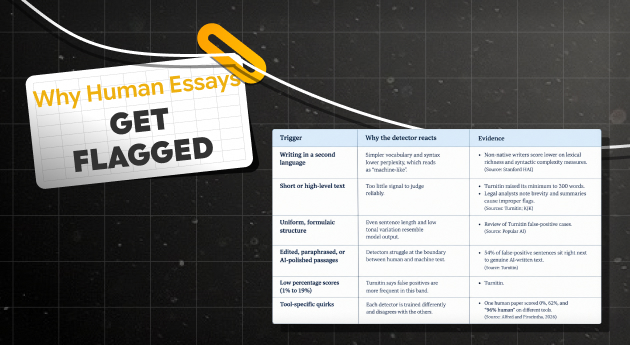
False flags rarely come from nowhere.
The table below maps the most common triggers to the evidence behind them, followed by a closer look at the three that affect students most.
| Trigger | Why the detector reacts | Evidence |
|---|---|---|
| Writing in a second language | Simpler vocabulary and syntax lower perplexity, which reads as “machine-like” | non-native writers score lower on lexical richness and syntactic complexity measures (Source: Stanford HAI). |
| Short or high-level text | Too little signal to judge reliably | Turnitin raised its minimum to 300 words. Legal analysts note brevity and summaries cause improper flags |
| Uniform, formulaic structure | Even sentence length and low tonal variation resemble model output | Review of Turnitin false-positive cases |
| Edited, paraphrased, or AI-polished passages | Detectors struggle at the boundary between human and machine text | 54% of false-positive sentences sit right next to genuine AI-written text. (Source: Turnitin data) |
| Low percentage scores (1% to 19%) | Turnitin says false positives are more frequent in this band | Turnitin. |
| Tool-specific quirks | Each detector is trained differently and disagrees with the others | One human paper scored 0%, 62%, and “96% human” on different tools. (Source: Alfred and Piracintha, 2026.) |
You Write In English As A Second Language
This is the best-documented cause.
The Stanford team behind the Patterns study found detectors were near-perfect on essays by US-born eighth-graders.
However, it flagged more than half of non-native TOEFL essays (61.22%).
If English is not your first language, a flag says more about the detector than about you.
Our guide to writing clearly without sounding robotic shows how to add natural variety without changing your voice.
Your Essay Is Short, Formulaic Or Highly Structured
The classic five-paragraph structure, repeated transitions, and evenly sized sentences all reduce burstiness.
Short pieces compound the problem because the detector has fewer sentences to average over.
If you are working on an argumentative essay or a personal statement, build in real variation.
You also need to add specific examples, first-hand detail, and sentences of different lengths.
You Mixed In AI-Assisted Editing
Many students use AI for brainstorming or grammar and then forget how much of the final wording came from the tool.
Turnitin’s own analysis shows false-positive sentences cluster next to real AI text.
So a rewritten paragraph can colour the sentences around it.
If your institution allows AI use, disclose it and cite it properly.
The Data: How Often Do AI Detectors Get It Wrong?
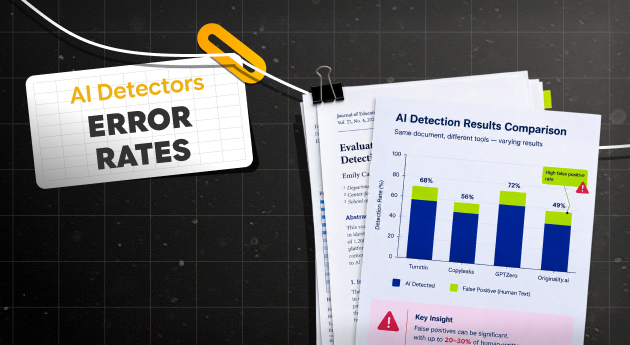
Accuracy claims and independent results tell different stories.
This section separates the two and adds the arithmetic that most vendor pages leave out.
Independent Studies And Tests
The table summarises the most useful public evidence.
Sample sizes and tool versions differ.
So compare findings with care.
| What Was Tested | Finding | Limitations | Study |
|---|---|---|---|
| 7 detectors, 91 TOEFL essays by non-native writers | • 61.3% average flagged as AI • 89 of 91 flagged by at least one tool • 18 flagged by all seven | Peer-reviewedTools have since been updated | Liang et al., Patterns, 2023 |
| 16 detectors on human-written control essays | False-positive rates ranged from 0% to 31% | Wide variation by tool | Walters, 2023, via Mount Royal |
| ZeroGPT and Copyleaks on 10 authentic Filipino student essays | • 5 essays labelled AI-generated • 5 labelled human • All were human-written | Very small sample | ASEAN Journal of Open and Distance Learning, 2026 |
| 4 detectors on one human-written academic paper | • Turnitin 0% AI • GPTZero 96% human • Originality.ai estimated 62% AI | Single paper | Alfred and Piracintha, 2026 |
| Pangram, GPTZero, Originality.ai on 495 human passages | • Pangram and GPTZero flagged none • Originality.ai flagged 19 (3.8%) | Not focused on second-language writers | Epoch AI, July 2026 |
(The Epoch AI result is a useful counterweight. False-positive rates vary widely between tools and between test conditions.)
Tool Claims Versus Real-World Conditions
Turnitin states a document-level false-positive rate below 1% for documents with more than 20% AI writing.
It also highlights a sentence-level rate of about 4%, as set out in its Chief Product Officer’s update.
Those figures are vendor-published and, by Turnitin’s own wording, do not describe the sub-20% band where it says reliability is weaker.
KU’s Center for Teaching Excellence reported the company found lab results differed from daily use, which is why it added the asterisk and the 300-word minimum.
The Base-Rate Problem: Why A “Good” Detector Still Accuses Innocent Students
Mount Royal University points out that the share of flagged papers that are truly AI-written depends on how many students actually use AI.
The illustration below applies that logic to 1,000 essays, 50 of them AI-written, with a detector that catches 90% of AI text.
| Detector false-positive rate | Human essays wrongly flagged | AI essays correctly flagged | Share of flags that are correct |
|---|---|---|---|
| 1% | about 10 | 45 | about 83% |
| 5% | about 48 | 45 | about 49% |
(Illustrative arithmetic by the essaywritingguides.com editorial team, using the method described in the Mount Royal advisory. Real prevalence and error rates vary by institution.)
At a 5% false-positive rate, roughly half of all flagged essays would be genuine.
That is why a single score should never be treated as a verdict.
Changes In AI Detection That We Need To Remember In 2027
The conversation has shifted from “can detectors be trusted?” to “what happens when they are wrong?”
| Date | Update |
|---|---|
| Aug 2026 | Mount Royal University publishes an advisory warning that detector scores cannot meet the standard of proof for misconduct decisions |
| Jul 2026 | Epoch AI tests three detectors on 495 human passages; two flag none, one flags 3.8% |
| Jul to Aug 2026 | Editorial reports a New York court reversing a student’s expulsion tied to a Turnitin false positive, treated by institutions as a liability signal |
| Jan 1, 2026 | Curtin University switches off Turnitin’s AI-writing detection while keeping text-matching in place |
| 2026 | Small studies on authentic student essays continue to find inconsistent classifications and recommend human review |
For more details on the ethical use of AI, you can read my detailed guide on how to use AI for studying.
Why AI Detection Tools Can Be Faulty (And What A Better Check Looks Like)
The false-positive problem is not a bug that one update will fix.
It follows from how detectors work and how they are deployed.
Five structural weaknesses explain most of the errors.
Five Structural Weaknesses
- They infer, and they do not verify.
A score is a statistical guess about style, with no access to your drafting history.
- They carry bias.
Stanford’s work shows systematic over-flagging of non-native English writing.
- They disagree with each other.
The same human paper received 0% on one tool and 62% on another in a 2026 test.
- They are fragile on short and mixed text.
Turnitin raised its minimum length and flags low scores with an asterisk for this reason.
- They err in both directions.
The Stanford team found light prompt-based rewriting could push AI text below detection thresholds.
So the same tools over-flag humans and under-flag machines.
A Better Way To Use A Detector: As A Draft-Stage Second Opinion
If detectors are probabilistic, the sensible response is to use them early, as one signal among several, and to keep your own proof of authorship.
Before you submit, run your draft through the essaywritingguides.com AI Text Detector to see how it reads to an automated check.
You can then revise any stiff or repetitive passages in your own words.
Treat the result with the same caution this guide recommends for every tool.
It is a prompt to review your writing, not a verdict on your honesty.
You can also use the Chrome extension while drafting.
Here, by no means do I recommend using “humanizer” or bypass tools.
They do not prove authorship, they can breach institutional policy, and they often make writing worse.
The safer route is a documented writing process.
Expert Views On AI Detector Reliability
Researchers and institutions that have studied detectors closely reach a consistent conclusion.
Use them cautiously, and never alone.
James Zou, Stanford University
Zou, senior author of the Patterns study, said that current detectors are “clearly unreliable and easily gamed.
He has advised avoiding reliance on them in educational settings, especially where many students are non-native English speakers.
He explained the mechanism.
non-native writers tend to score lower on perplexity-related measures such as lexical diversity and syntactic complexity.
Here is a quote from James Zou of Stanford University’s Human-Centered Artificial Intelligence.
“They typically score based on a metric known as ‘perplexity,’ which correlates with the sophistication of the writing — something in which non-native speakers are naturally going to trail their U.S.-born counterparts.”
Turnitin’s Chief Product Officer
In its public update, Turnitin’s Chief Product Officer, Annie Chechitelli, distinguished document-level from sentence-level error rates.
She also noted that false-positive sentences tend to appear near transitions between human and AI text.
The company also said its 20% threshold, 300-word minimum and sentence-level rate may change as models evolve.
That candour is useful context for any student reading a report.
University Guidance
Mount Royal University advises that detector output should support, not replace, academic judgement.
A 2026 higher-education case study reached the same conclusion.
It has recommended detectors only as screening aids within a documented process that includes policy, source checks, writing history and student explanation.
Case Studies: What Happens After A False Flag
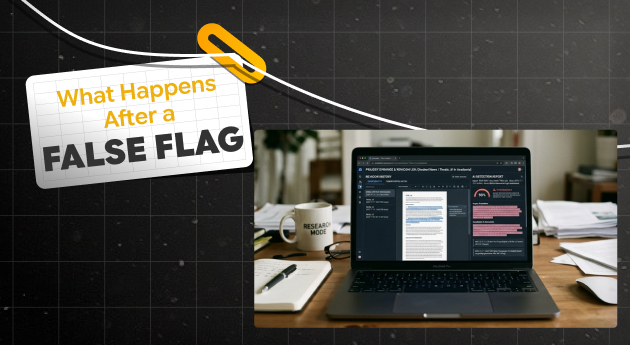
I have shared two examples of how to use evidence to evade a false-positive AI flag.
The first example is real and the second example is hypothetical.
Drafts And Timestamps Beat A “100% AI” Report
PopularAI’s write-up describes a student whose final outline was flagged by Turnitin as 100% AI-generated.
The student overturned the accusation using drafts, timestamps, and other records.
The takeaway is practical: documentation, not the score, decided the outcome.
A Hypothetical Case (Illustrative, Not A Real Student)
Imagine Aarav, a second-year student writing in English as a second language.
His 1,100-word essay returns a 34% AI score.
He has Google Docs version history showing the essay growing over six days, a notes file with his sources, and two earlier outlines.
He sends these to his instructor, points to the research on second-language bias, and asks for a human review of the highlighted sentences.
In this scenario, the process evidence is far stronger than the score, and the review closes without penalty.
What To Do If Your Human-Written Essay Is Flagged
Do not panic if your human-written essay is getting flagged as AI.
Focus on gathering evidence that establishes your writing as human.
Here is a step-by-step guide that you can follow to establish a false-positive flag.
However, always confirm the policy of your organization.
Ask What Was Exactly Flagged
Ask for the full report if your human writing is getting flagged as AI.
The report must have the sentences highlighted, and also some tools such as Hive or Scribbr can roughly guess the family or platform, such as ChatGPT.
Also, check whether the score is document-level or sentence-level, and note whether it falls in a low-reliability band.
Build Your Evidence File
- Show the version history from Google Docs or Microsoft Word showing gradual edits.
- Furnish earlier outlines, drafts, handwritten notes, and research highlights.
- Source PDFs, browser history for research, and any messages with tutors
- Produce prior graded work that shows a consistent writing style.
Write A Calm, Factual Response
Explain the writing process for the entire essay.
You can attach the evidence and cite research pieces such as Stanford HAI or Mount Royal to establish the limitations of AI detectors.
Then, you can request a human review, and you can even ask for a short conversation or oral check on the content.
Reduce Risk Next Time
Use Google Docs, Microsoft OneDrive, or Notion to draft your content.
These platforms record version history and keep drafts.
Also, properly cite or disclose the use of AI.
Frequently Asked Questions (FAQs):
Here are some common answers about why my human-written essay was flagged as AI.
Does A Low AI Percentage Mean No AI Was Used?
No, a low AI percentage does not mean that no AI was used.
Like a false positive result, an AI detector can also show a false negative result.
So, a low or high number is a prompt for review, not a conclusion.
Do Grammar Checkers Cause AI Flags?
Despite limited evidence, my practical experience says that grammar checkers cause AI flags.
I have seen many writers using incorrect spelling or grammar to reduce the AI percentage rate.
Also, sometimes, a simple Grammarly check and fixes have raised my AI score.
However, this is also true for Yoast.
Suppose Yoast asks you to add more transition words and reduce the percentage of passive voice.
You do that, and the score will go up.
Should I Use A Humanizer Tool To Avoid A Flag?
No, you must not use a humanizer tool just to evade the AI score.
You know best whether the score is a false positive or genuine one.
So, make the changes that are ethical and align with the policy of your institution.
Also, you can keep the entire process documented for stronger protection.
What Should I Do If I Am Falsely Accused?
You should document your writing process.
It can be a screen recording, and if you are working on an online document such as a Google Doc, there will be revision history.
Also, if you are using AI for ideation, research, or making a framework, keep the link to your conversation handy.
When your writing is flagged, request the report.
Then, gather version history and drafts, and ask for a human review.