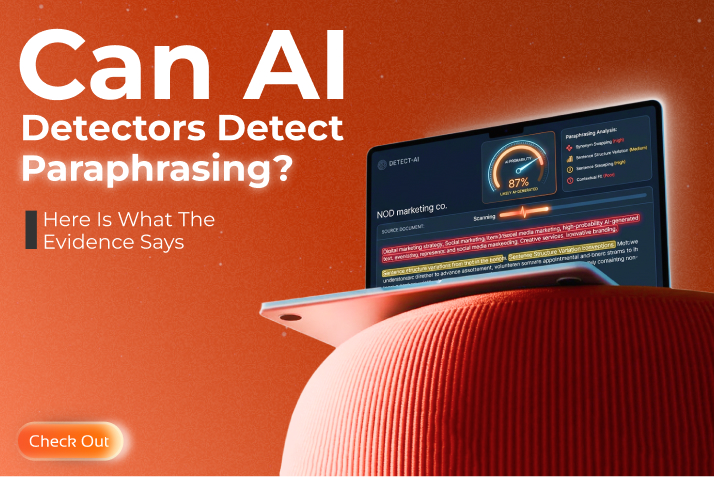
| Quick Answer: Yes, AI detectors can sometimes detect paraphrasing. However, there is no guarantee of success or consistency. In my practical experience, I have seen AI detectors such as Copyleaks catch some paraphrased text, especially when run through common rewriting tools. However, if you are doing heavy editing or paraphrasing on your own, the percentage of detection becomes lower. Again, the score an AI detector offers for a piece of writing is only a probability. It is never a guarantee of a piece of content being human-written or machine-written. As I have mentioned in my guide on AI detectors flagging my human-written article, there can also be False-Positive and False-Negative results. |
Key Takeaways On Can AI Detectors Detect Paraphrasing
- If you are doing light rewording or paraphrasing, the latest AI detectors such as Copyleaks, GPTZero, or ZeroGPT will still flag an AI-written piece.
- However, an AI detector may not flag deep human-style rewriting.
- Research shows that paraphrasing can sharply reduce the accuracy of older detectors.
- Turnitin added AI bypasser detection for English text in August 2025.
However, its Spanish and Japanese detectors do not include paraphrase or bypasser detection.
- Detectors also misfire on human writing. So, a flag should start a conversation, not end one.
How AI Detectors Judge Text
We know that AI detectors are different from plagiarism checkers.
So, AI detectors cannot compare your essay against any specific source or database.
AI detectors work on the principles of predictability/perplexity and burstiness.
Then, they furnish a result based on the likelihood of any content being machine-written.
Perplexity means how surprising the word choice is based on a language model.
Burstiness, on the other hand, describes how much sentence length and structure vary.
When an essay or article is machine-written, it is smoother and more predictable than human writing.
However, in many cases, we have to do formulaic writing, and some non-native writers may use simple vocabulary to write a piece.
The AI detection rate can also be higher in these cases.
These are examples of false-positive cases. Also, it raises a pertinent question.
Is vocabulary then more important or acceptable than authenticity?
Why Paraphrasing Changes The Signal
When we paraphrase a text, we usually change the vocabulary, reorder clauses, and make variations in the sentence length.
So, we are practically working on areas that AI detectors lean on.
Thus, we can evade the AI score.
So a heavily reworded passage can look far less machine-like even when the ideas are unchanged.
However, if you are using another AI model to do the rewriting and bypass AI, it can leave its footprint.
How Are Modern AI Detectors Responding To It?
Modern AI detectors are now getting updated on paraphrased output.
For example, instead of relying on rigid, word-level rules, Copyleaks trains its models to map the underlying semantic meaning and structural flow of text.
| “Content rewritten by Quillbot may be able to evade basic keyword models in AI detection platforms, but it can still be flagged by Copyleaks. Because Copyleaks reviews text for semantic similarity, analyzing meaning and not just wording, Copyleaks can detect AI paraphrasing, not simply word overlap.On top of that, the Copyleaks AI detection tool is able to find and flag AI in over 30 different languages.” |
Again, Turnitin introduced a new detector for AI bypassers on 27th August 2025.
| “The new bypasser detection capability is integrated seamlessly with Turnitin’s overall AI writing detection capabilities. When AI writing detection is enabled, educators can automatically check submissions for likely AI-generated content as well as content that may have been further modified by leading bypassers without the need for additional integrations or outside tools that could pose data or security risks.” |
Paraphrase And Bypasser Detection At Turnitin
According to a university library training deck, Turnitin’s report uses cyan for AI-generated text and purple for AI-generated text that was also paraphrased.
Turnitin’s own documentation states that paraphrase and bypasser detection exist for English submissions only.
| Text type | Turnitin (English) | Turnitin (Spanish, Japanese) |
|---|---|---|
| AI-generated text | Detection included | Detection included |
| AI-paraphrased text | Detection included | Not included |
| AI bypasser/humanizer text | Detection included | Not included |
Also Check: How To Use An Essay Checker To Maintain Authenticity In Your Writing
What Independent Research Found

Two widely cited studies tested detectors against paraphrased or otherwise altered AI text.
| Study | What was tested | Key finding |
|---|---|---|
| Krishna et al., NeurIPS 2023 | An 11B-parameter paraphraser (DIPPER) against GPTZero, DetectGPT, watermarking, and OpenAI’s classifier | DetectGPT accuracy fell from 70.3% to 4.6% at a constant 1% false-positive rate. |
| Weber-Wulff et al., 2023 | 14 detectors, including Turnitin and PlagiarismCheck, on ChatGPT text with paraphrasing and machine translation | Tools were unreliable, tended to label text as human, and performed worse on obfuscated text. |
A summary of the Weber-Wulff study adds that no tool scored above 80% accuracy and that accuracy dropped further once output was edited, paraphrased, or translated.
What These Studies Do And Do Not Prove
In both the studies I have mentioned, you can see that 2023-era detectors have been tested against 2022-23-era models.
So, despite the studies showing real weaknesses, we also have to consider the updates.
For example, Copyleaks can detect paraphrasing as “AI-generated text retains measurable statistical markers, even when it is reworded.”
It is true that the authors of the Weber-Wulff paper concluded that the tools are “neither accurate nor reliable,” and that wording is a useful reminder to read any score with caution.
Still, tools like Copyleaks use methods such as text normalization, contextual and semantic comparison, and model-level probability mapping.
However, even Copyleaks admits that the detection of paraphrasing may not be 100% accurate.
That is the dilemma we face every day as writers, editors, and educators.
We always have to leave some room for human judgment.
I was talking to Piyasa Mukhopadhay, a senior writer working in the niches of real estate, business, and lifestyle.
She shared her views on AI detectors flagging paraphrasing.
“AI detectors can easily spot basic rephrasing; however, they often struggle to catch high-quality rewriting.
In my 5+ years as a content writer, I have used various paid and free tools, and I have realized they only look for patterns to flag AI logic.
If you just use a paraphrasing tool to swap a few words with synonyms, detectors will still flag it as AI-written.
So, I believe the best approach is always to grasp the core idea and write it from scratch using your own creative ideas.”
Not All Paraphrasing Is The Same
The word “paraphrasing” covers very different behaviour, and detectors respond to each differently.
| Type of rewrite | What changes in the text | Typical detector reaction |
| Synonym swapping | Individual words replaced, structure unchanged. | Underlying patterns often remain, so flags are still common. |
| AI paraphrasing tool | Phrasing and sentence order rewritten by another model. | Newer detectors target this pattern, and older ones are easier to fool. |
| Humanizer/bypasser tool | Text altered specifically to resemble human writing. | Vendors such as Turnitin now run dedicated detection for English. |
| Genuine rewriting from understanding | Ideas restated in the writer’s own voice and structure. | Little machine signal remains, because it is effectively new writing. |
Now, as educators or writers, we all should aim for the type of rewrite mentioned in the last row.
Once a writer restates ideas from real understanding, the result is simply their own work, which is what academic integrity policies ask for in the first place.
Detectors Can Also Be Wrong About Human Writing
The Stanford study published in *Patterns* shows how seven detectors have wrongly assessed an average of 61.3% of TOEFL essays by non-native English writers.
However, the same tools have shown high accuracy in the assessment of eighth-grade US students.
The authors argued that the design of many detectors “inherently discriminates against non-native authors.”
That study did not test Turnitin specifically.
Also, the same paper found that prompting a model to use more varied language removed the bias against non-native writers.
It also helped AI-generated text slip past the detectors.
In other words, the signal detectors rely on predictable wording, which is shared by some human writers and is easy to change in machine text.
That is the core reason paraphrasing and false positives are two sides of one problem.
Turnitin publishes its own error figures. It reports a document-level false-positive rate under 1% when more than 20% of a document is flagged.
It also shows a sentence-level rate of about 4%, and an asterisk on scores below 20% because those are less reliable.
What Students And Educators Should Do
A detector score is most useful as the start of a conversation.
These steps keep that conversation fair and evidence-based for both sides.
For Students
- Follow your course’s AI policy and disclose any AI help.
- Save drafts and version history so you can show how the work developed.
- Use AI to understand and plan, then write in your own words.
For Educators
- Turnitin’s guidance says its score should not be the “sole basis for adverse actions against a student.”
- Pair any flag with drafts, a short conversation about the topic, and the course’s stated rules.
Can AI Detectors Detect Paraphrasing? Frequently Asked Questions (FAQs)
Here are the frequently asked questions and answers about AI detectors detecting paraphrasing.
Can Turnitin Detect Paraphrased AI Text?
Yes, Turnitin can now detect paraphrased AI text for English submissions in many cases.
After the August 2025 updates, Turnitin now has AI paraphrasing and bypasser detection.
Still, Turnitin is careful in its stance and mentions that results are likelihoods that should not stand alone as proof.
Does Using A Paraphrasing Tool Make Text Undetectable?
No, using a paraphrasing tool does not make text undetectable.
No paraphrasing tool can guarantee that.
Heavy human editing can impact the accuracy of AI detection tools.
However, with constant upgrades and training, tools such as Turnitin and Copyleaks can now detect paraphrasing.
No tool can guarantee that. Research shows paraphrasing can reduce detection, but vendors keep retraining their systems, and some now target paraphrased output directly.
Can AI Detectors Catch A Person Paraphrasing Another Person’s Work?
No, AI detectors cannot catch if a person is manually paraphrasing another person’s work.
Spotting reworded human sources is a similarity-checking job, not an AI-detection job.
Additional Resource: How Do AI Detectors Work? What They Measure, Their Limitations, And What 2026 Evidence Shows