AI Detector Vs. Plagiarism Checker: The Short Answer
A plagiarism checker works by comparing your text against the following sources or databases.
- Web Pages
- Journals
- Past Submissions.
Then, they highlight the passages that match.
An AI detector compares your writing’s statistical patterns with patterns typical of language models, then returns a probability.
Matching can be traced to a source, but prediction can’t.
That one difference explains most disagreements between the two tools.
Comparing AI Detector Vs. Plagiarism Checker
Here is a comparison table of how plagiarism checkers and AI detectors work.
| Feature | Plagiarism Checker | AI Detector |
|---|---|---|
| Core question | Does this text match existing sources? | Does this text look machine-generated? |
| Method | Database text matching | Statistical classification of writing patterns |
| Output | Similarity percentage with linked sources | Likelihood percentage of AI-written text |
| Evidence | Points to a specific source | No source to point to |
| Main risk | Flags correctly cited quotations | False positives on human writing |
| Catches fresh AI text? | Often not, because nothing was copied | Sometimes, with notable error rates |
How A Plagiarism Checker Works
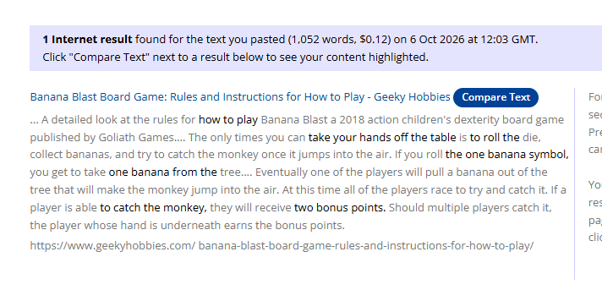
We all know that a plagiarism checker matches a piece of writing against billions of databases.
For example, I was checking an essay on Copyscape, and it offered me this plagiarism result.
Here is a detailed understanding of how it works.
What A Similarity Score Means
A similarity score means a percentage of matched text.
It is not a verdict, though.
For example, Turnitin clearly states,
“Turnitin does not check for plagiarism, nor does it define whether a paper has been plagiarized.”
It, in fact, flags text matches from external sources.
This helps educators decide whether the student has used proper citations or they have plagriarised or poorly paraphrased the source.
What Plagiarism Checkers Miss
Did you know that a text can have hidden text?
The writing can have characters or spaces invisible to human eyes but readable by a machine.
A plagiarism checker cannot read this hidden text.
Also, a plagiarism checker can only match your text against what is in the database.
It cannot match your writing with a commissioned essay or a passage an AI model has generated freshly.
How Does An AI Detector Work?
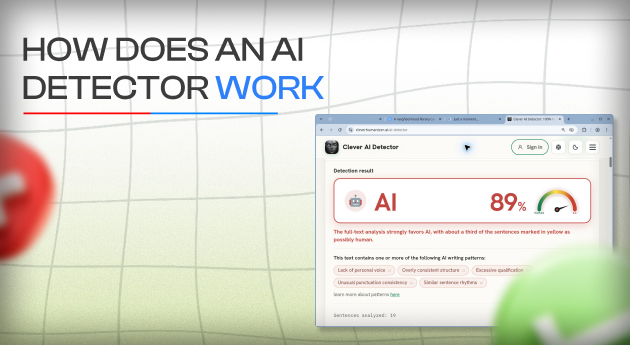
AI detectors are trained classifiers on human and AI writing.
Most detectors work on the core mathematics of perplexity, which measures how predictable the word choices are.
There is also the method of burstiness, which indicates the variations in sentence length.
A human-written text is less refined or uniform than a machine-written text.
So, when a human writes an essay, the variations in sentence length will be higher, and the word choices will be less predictable.
Still, once again, the scores by AI detectors are just a flag that your writing needs review.
OpenAI says,
“While it is impossible to reliably detect all AI-written text, we believe good classifiers can inform mitigations for false claims that AI-generated text was written by a human.”
Document-Level Vs. Sentence-Level Scores
Turnitin shows that the accuracy rate of an AI detector is different for sentence-wise scanning and document-wise scanning.
Annie Chechitelli, the Chief Product Officer of Turnitin, highlights this in the “Understanding the false positive rate for sentences of our AI writing detection capability” report.
She says that the document-level false positive rate of Turnitin is less than 1% for documents that have 20% or more AI text.
On the other hand, the sentence-level false positive percentage is 4%.
Moreover, according to the same report, 54% of false-positive sentences sit right beside genuine AI-written text.
Limits: Length And Editing
An AI detector suffers more in accuracy when the text is very short.
Also, while working with the free versions of AI detectors such as ZeroGPT, I have seen that it cannot assess more than 15,000 characters in one go.
Turnitin needs a submission of at least 300 words for AI detection.
Furthermore, if AI-generated content is heavily edited, the AI detection tool may fail.
A Hong Kong lecturer has explained how AI detectors can fail to score heavily edited texts correctly.
AI Detector Vs. Plagiarism Checker: How Reliable They Are
The reports plagiarism checkers offer are deterministic.
If your text matches an existing source, it will get flagged.
AI detection is probabilistic, and published error rates show why scores need human review.
| Measure | Finding | Source |
|---|---|---|
| Turnitin AI detection, document level | Under 1% false positives (documents with 20%+ AI text) | Turnitin |
| Turnitin AI detection, sentence level | About 4% false positives | Turnitin |
| OpenAI AI classifier | Caught 26% of AI text, mislabeled 9% of human text Withdrawn July 20, 2023 | OpenAI |
| Seven detectors on TOEFL essays | 61.22% of non-native writers’ essays flagged as AI | Stanford HAI |
| Same TOEFL test | 89 of 91 essays flagged by at least one detector |
Even if the Turnitin report looks small or negligible with a false positive rate of 1%, even a low rate adds up.
If we illustrate the false-positive rates in terms of mathematics, a review of 100,000 documents and a 1% false-positive rate means the flagging of 1000 honest students or writers.
Bias Against Non-Native English Writers
The same Stanford Report I have cited for the high false-positive cases of TOEFL essays shows an AI detection bias for non-native writers.
The simpler vocabulary of non-native writers and simple sentence patterns often “Look” predictable to AI detectors.
In this regard, the Business and Human Rights Centre quotes the product officer of Turnitin.
“Annie Chechitelli, chief product officer for Turnitin, said the company’s tool was trained on writing by English speakers in the U.S. and abroad as well as multilingual students, so shouldn’t have the bias Liang’s paper identified.”
Still, the problem of high AI detection for non-native writers remains.
When False Positives Reach Court
On January 28, 2026, a New York judge annulled Adelphi University’s finding against Orion Newby, whose essay Turnitin scored “100% AI.”
The ruling called the finding “without valid basis and devoid of reason,” and ordered his record expunged.
Here, you must note that the court questioned the process of the University and not the tool in general.
In a different scenario, Vanderbilt and the University of Cape Town have discontinued AI detection.
What Experts Say
Researchers and integrity specialists agree on a narrow point: a detector score is a lead, never proof.
| Expert | Position |
|---|---|
| James Zou, Stanford (senior author) | Advises avoiding reliance on detectors in education, especially with many non-native English speakers. |
| Jim Samuel, Rutgers | Says it is “difficult to say with a sufficiently high degree of certainty” that someone used AI, yet warns that ignoring AI misuse is counterproductive. |
| Jonathan Bailey, plagiarism specialist | Calls AI detectors “black boxes” to be used cautiously. |
| University of Melbourne integrity office | States a high AI score is not proof that misconduct occurred. |
A Worked Example (Hypothetical)
Suppose you are a student and you have written a 1,200-word essay on climate policy.
You have quoted three studies with citations and your classmate has proofread it.
The plagiarism checker returns 18% similarity, almost all from the quotations and reference list, which an instructor can clear in minutes.
The AI detector, however, highlights two tidy, formulaic paragraphs as likely AI-written.
Nothing in the similarity report explains that flag, because there is no source to compare against.
Drafts and version history become the only evidence that resolves it.
This scenario is illustrative, not a real case.
Which Tool Should You Use?
You cannot pick between a plagiarism checker and an AI detector.
The functions of both tools are different.
Here is a brief comparison of which tool is suitable for which purpose.
| Situation | Start with | Why |
| Checking citations and quotations | Plagiarism checker | Shows exactly which sources matched. |
| Suspected copying from web or peers | Plagiarism checker | Produces traceable, checkable evidence. |
| Suspected AI-generated draft | Drafts and a conversation; detector as a hint | A score alone is not evidence. |
| Second-language writer’s essay flagged | Human review first | Documented bias risk in detectors. |
For Students
Check similarity before submitting, and keep drafts, notes, and version history.
Authorship-tracking tools such as Grammarly Authorship or Turnitin Clarity can document how a paper was written.
Also, if you are using AI for essay writing or research, cite the AI usage ethically.
For a deeper dive, you can even check my guide on how to use AI for studying.
For Educators
Review matched sources in the similarity report, then talk with the student.
Where AI use is suspected, ask for early drafts and records, as some Hong Kong universities now do, rather than relying on a percentage.
For Writers And Editors
Run a plagiarism check before publishing.
Use an AI detector only as an informal gut-check, never as a quality or originality guarantee.
Latest Updates On The Effectiveness Of AI Detectors
- January 2026: the Adelphi ruling made false-positive risk a legal question as well as an academic one.
- May 2026: a Hong Kong report noted OpenAI had not released a replacement classifier, and described a nursing student who failed a course after an AI flag.
- July 2026: an editorial reported universities switching off AI-writing checks while keeping similarity checks.
Summing Up: AI Detector Vs. Plagiarism Checker
Plagiarism checkers find out the sources from which the text came.
On the other hand, an AI detector guesses how the content has been created.
However, plagiarism or similarity reports show evidence of a text being copied.
An AI detector suggests that your article may have been written by an AI or machine.
So, the output or result of an AI detector is more uncertain.