Quick Answer: What Is An AI Use Disclosure Statement?

An AI use disclosure statement is a short note that we use to tell readers the AI tools we have used, how we have used them, and how we have checked the results.

Disclosure is different from citation because the latter credits specific AI-generated content.
When you cite ChatGPT or AI, you mention “This passage came from a Model.”
On the other hand, a disclosure states that “Here is how I have used AI for this writing.”
The Georgian College “Generative AI Literacy” and many other university guides ask you to mention the disclosure in the introduction or methods section of a piece.
Also, some institutions ask you to mention the exact prompts and responses in an appendix.
| Element | Purpose | Where it Goes |
| Disclosure statement | States which tools you used and for which tasks | Introduction, methods, acknowledgments, or end note |
| Citation and reference | Credits specific AI output you quote or paraphrase | Body text and reference list |
| Appendix or transcript | Lets readers see exact prompts and responses | After the references. |
Why Do You Need An AI Disclosure Statement?
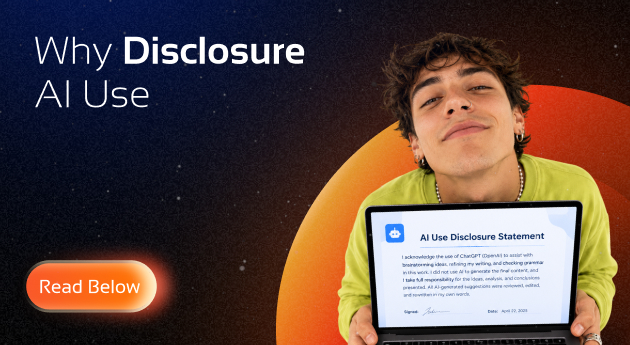
You have to furnish an AI disclosure statement if your journal policy asks you to do so.
Also, you have to confirm the requirement or policy for AI use in our paper.
Make sure that your organization allows the use of AI, and set aside the citation or disclosure.
If your institution does not allow the use of AI, disclosing it does not make it acceptable.
So, know how to use AI for studying or writing from your instructor.
In Coursework
Georgian College’s library in its Generative AI Literacy note says that if any assignment permits the use of AI, there should be proper acknowledgment.
Furthermore, the “APA – Referencing Guide” of Murdoch University mentions,
“If you use an AI tool in any way to help with your research or assignment, disclose how you used it in the introduction or method section.
This includes using AI for editing or grammar enhancement purposes.”
However, the Institute of Electrical and Electronics Engineers (IEEE) keeps the use of AI for editing and grammar enhancement outside the scope of AI disclosure.
It says,
“The use of content generated by artificial intelligence (AI) in an article (including but not limited to text, figures, images, and code) shall be disclosed in the acknowledgments section of any article submitted to an IEEE publication.”
In Journals And Publishing
If your journals are aligned with the International Committee of Medical Journal Editors (ICMJE), you will have to disclose the use of AI at submission.
You have to submit it in the manuscript and in the cover letter.
Along with ICMJE, the Committee on Publication Ethics (COPE) also agrees that you cannot list AI as an author.
What Does An AI Use Disclosure Statement Have? Know The Five Elements
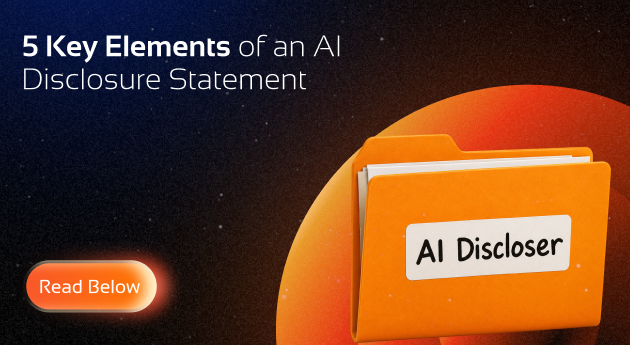
An AI use disclosure statement usually has five elements.
Also, you have to name the tool you have used and describe the purpose of the use,
“I acknowledge the use of (tool) to (purpose).”
| Element | What to Write | Example |
| Tool | Name, version, and developer | ChatGPT, OpenAI |
| Purpose | The exact task AI performed | Brainstorming, outlining, grammar edits |
| Timing | When you used it | September 2026, second draft |
| Evidence | Prompts and output, where required | Appendix A |
| Responsibility | How you verified and revised | Checked facts against sources |
Furthermore, APA-based guides advise including the prompt used.
Chicago-style guidance suggests placing non-shareable chats in an appendix.
AI Disclosure Statement Templates
Here, I have drafted templates, and these follow the common “tool, purpose, and responsibility” pattern.
Here, you can replace the words in the brackets with actual actions.
For Student Essays
AI Use Statement:
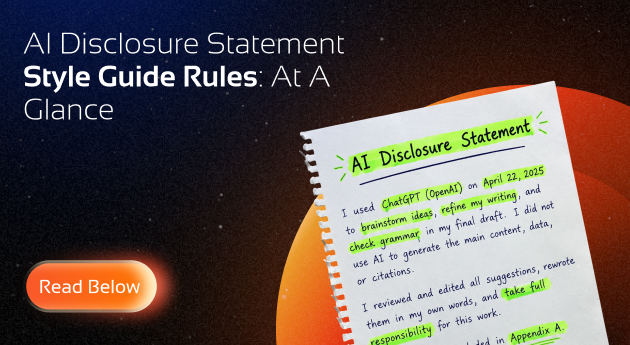
“I used [tool name and version] on [date] to brainstorm angles and check grammar in my second draft.
I did not use AI to write, paraphrase, or generate text, data, or citations.
Also, I reviewed every suggestion, rewrote it in my own words, and I take full responsibility for this work.
My prompts appear in Appendix A.”
For Research Papers And Journals
You need to furnish a generative AI disclosure for the submission of research papers and journals.
“The authors used [tool, version, developer] in [month, year] for language editing of the Discussion section.
No AI tool was used to generate results, analyse data, or create references.
The authors reviewed and edited all output and take full responsibility for the content.”
If You Have Used No AI
If you have used no AI for writing, you can add a statement,
“No generative AI tools were used in researching, drafting, or editing this work.”
Weak Vs. Strong Statements (Hypothetical Example)
Suppose you are a student and you have used an AI chatbot to outline an essay and fix grammar.
If you just write, “I used AI to write this essay,” it will be a weak statement, as it says nothing about how you have used the AI.
Here is a comparison of weak and strong comments.
| Version | Statement | Why It Works or Fails |
| Weak | “I used AI to help with this essay.” | No tool, task, timing, or verification. |
| Strong | “I used [tool] in October 2026 to outline my argument and correct grammar. I wrote all text myself, checked every claim against my sources, and saved my prompts in Appendix A.” | Names the tool, limits the scope, and shows accountability. |
If I am a reader, I can verify the strong statement you have made against your appendix and drafts.
AI Disclosure Statement Style Guide Rules: At A Glance
The guidance related to AI use disclosure statements is still evolving in different styles.
| Style | Disclosure Expectation |
| APA | • Disclose in the introduction or methods. • Include the prompt. • Place long responses in an appendix. |
| MLA | Cite AI when you paraphrase, quote, or incorporate its content, and acknowledge functional uses in the text or elsewhere. |
| Chicago | • Skip the reference-list entry unless a public URL exists. • Put non-shareable chats in an appendix. |
| IEEE | • Identify the AI system, the sections affected, and the level of use. • Routine editing is generally exempt. |
Does Disclosing Hurt You? The Data
AI use is now routine, which makes disclosure a practical question rather than a rare confession.
Yet research shows honesty carries a social cost.
| Measure | Finding | Source |
| Students using any AI tool (2025) | 92%, up from 66% in 2024 | HEPI |
| Students using generative AI for assessments | 88%, up from 53% | |
| Students saying their institution has a clear AI policy | 80% | |
| Trust after AI disclosure | Fell in 13 experiments with 5,000+ participants | University of Arizona |
The Transparency Dilemma
Researchers Oliver Schilke and Martin Reimann found that people who disclose AI use are trusted less, whether disclosure is voluntary or mandatory.
But Schilke notes trust drops even further if someone else exposes the use, for example through an AI detector.
The authors suggest an enforced, universal disclosure policy could soften the penalty.
For students, the safer path is still to disclose: the penalty for being found out is larger.
What Experts Say
| Source | Position |
|---|---|
| ICMJE and COPE | AI cannot be an author.Humans remain accountable and must disclose use. |
| Schilke and Reimann, University of Arizona | Disclosure lowers trust, but exposure lowers it more. |
| HEPI | Policies should treat student AI use as inevitable and often beneficial, not mainly punitive. |
| Skyline College library | Advises students to err on the side of transparency. |
Common Mistakes To Avoid
- Being vague. “AI was used” says nothing; name the tool and the task.
- Naming AI as an author. Publishers reject this outright.
- Skipping minor uses. Grammar help can still count under some policies.
- Losing your prompts. Output changes over time, so save the text as an appendix.
- Assuming one rule fits all. Course, journal, and style-guide rules differ.
Latest Updates On Writing An AI Use Disclosure Statement
- 2026: ICMJE’s guidance now includes a dedicated “Use of AI by Authors” page, cited by journals in their policies.
- 2025: The Schilke and Reimann trust study appeared in Organizational Behavior and Human Decision Processes.
- February 2025: HEPI reported near-universal student AI use, 92% of undergraduates.
AI Disclosure Use Statement: Frequently Asked Questions (FAQs):
Here are the frequently asked questions and answers about the AI disclosure use statement.
Do I Need A Statement If I Only Used A Grammar Checker?
You have to check the policy of your organization to know whether you need a disclosure statement or not for using AI as a grammar checker.
For example, institutions like Georgian College ask you to disclose the use of AI even if you are using it for grammar checks.
On the other hand, IEEE does not ask you to disclose an AI statement if you are using it for AI usage.
Is A Disclosure Statement The Same As A Citation?
No, an AI use disclosure statement is not the same as a citation.
A disclosure describes your overall AI use, while a citation credits specific output you quote or paraphrase. Most work needs both when AI content appears.
Where Should The Statement Go?
The disclosure should usually go in the introduction, methods, acknowledgments, or a note at the end.
Check with your style guide and institution to know where you need to mention the disclosure specifically.
Will A Disclosure Statement Stop An AI Detector From Flagging My Work?
No, a disclosure statement will not stop an AI detector from flagging your work.
AI detectors cannot read your statement and score your text based on that.
So, you have to maintain the version history and draft.
Writing An AI Disclosure Statement Takes Minutes, But It Is Important
Write a specific statement, including tool, purpose, verification, and, where required, an appendix.
Check the policy first, disclose honestly, and keep your drafts.
Before submitting, run four checks: does the statement name the tool, state the task, describe how you verified the output, and sit where your instructor or journal expects it?
If any answer is no, revise it. Writing a disclosure takes minutes, while undisclosed use that surfaces later can cost far more, as the trust research above shows.