AI has wormed its way into pretty much every corner of academic writing at this point. Students lean on it, professionals lean on it — but two very different kinds of tools have popped up out of that shift, and people keep lumping them together even though they’re not really doing the same job.
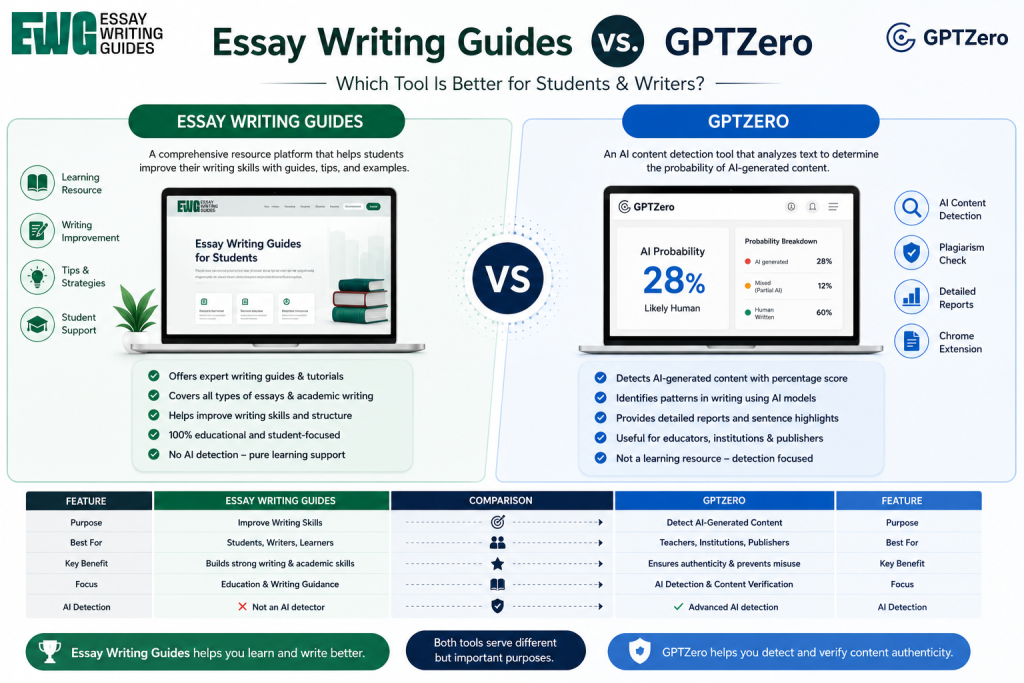
On one side you’ve got essay writing guides. These are meant to make you a better writer over time — structure, technique, formatting, research, the whole toolkit. On the other side there’s GPTZero, which doesn’t care about making you a better writer at all. It just looks at a chunk of text and tries to guess: did a person write this, or did a machine?
I get why people compare them. Both end up touching the writing process somewhere along the line. But once you dig in, it’s pretty clear they’re built for different jobs entirely.
Essay Writing Guides, Explained
These are your standard educational resources — blogs, courses, dedicated writing platforms, sometimes just a really good page buried on a university website. The good ones tend to cover a similar set of ground:
- Essay structure
- Building a solid thesis statement
- Writing introductions and conclusions that don’t feel bolted on
- Research techniques
- Citation styles — APA, MLA, Chicago, Harvard, take your pick
- Grammar
- Editing strategies
- Critical thinking, believe it or not
Here’s the thing that separates them from a detector like GPTZero: a writing guide isn’t judging anything you’ve already written. It’s trying to get you to a point where you don’t need judging in the first place.
Students get the most out of these, obviously, but researchers, bloggers, and ESL learners tend to find them just as useful.
And GPTZero?
GPTZero exists to answer one question: does this text look like it came from a model — ChatGPT, Claude, Gemini, whatever — or from an actual human?
It’s not trying to help you write better. It’s running the text through a handful of statistical checks — perplexity, burstiness, how much sentence lengths vary, general consistency across the piece — and spitting out a probability. Teachers use it. So do universities, publishers, recruiters, editors. Anyone who needs a quick gut-check on whether something was AI-assisted.
Side-by-Side
| Feature | Essay Writing Guides | GPTZero |
|---|---|---|
| Primary purpose | Teach essay writing | Detect AI-generated content |
| Improves writing skills | Yes | No |
| AI detection | No | Yes |
| Grammar guidance | Yes | Limited |
| Citation help | Yes | No |
| Essay structure support | Yes | No |
| Educational value | Excellent | Moderate |
| Content evaluation | Limited | Excellent |
On Accuracy
Honestly, “accuracy” doesn’t really apply to writing guides in the way people usually mean it. They’re not detecting anything, so there’s nothing to score. What actually matters is whether the guide is any good — is the advice current, are the examples useful, does it reflect how essays are actually graded these days. A well-written guide can genuinely cut down on the mistakes students make over and over.
GPTZero is a different story. It does a decent job overall, but it’s far from perfect, and I’d be cautious about treating it as gospel. A few places it tends to stumble:
False positives crop up on writing that’s just unusually polished — sometimes a strong human writer gets flagged simply for being good. False negatives happen too, especially with AI text that’s been edited afterward by a person. Mixed content, part human and part AI, tends to confuse it. And accuracy shifts noticeably depending on the language and style of the writing being checked.
This isn’t really a knock on GPTZero specifically — every AI detector on the market has some version of this problem. My take: use it as one data point, not a verdict.
Weighing the Pros and Cons
Essay writing guides give you something that sticks — skills you keep using long after you close the tab. They help you organize your thinking, reinforce good academic habits, and work whether you’re just starting out or already pretty advanced. The downside? They take actual time and effort. Nobody hands you a finished essay. And quality really does vary a lot depending on where you’re getting your guide from — some sites are genuinely great, others are recycled fluff.
GPTZero is fast. You paste text, you get a probability score, done. Educators find it genuinely useful, and the detailed breakdowns help when you need to make a case one way or another. But it’s not without problems — false positives happen, it can’t offer any real guarantee, it does zero for your actual writing ability, and it gets shakier the more a piece of AI text has been edited by hand afterward. Oh, and the good stuff is usually behind a subscription.
Which Should You Actually Use?
Depends entirely on what you’re trying to do.
If you want to get better at writing — really improve, not just get through one assignment — go with a solid essay writing guide. Same goes if you’re still learning the fundamentals, struggling to organize your ideas, or want to tighten up your research and citation game.
If you need to check whether a piece of text looks AI-generated, that’s GPTZero’s lane. Educators reviewing student work, editors screening submissions, anyone who wants an extra signal before hitting publish — that’s exactly what it’s for.
Most people I’d guess don’t actually need to pick one. They work fine together.
My Ratings
| Category | Essay Writing Guides | GPTZero |
|---|---|---|
| Ease of Use | 5/5 | 5/5 |
| Educational Value | 5/5 | 3/5 |
| Writing Improvement | 5/5 | 2/5 |
| AI Detection | 1/5 | 4/5 |
| Reliability | 5/5 | 4/5 |
| Overall | 4.9/5 | 4.2/5 |
Where I Land
Comparing these two head-to-head has always felt a little off to me — it’s like comparing a tutor to a metal detector. They’re solving completely different problems. Writing guides build something durable: real skill, structure, argumentation, a sense of academic integrity that carries into everything you write afterward. GPTZero answers one narrow question and answers it reasonably well: does this look AI-generated?
If you actually want to become a better writer, a good guide will get you there faster and the benefit keeps paying off. If you just need to know whether something looks machine-written, GPTZero does the job — just don’t treat the number it spits out as the final word. Pair it with your own judgment.
Honestly, the best approach is probably both: use solid writing guidance to produce original work you’re proud of, and pull in something like GPTZero when you need a second opinion as part of a bigger review.