Of all the academic writing you get stuck doing, the narrative essay’s probably the one that doesn’t feel like a chore. You get to tell an actual story, usually your own, and let your voice and whatever you were feeling at the time carry it. Compare that to an argumentative essay, which lives or dies on evidence and structure — not feeling, really, at all.
If you searched “how to write a narrative essay step by step” and landed here, this is meant to walk you through the whole thing. Picking a topic, shaping the story, cleaning up the draft at the end — all of it.
Doesn’t matter if you’re in high school, in college, or just trying to get better at writing on your own time. The stuff below should help you put together something that actually holds a reader’s attention start to finish, not just fills space.
Okay, So What Even Is a Narrative Essay?
At the core it’s just a story. Could be yours, could be something you watched happen to someone else, or — depending what the assignment allows — something you made up entirely.
What separates it from a research paper or a persuasive essay is that storytelling is the whole point here. You’ve got characters, a setting, some kind of conflict, real emotion, maybe dialogue if it fits, and events that unfold in an order that actually makes sense to follow.
The goal isn’t reporting what happened, not really. It’s putting the reader inside it — getting them to feel it alongside you instead of just reading about it after the fact.
What Makes One of These Actually Good?
A few things tend to show up in the ones that work:
- a clear beginning, middle, end
- one theme tying the whole thing together
- a voice that actually sounds like a person
- vivid, sensory description
- dialogue that sounds real, if you’re using it at all
- events told in an order that makes sense
- some kind of reflection on what it actually meant afterward
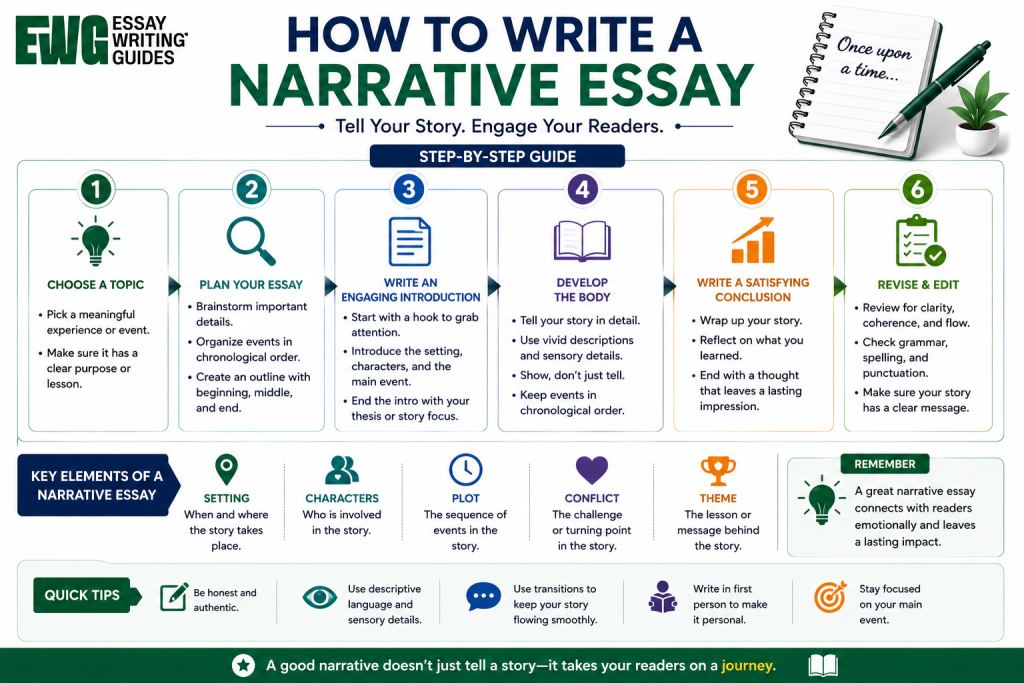
Breaking It Down, Piece by Piece
Way less overwhelming this way, trust me.
Start by actually reading the prompt — not skimming it. Is this supposed to be personal? Is there a word count you’re stuck working inside of? Does it need to teach some kind of lesson by the end? Any formatting rules buried in there you’d miss otherwise? Getting this clear early saves you from writing three paragraphs in a direction you’ll just delete later.
Then pick a topic that actually means something to you. The narrative essays that land tend to circle around moments that changed something — taught a lesson, shifted how you saw things, left a mark that stuck around after.
A few directions, if you’re stuck:
- my first day at college
- the biggest mistake I ever made
- a trip that changed my perspective
- overcoming my biggest fear
- a memorable family tradition
- the day I learned something important
- meeting someone who actually inspired me
- my proudest achievement
- an unforgettable teacher
- a hard decision I had to make
Whatever you land on, just make sure it’s something where you can actually talk about emotion and change — not a list of things that happened in order with nothing underneath.
Brainstorm before touching the actual essay. Give yourself a few minutes just to think. What happened, exactly? Who was there? Where’d it take place? What was the real conflict at the center of it, not just the surface one? How’d you feel, in the moment and after? What shifted once it was over? What’d you actually walk away with?
Write all of it down first, messy, unsorted. You can figure out what’s worth keeping once it’s all on the page.
Build an outline. Easy step to skip, and it always shows when you do. Something roughly like — intro with a hook, some background, a thesis. Then body paragraphs covering the start of the event, rising action, the conflict, the climax, resolution. Then a conclusion — reflection, the lesson, one final thought to leave people with. Having this mapped before you draft makes the actual writing go so much smoother, genuinely.
Getting the Opening Right
Your first line has one job — make someone want to keep reading. A surprising statement works. So does a question, a vivid image, a bit of dialogue dropped in with no context yet, or just an interesting memory.
Something like: “I never imagined that missing one school bus would completely change my life.”
That line does its job. You want to know what happens next. After a hook like that, drop in a little background before easing into the real story.
Keep the Story Moving in Order
Don’t jump around. Let people follow it the way it actually happened — what came first, what came next, what problem showed up, how it got solved eventually. Chronological order isn’t just easier to write, it’s easier to follow, and that matters more than people usually give it credit for.
Description Is Where the Story Actually Lives
The essays people remember make you feel like you’re standing inside the scene, not reading a summary of it.
I was scared — versus — my hands trembled, my heartbeat echoed in my ears, and every step felt heavier than the last.
One’s a fact. The other puts you there. Think about what a reader could see, hear, smell, taste, physically feel in that exact moment. That’s where the actual detail lives, not in adjectives stacked on top of each other.
Show It, Don’t Just Announce It
Probably the single most common mistake in this kind of writing — flatly stating a feeling instead of letting the reader arrive at it themselves.
Instead of I was nervous, something like: I kept checking my notes, wiped my sweaty palms against my jeans, avoided eye contact with everyone in the room.
That version does the emotional work without saying the word “nervous” once. The reader feels it instead of just being told.
Dialogue, But Sparingly
A real line of dialogue can make a scene feel alive in a way narration alone just can’t manage.
“You’ll do great,” my mother whispered before I walked onto the stage.
Don’t overdo it though. Every line needs to be earning its spot — moving things forward, not just filling space because dialogue “feels” more engaging.
Don’t Skip the Emotional Part
People remember how a story made them feel a lot longer than they remember the actual facts of it. Explain what you were thinking in the moment, how you reacted, why it mattered, how it changed you afterward. That reflection is honestly what separates a memorable essay from a list of things that happened to someone once.
Stick the Landing
Don’t just stop the second the main event’s over. Take a beat — explain what you learned, how you changed, why it still matters to you now, today, not just back then.
Something like: “Looking back, I realize that failure wasn’t the end — it became the beginning of my confidence and determination.”
A reflective ending like that gives people something to actually sit with after they finish reading.
The Basic Shape
| Section | What It’s Doing |
|---|---|
| Introduction | Hooks the reader, introduces the story |
| Body Paragraph 1 | Sets the scene, introduces characters |
| Body Paragraph 2 | Lays out the conflict |
| Body Paragraph 3 | Climax and resolution |
| Conclusion | Reflection, lesson learned |
One Example Outline
Topic: the day I overcame my fear of public speaking
- intro — hook, background, thesis
- body 1 — preparing for the speech
- body 2 — the nerves setting in
- body 3 — actually delivering it
- body 4 — how people reacted
- conclusion — the confidence gained, what I took from it
Mistakes That Quietly Wreck a Good Essay
Students lose points on stuff that’s easy to fix once you know to watch for it:
- picking a story with no real lesson underneath
- piling in details that don’t actually matter to the story
- jumping around instead of staying chronological
- staying too surface-level, not describing enough
- leaning too hard on dialogue
- a flat opening nobody remembers
- an ending that just stops instead of landing
- sloppy grammar dragging the whole thing down
- skipping reflection entirely, just ending on the event itself
A Few Things Worth Keeping in Mind
- pick a story that genuinely matters to you — it shows either way
- write first person if the assignment lets you
- go specific and vivid instead of vague
- keep tone and tense consistent the whole way through
- build a little suspense, reveal things gradually instead of dumping it all upfront
- stay focused on one central event, don’t try to cram in three
- revise — clarity and flow basically always need a second pass
What a Good Opening Actually Sounds Like
“The rain poured so heavily that I could barely see the road ahead. My backpack was soaked, my shoes were covered in mud, and I was convinced the day couldn’t get any worse. I had no idea that what happened next would become one of the most important lessons of my life.”
Does three things at once — sets the scene, builds curiosity, pulls you forward without giving anything away yet.
A Quick Checklist Before You Submit
- does the intro actually grab attention?
- is the story easy to follow start to finish?
- enough descriptive detail in there?
- did you show emotion instead of just naming it?
- does every paragraph support the main story?
- clear lesson or takeaway by the end?
- grammar and spelling cleaned up?
- does the conclusion actually land, or just stop?
A few minutes reviewing at this stage matters more than people expect.
A Few Questions People Actually Ask
What’s the first step?
Understanding the assignment, picking a topic with a real story and purpose behind it.
How long should it be?
Depends on the assignment, but most school and college narrative essays land somewhere around 500 to 1,500 words.
Can it be fictional?
Sometimes — plenty are based on real experience, but some assignments allow fiction as long as it still follows a clear narrative structure.
Should I write in first person?
If it’s personal, yes — “I,” “me,” “my” is usually encouraged, not discouraged.
What actually makes one engaging?
Strong storytelling, vivid detail, real emotional depth, dialogue that sounds natural, a lesson that actually means something.
Final Thoughts
Learning how to write a narrative essay step by step isn’t really about following a formula — it’s about telling something that actually resonates with whoever reads it. Pick a topic that means something, get your thinking organized before you write, lean into vivid detail, and actually reflect on why it mattered. Do that, and an ordinary memory turns into something people remember.
The best narrative essays don’t just report what happened. They let you see it, hear it, feel it — and understand why it mattered in the first place. Plan a little, write carefully, revise for real at the end, and you’ll end up with something that actually sticks with people.