AI has completely changed how people write. Essays, research papers, blog posts, marketing copy — a growing share of it now starts with a prompt rather than a blank page. And as AI-generated content becomes more common, schools, publishers, and businesses are all asking the same question: how do we verify that something is actually original?
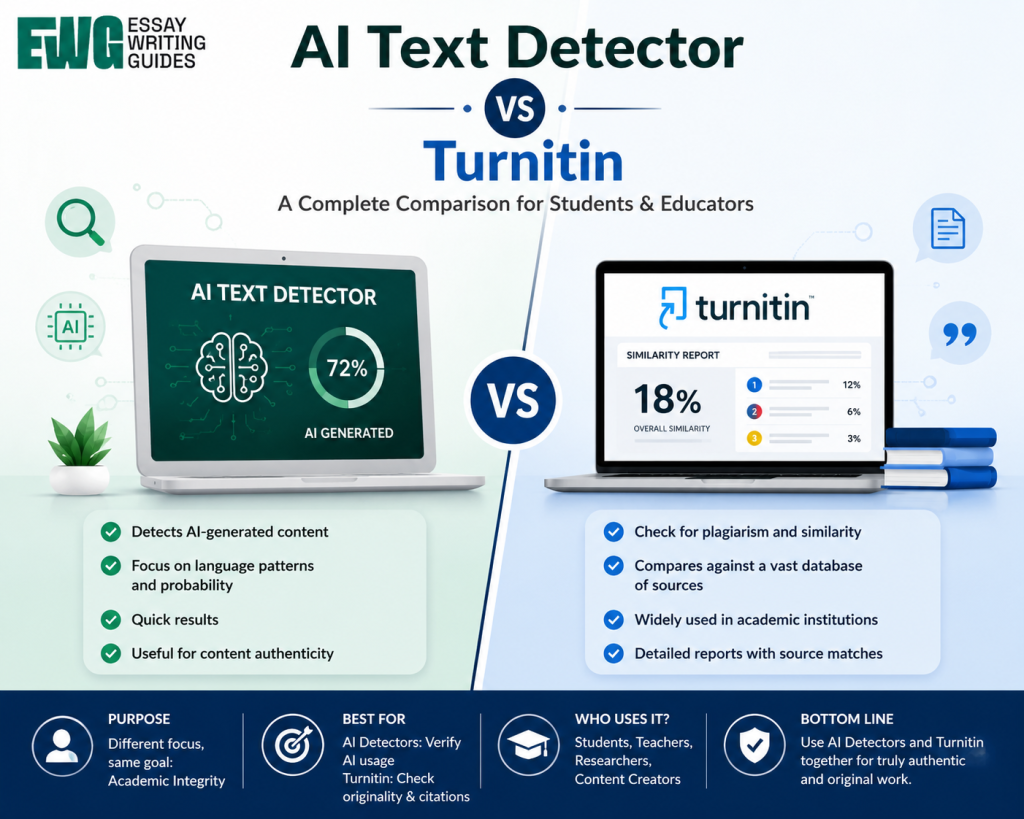
Two names keep coming up in that conversation: AI Text Detector and Turnitin. They’re often mentioned in the same breath, but they’re not really built for the same job. AI Text Detector is laser-focused on spotting AI-written content. Turnitin, on the other hand, is a full academic integrity platform — plagiarism checking and AI detection rolled into one.
So which one actually fits your needs? Let’s break down how they stack up on features, accuracy, ease of use, pricing, and everything in between.
What Is an AI Text Detector?
An AI Text Detector is exactly what it sounds like: a tool that scans a piece of writing and estimates whether a person or a machine wrote it. There’s no shortage of options in this space — Originality.ai, GPTZero, Copyleaks, and ZeroGPT all fall into this category.
Under the hood, these tools are looking at patterns: sentence structure, word predictability, and other subtle language cues that tend to give AI writing away.
Key features:
- Flags AI-generated content
- Estimates how much of a piece was AI-written
- Highlights the specific sections it suspects
- Works across multiple file formats
- Quick, straightforward interface
Who it’s built for: content creators, SEO agencies, publishers, freelancers, and any business that needs a fast read on AI-assisted writing.
What Is Turnitin?
Turnitin needs less introduction — it’s been the go-to academic integrity tool for universities and colleges for years, mostly known for catching plagiarism. More recently, it’s added AI writing detection to that toolkit, giving educators a way to flag content that might have come from an AI model.
The big difference between Turnitin and a standalone detector is scale. Turnitin isn’t just analyzing writing patterns — it’s checking submitted work against a massive archive of academic papers, journals, websites, books, and past student submissions.
Key features:
- Industry-leading plagiarism detection
- Built-in AI writing detection
- Detailed similarity reports
- Citation and referencing checks
- Integrates with Canvas, Moodle, Blackboard, and other LMS platforms
- Feedback and grading tools for instructors
Who it’s built for: universities, colleges, schools, researchers — essentially, anyone operating inside an academic institution.
Head-to-Head Comparison
| Feature | AI Text Detector | Turnitin |
|---|---|---|
| Primary purpose | Detect AI-generated content | Detect plagiarism and AI-generated writing |
| Plagiarism detection | Limited or unavailable (varies by provider) | Excellent |
| AI detection | Excellent | Very good |
| Academic database | No | Extensive |
| Similarity reports | Usually unavailable | Comprehensive |
| Student paper database | No | Yes |
| Citation checking | Limited | Advanced |
| Integrations | Minimal | Extensive LMS support |
| Ease of use | Very easy | Moderate |
| Target users | Writers, marketers, publishers | Educational institutions |
| Pricing | Often affordable or subscription-based | Institutional licensing (higher cost) |
Digging Into the Details
AI Detection Accuracy
AI Text Detectors were built for one job, and they tend to do it well — most give you a clear AI-probability score, though results can shift depending on the specific tool and the writing style being analyzed.
Turnitin’s AI detection is tuned for academic writing, and it holds up reasonably well. That said, Turnitin itself is upfront that its AI detection is meant to support an educator’s judgment, not replace it.
Edge: AI Text Detector, when it comes to AI detection specifically.
Plagiarism Detection
This one isn’t close. Turnitin’s massive academic database and similarity-report system make it the industry standard for catching plagiarism — nothing else really competes at that scale.
Most standalone AI detectors either skip plagiarism checking entirely or offer a fairly thin version of it.
Edge: Turnitin, no contest.
Ease of Use
Paste your text, hit submit, get a result in seconds — that’s the typical AI Text Detector experience, and it’s about as low-friction as it gets.
Turnitin is a different animal. It’s built around institutional access and assignment workflows, which makes sense for its purpose but adds real complexity for anyone trying to use it as an individual.
Edge: AI Text Detector.
Database Coverage
Turnitin’s reach is hard to overstate — billions of web pages, scholarly journals, books, and millions of previously submitted student papers, all searchable in one system.
AI Text Detectors take a different approach entirely, relying on statistical analysis of the text itself rather than cross-referencing it against a giant database.
Edge: Turnitin.
Who’s It Actually For?
AI Text Detectors cast a wide net — content creators, digital marketers, editors, and businesses of all kinds use them.
Turnitin stays in its lane: education and research.
Edge: Depends entirely on what you need it for.
Pros and Cons
AI Text Detector
What works well:
- Fast turnaround
- Simple to use, no learning curve
- Purpose-built for AI detection
- Budget-friendly for individuals
- A solid fit for SEO and content marketing work
- No academic account needed
Where it falls short:
- Accuracy isn’t consistent across every provider
- False positives and false negatives do happen
- Plagiarism detection is limited at best
- Comparison databases are smaller
- Not really designed for academic integrity work
Turnitin
What works well:
- Best-in-class plagiarism detection
- An enormous academic database behind it
- Trusted by universities around the world
- AI detection built right into existing academic workflows
- Detailed similarity reports
- Strong LMS integration
Where it falls short:
- Pricey for individual use
- Mostly accessible only through an institution
- AI detection results aren’t always conclusive
- Steeper learning curve for new users
- Limited reach outside of education
So, Which One Should You Use?
Go with an AI Text Detector if you:
- Need a quick check on whether content is AI-generated
- Work in blogging or content marketing
- Want something simple and affordable
- Review AI-assisted writing on a regular basis
Go with Turnitin if you:
- Have institutional access as an educator or student
- Need dependable plagiarism detection
- Require academic integrity tools as part of your workflow
- Want detailed similarity reports alongside AI detection
A Quick Rating Breakdown
(Editorial note: these ratings reflect a general assessment and can vary depending on the specific AI detector you’re comparing against.)
| Category | AI Text Detector | Turnitin |
|---|---|---|
| AI Detection | 4.5/5 | 4.3/5 |
| Plagiarism Detection | 2.5/5* | 5/5 |
| Ease of Use | 4.8/5 | 4.0/5 |
| Value for Money | 4.4/5 | 3.9/5 |
| Academic Use | 3.5/5 | 5/5 |
| Overall | 4.3/5 | 4.7/5 |
*Plagiarism detection scores vary significantly depending on which AI text detector you’re using — some offer more than others.
The Bottom Line
Neither of these tools is trying to be everything to everyone, and that’s really the point. AI Text Detectors are quick, affordable, and genuinely good at spotting AI-generated writing — a natural fit for writers, publishers, and businesses that deal with AI-assisted content on a regular basis.
Turnitin plays a different game entirely. Its plagiarism detection is still the gold standard in education, and layering AI detection on top of that only strengthens its case for schools and universities. Yes, it costs more and requires institutional access, but for academic use, that trade-off is easy to justify.
At the end of the day, it comes down to what you’re actually trying to solve. Need a fast, no-frills way to flag AI content for professional work? An AI Text Detector will serve you well. Need comprehensive plagiarism checking baked into an academic workflow? Turnitin is still the stronger choice.