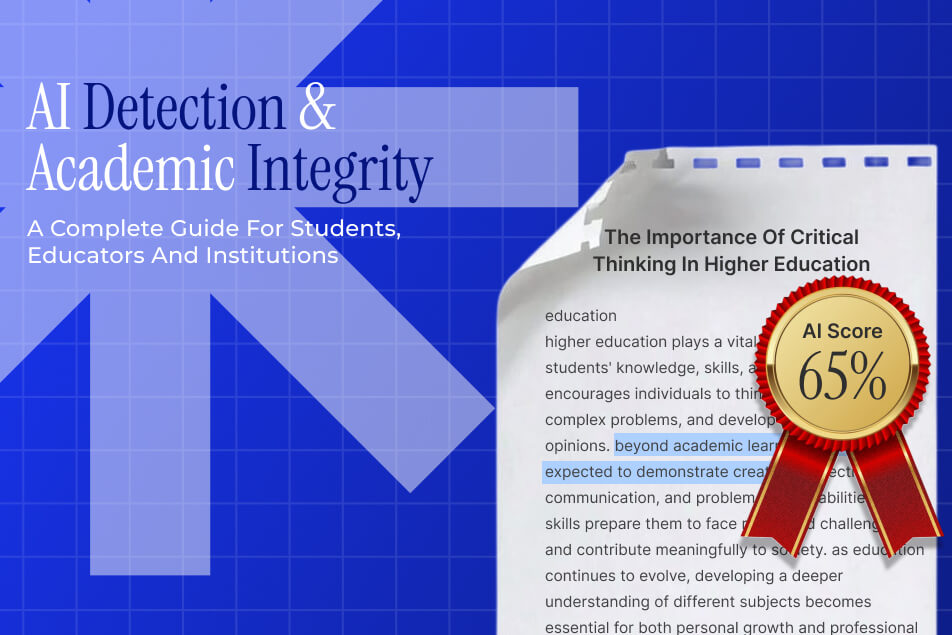
| Quick Answer: AI detection is a signal that an essay or a piece of writing needs review. It is not the final proof that the author has used AI in it. AI detectors work by estimating how predictable, formulaic, or simplistic a text looks. They also check the variations in sentence structure and sentence length. There are even inconsistencies and false-positive cases questioning the submission of honest students. Turnitin cites around a 4% false-positive rate at the sentence level, and a 2023 Stanford study found 61.3% of non-native English essays flagged by testing seven AI detectors. Also, AI detectors have limitations in detecting paraphrasing. So, if you have used AI according to the syllabus policy and have a draft, do not worry. Your academic integrity is not defined by the score of an AI detection tool. |
Academic integrity is much bigger than educators looking for catching students violating the AI policy.
The International Center for Academic Integrity (ICAI) frames academic integrity around six values.
- Honesty
- Trust
- Fairness
- Respect
- Responsibility
- Courage.
Also, as of 2026, the most defensible policy to prove academic integrity is a combination of four things.
It needs a clear AI policy, a visible writing process, assessments designed with AI in mind, and human review.
So, the score of an AI detector alone should not determine the fairness of a student.
Also, the question of how to use ChatGPT without getting flagged should be changed into how to grow healthy AI habits for studying.
What Does Academic Integrity Mean In The Age Of AI?
ICAI first published its Fundamental Values in 1999 with five values and added courage in a later edition.
The framework of academic integrity applies to students and staff alike, and generative AI makes adhering to each of these values more challenging.
| Value | What it Asks of Students | What it Asks of Institutions |
|---|---|---|
| Honesty | Be truthful about your work and any AI help. | Do not present a probability score as proof. |
| Trust | Prepare work that is genuine. | State AI expectations clearly and follow through. |
| Fairness | Follow the same rules as everyone else. | Apply policies equally, including to non-native writers. |
| Respect | Credit others’ ideas and meet your commitments. | Listen to students and explain decisions. |
| Responsibility | Own your choices, including AI use. | Publish assessment-specific rules. |
| Courage | Act with integrity even when it is costly. | Review policies honestly, even when it is uncomfortable. |
Why Does AI Detection Raise Academic Integrity Questions Of Its Own?
An open textbook from eCampusOntario explains the six values of academic integrity with respect to the “issues of generative AI in education.”
It argues that detection tools do not provide the true evidence of misconduct and it cannot assess every student’s work equitably.
As a result, it already challenges the values of honesty and fairness.
Also, the same text mentions that ignoring the use of generative AI is a failure to maintain academic integrity.
It says,
“Ignoring generative AI and continuing on as usual may seem like the easiest option for instructors.
However, doing so fails to address several fundamental values of Academic Integrity: trust, fairness, responsibility, and courage.”
So, there should be a clear AI policy and clear expectations set for students.
If the scores of the AI detectors look alarming, as an educator, you must initiate a conversation and check the drafts before concluding.
How AI Detection Works, And Where It Fails
An AI text detector does not search a database of sources.
Turnitin’s AIW-1 model, launched in April 2023, scores each sentence from 0 to 1 and combines the scores into a document percentage.
The approach rests on patterns such as predictable word choice and uniform sentence structure.
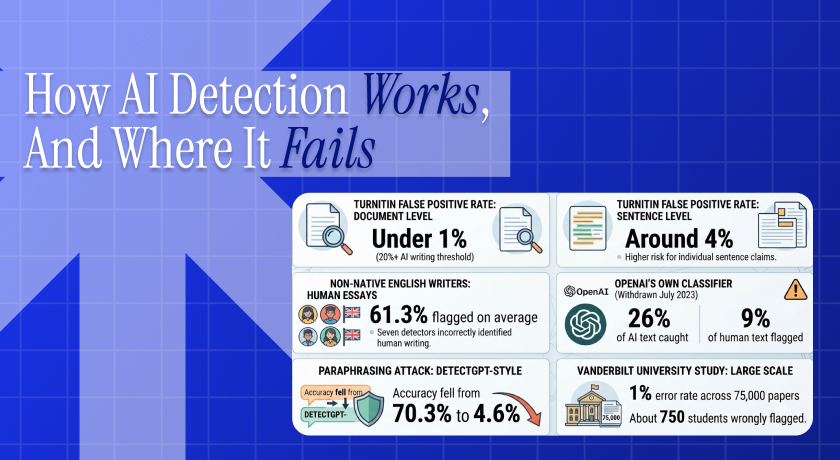
| Evidence | Figure |
| Turnitin false positive rate, document level (20%+ AI writing) | Under 1% |
| Turnitin false positive rate, sentence level | Around 4% |
| Seven detectors on human-written essays by non-native English writers | 61.3% flagged on average |
| OpenAI’s own classifier (withdrawn July 2023) | 26% of AI text caught; 9% of human text flagged |
| Paraphrasing attack on a DetectGPT-style detector | Accuracy fell from 70.3% to 4.6% |
| Vanderbilt: 1% error rate across 75,000 papers | About 750 students wrongly flagged |
From these figures, we can understand some patterns in why human-written articles get flagged as AI.
Detectors can wrongly flag honest writers, especially non-native English speakers, because simpler language scores as more predictable.
Stanford researcher Weixin Liang and colleagues concluded that detector design can penalize writers with limited linguistic variety, and warned against treating low perplexity as proof of AI authorship.
They can also miss AI text that has been paraphrased.
Turnitin has acknowledged a higher incidence of false positives when under 20% of a paper is flagged, which is why a low score is the hardest to interpret.
Also, Turnitin’s Annie Chechitelli has acknowledged that the tool learns that more complex writing is more likely human.
What Are The Institutions Doing Instead Of Relying On Detectors?
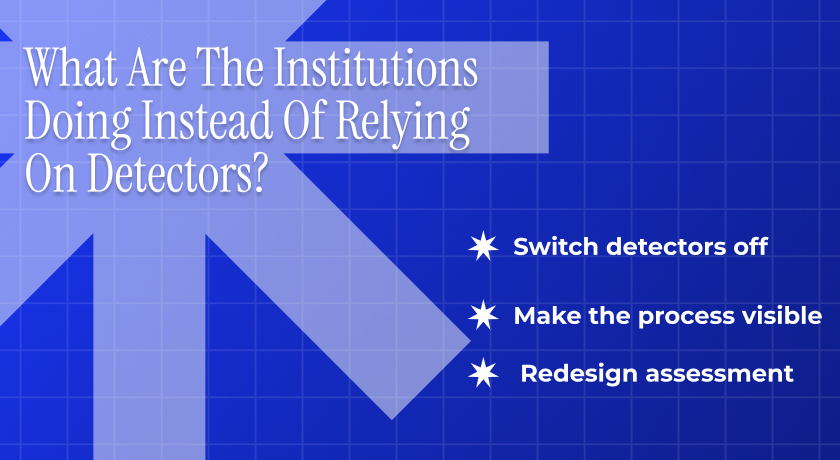
Three directions are common among institutions and universities that do not want to rely on AI detectors.
| Approach | Example | Strength | Limitation |
| Switch detectors off | Vanderbilt (August 2023) Waterloo reportedly ended Turnitin AI detection in September 2025 | Removes false-positive risk | Leaves no screening at all. |
| Make the process visible. | Turnitin Clarity shows pasted versus typed text, revision timelines, and AI chat summaries | Evidence of how work was built | Needs a paid add-on and student buy-in. |
| Redesign assessment | Sydney’s two-lane model: secure, supervised tasks and open, AI-permitted tasks | Verifies learning where it counts | Takes time, staffing, and planning. |
Introducing Process Transparency: Turnitin Clarity
Turnitin Clarity offers a monitored composition space to students and allows educators to see pasted text, typing patterns, construction time, and draft history.
Chief product officer Annie Chechitelli framed the shift with the remark that students “will need to use AI in their future careers.”
Here, the direction has more clarity, as the educators will not judge a finished text and they will check how it was created.
Assessment Redesign: The Two-Lane Approach
From Semester 2, 2025, the University of Sydney classifies assessments as secure (supervised, AI controlled) or open (unsupervised, AI permitted).
Its education leadership argued that a blanket ban is “not practical, enforceable or desirable” for take-home work.
Australia’s regulator TEQSA announced in May 2025 a shift to a regulatory-led approach beginning in 2026.
Critics counter that secure lanes can harm equity and that scaffolding AI use in open tasks is weak pedagogy.
So the model is debated rather than settled.
The Student View: Staying On The Right Side Of Integrity
HEPI’s 2026 survey of 1,054 UK undergraduates found 94% using generative AI for support.
It also found 12% including AI-generated text in their work, and 42% holding back from using it for fear of an accusation.
So, students are using AI at scale while rules lag behind.
As a student, you can grow these five habits to stay on solid ground in academic integrity in this age of generative AI.
| Core Principle | What You Should Do | Why It Matters |
| Verify Course Rules | Check your syllabus for AI guidelines before starting. If the policy is unclear or missing, email your instructor for written permission. | Written confirmation protects you from accidental policy violations. |
| Maintain Authorship | Limit AI assistance to approved tasks (like brainstorming or outlining) and write the final text in your own words. | Keeping the writing genuinely yours ensures your work reflects your actual understanding. |
| Be Transparent | Include an AI disclosure statement or proper citations using the exact format your instructor specifies. | Openly acknowledging AI tools builds trust and follows academic honesty standards. |
| Document Your Process | Save your editing history, research notes, marked-up sources, and email approvals from your instructor. | A clear paper trail proves your work evolved organically if your authorship is ever questioned. |
| Skip AI Humanizers | Never use paraphrasing or “humanizer” tools to disguise AI text. Modern platforms like Turnitin actively flag AI-bypassing attempts. | Attempting to hide AI use directly violates academic integrity and carries strict penalties. |
For The Educators: How To Use AI Detectors Responsibly?
If your institution uses an AI detector, your integrity-based approach will be to treat the score as a prompt for conversation.
Here are the practices you can follow as an educator.
| Best Practice | Recommendation Action | Supporting Rationale |
| Combine Evidence | Never rely on an AI detector score by itself. Evaluate it alongside early drafts, document versions, and histories. Have a direct discussion with the student. | Detector probabilities are fallible and require human context to verify authorship. |
| Set Clear Assignment Rules. | Share transparent, easy-to-understand AI guidelines tailored to each specific assignment. | Research from HEPI highlights that clear, task-level rules prevent student confusion. |
| Watch for Algorithmic Bias. | Review flagged submissions from non-native English writers with extra care before concluding. | Studies from Stanford show that AI detectors disproportionately misclassify non-native English writing. |
| Ensure Due Process. | Show students which sections were flagged. Allow them to share proof of their work, and offer a clear appeal pathway. | Transparent review procedures protect students from unfair penalties caused by false positives. |
| Focus on the Writing Process. | Build draft milestones, brief oral check-ins, and in-class work directly into assignments. | Process-oriented assessments verify learning naturally and reduce reliance on detection software. |
Overall, AI detection and academic integrity are not the same thing.
AI detection is a tool that can raise questions, and integrity, on the other hand, is a shared commitment to honesty, fairness, and responsibility.
Students who follow their syllabus policy and document their process, and institutions that pair clear rules with human judgment, protect both.