


| Quick Answer: AI detectors are not accurate in any single, dependable way because of how they work on the principles of perplexity and burstiness. Even under the most favorable conditions where long and unedited texts are assessed, the best academic AI detectors like Turnitin report a sentence-level false-positive rate of 4%. When that 4% translates to real numbers when assessing thousands of students, the head count is quite high. Furthermore, an independent testing of five popular commercial detectors, presented at a 2026 IEEE security conference, found false positive rates anywhere from 0.05% to 68.6%. In the same test, the false negative rates were as high as 99.6%, and the research said that AI detectors were “poorly suited for deployment in academic or high-stakes contexts.” As a writer and a close observer of how generative AI and the detectors work, I also find that the accuracy depends on the tool, the text length, how much of it was edited, and who wrote it. So, for 2027, the safest approach to survive the inconsistencies of AI detectors is to treat a detector score as a rough signal and never as a verdict. However, you need to build your evidence trail like a draft with a trackable revision history, proper citations where the AI policy of your syllabus allows, and a proper disclosure statement. |
Integrity Note:
EssayWritingGuides.com does not encourage the unethical use of ChatGPT or any other AI tool by students.
Here, the discussion is not on the ways to bypass detectors or “humanize” text.
We only encourage AI use that is allowed under the AI policy of your specific course or institution.
Key Takeaways
- AI detector accuracy is not one number. Independent tests show false positives from 0.05% to 68.6%.
- Even a 1% error rate means hundreds of wrongly flagged papers at university scale.
- Short, mixed, and non-native English writing carries the highest risk of false flags.
- Your best protection is evidence: policy clarity, version history, disclosure, and the ability to explain your work.
- Never use bypass tools, as that is unethical, and paraphrasing can get detected by AI detectors like Turnitin.
- Integrity and a documented process are the only reliable defense.
What “Accurate” Really Means For An AI Detector
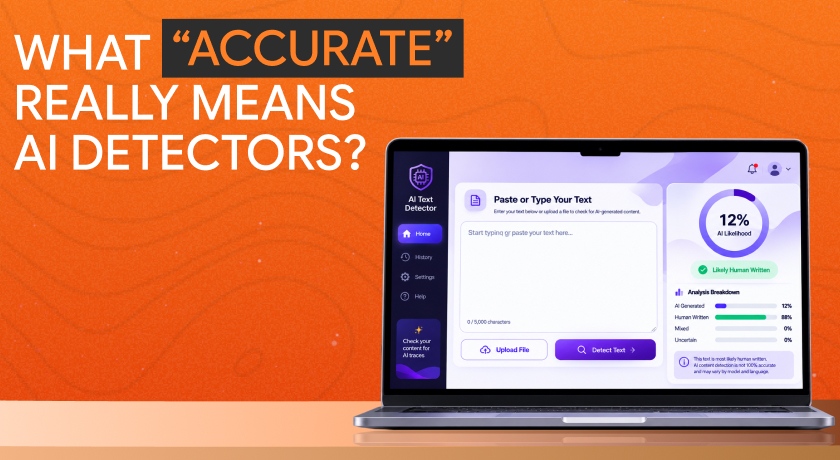
Two things, false positives and false negatives, are important aspects when we talk about the accuracy of AI detectors.
A false positive detection means human writing is flagged as AI, and a false negative means AI-written text gets passed as human.
The false positive cases are more dangerous when using AI for studying. For a student, it calls for an academic integrity meeting about checking your drafts and tracking your work trail.
On the other hand, a false negative case means an instructor misses the misuse of AI or not adhering to the AI policy.
An AI tool with a low false positive rate on average can fare badly in false negative cases. So, a single vendor claim of 99% accuracy, as Originality.AI mentions, and flat figures do not prove the efficacy of a tool.
So, even for self-checks before the submission of the work, you must use multiple tools.
The Gaps Between Inaccuracy: Facts And Numbers
| The Tests/Annoucements | What Was Tested | What It Found | Why It Matters |
| University of Florida (IEEE S&P, May 2026) | Five popular commercial detectors on about 6,000 pre-ChatGPT research papers and AI-written clones |
| The use of tools impacts the accuracy rate. |
| Stanford, Liang et al. (2023) | Seven detectors on 91 essays by non-native English writers |
| Serious bias risk for multilingual writers. |
| Turnitin Company Report | Document-level tests on pre-2019 papers |
| The percentage looks small but can translate into large numbers. |
| OpenAI AI Classifier (2023) | OpenAI’s own challenge set |
| This shows how even the makers of ChatGPT failed to develop a detector that is accurate. |
| Chicago Booth Review of December 2025 | Three commercial detectors, Pangram, Originality.AI, and GPTZero, and one open-source model, RoBERTa, were tested. |
| Open-source models are not reliable. |
What These Numbers Reflect?
When you see all these numbers together, they agree with the August 2026 HEPI analysis.
The Higher Education Policy Institute (HEPI) says that there is no universal accuracy figure. Also, the error rate changes with the tool.
“A detector score should never be sufficient evidence of misconduct on its own.
It can justify a closer look, never a verdict, and the burden of proof should rest with the process, not with the accused student.” – HEPI.
Furthermore, international students face more inconsistencies with the use of AI detectors.
However, the report also acknowledges that AI detectors are not always wrong. It mentions one study of 160 genuine student assignments found no false positives at all.
Moreover, the use of AI is getting more widespread. Turnitin reported that since October 2025, about 15% of essay submissions contained more than 80% AI-generated writing.
So, the AI detectors are not useless, but they are inconsistent.
Why A “Small” Error Rate Is Not Small In Real Scenarios
When Turnitin launched its detector claiming a false positive rate of about 1%, Vanderbilt University did the arithmetic.
It had submitted 75,000 papers in 2022, so a 1% error rate implied roughly 750 honest papers wrongly labeled.
It switched the tool off, and Northwestern University also turned it off.
Imagine a course with 200 students who each submit five assignments. That is 1,000 checks per term.
Even at a 1% false positive rate, about ten honest pieces of work would be flagged in a single term.
For any one student, the chance of at least one false flag across five assignments is roughly 5% (1 minus 0.99 to the fifth power). A number that sounds negligible per document becomes a real risk per student.
Where Flags Go Wrong In Real Life
The AI scores or flags are not random. They cluster around certain kinds of texts and how the writers are using AI.
Here are the details about where AI detectors perform more inconsistently.
Short, Edited, And Mixed Text
Length, mixed, and lack of certainty about low AI scores impact the accuracy.
Length
Turnitin raised its minimum from 150 to 300 words because accuracy improves with more text (Higher Ed Dive).
OpenAI’s classifier was very unreliable below 1,000 characters, and a 2026 research paper shows false positive rates drift as passages get shorter.
Low Scores
Turnitin now puts an asterisk on scores under 20% because false positives are more common there, and 54% of false-positive sentences sit right next to genuine AI writing.
In a mixed document, honest sentences near AI-assisted ones are the most exposed.
Mixed Verdicts
In a study of admissions essays, counting a detector’s “mixed” label as AI use and relaxing the confidence threshold raised false positives by about an order of magnitude.
A “mixed” result deserves the most caution of all.
Multilingual And Non-Native Writers
The Stanford team found detectors were near-perfect on essays by U.S.-born eighth graders yet misclassified more than half of the TOEFL essays.
Senior author James Zou said the detectors were “just too unreliable at this time” for stakes this high.
If English is not your first language, a thorough paper trail matters even more for you.
Also, if you are writing a paper in any language other than English, you need to understand how multilingual AI detectors such as Turnitin, Copyleaks, or ZeroGPT work.
The Flip Side: Detectors Also Miss
The same University of Florida research found that two detectors which looked strong at first became largely useless once AI output was rewritten with more complex vocabulary.
Lead researcher Patrick Traynor put it bluntly. He said,
“We really can’t use them to adjudicate these decisions.”
Two lessons follow here. A clean score is not a shield, and chasing a lower score by rewriting is a game you cannot reliably win.
The Survival Playbook For 2027 To Overcome The Inconsistencies Of AI Detectors
You cannot control a detector, but you can control your evidence. These five habits protect you whether the tool is right or wrong, and none of them require tricking anything.
Know The Rule Before You Open The Tool
AI policies differ from course to course.
Read the university AI policy and the syllabus AI policy, and if it is unclear, ask your instructor in writing what is allowed, such as brainstorming, grammar help, outlining, or none.
This written clarification will be your defense when your work is reviewed.
Build A Paper Trail While You Write
- Write in a tool with version history, such as Google Docs or Word with autosave, so your drafts show how the piece grew.
- Keep notes, outlines, source links, and early drafts in one folder.
- If AI use is permitted, save the prompts and responses you used.
Some institutions now build this trail in. Turnitin Clarity records revision history, typed versus pasted text, and active writing time, with a playback feature.
Importantly, UCLA notes that Clarity does not itself detect AI writing. So, it provides evidence rather than a verdict. If your course does not use it, replicate the habit informally.
Disclose Permitted AI Use
If your policy allows AI help, say so plainly. A short disclosure turns a potential “gotcha” into a documented, policy-compliant process.
Read Any Score Like A Smoke Alarm
If you run a self-check with a tool such as ours, use one tool consistently, because different detectors disagree sharply.
If flagged passages are your own, do not run them through “humanizer” tools. That risks the very integrity problem you are trying to avoid.
Also, AI detectors such as Turnitin now have features to detect paraphrasing.
So, a better fix is to make the text more specific with what you have learned in the classes and through authentic research.
Use your own examples, course-specific references, and properly cited sources.
Be Ready To Explain Your Own Work
Many integrity processes begin with a conversation.
Turnitin has said its reports are data points to support a discussion with students, “not determinations of misconduct.”
If you can walk an instructor through your argument, why you chose each source and how the draft changed, you answer the real question behind any flag.
| Moves that Protect You | Moves that Backfire |
|---|---|
| Reading and clarifying the course AI policy in writing | Assuming the rules are the same across all your courses |
| Drafting in a tool with version history | Writing everything in one sitting and pasting it in |
| Disclosing permitted AI help | Using AI quietly and hoping the detector misses it |
| Treating a score as a prompt to review your work | Rewriting repeatedly to hit a “0% AI” number |
| Adding your own examples and cited sources | Running text through humanizer or bypass tools |
If You Are Flagged: A Calm Response Plan
Being flagged is not the same as being found responsible.
Even so, the American Bar Association Journal reports that students have been penalized on detector output alone and that some schools ask for drafts or version histories. Preparation matters.
Step By Step
- Stay calm and reply in writing. Keep the tone polite and factual.
- Ask for the evidence and method. Which tool and version, what score, and which passages were flagged?
- Gather your trail using the table below.
- Offer to walk through your work in a meeting or short oral explanation.
- Ask about the process. Find out whether your school allows appeals and whether detector scores can serve as sole evidence.
Evidence That Helps
| Evidence | What it Shows | Where to Get it |
|---|---|---|
| Version history | The piece grew gradually over time | Google Docs, Word, or OneDrive history. |
| Notes and outlines | Your thinking before the draft | Notebooks, apps, saved files. |
| Source trail | You read and used the cited material | Bookmarks, PDFs, library records. |
| Earlier writing samples | Your usual voice and level | Past graded assignments |
| AI chat logs (if permitted) | Exactly how any allowed AI help was used | Saved chat history or exports. |
For Instructors And Institutions: Using Scores Fairly
Students are not the only ones who need a plan. The educators also need to keep certain things in mind when checking a text through Turnitin alone or with Canvas integration.
- Never treat a detector score as sole evidence. Use it to open a conversation.
- Know and publish the assumed false positive rate, and read it against your own submission volume and share of international students, as the HEPI analysis recommends.
- Apply extra caution to short submissions, low scores, and “mixed” verdicts.
- Pair detection with process evidence and clear, early communication about AI, the approach Vanderbilt recommended when it disabled the tool.
What To Plan Around In 2027?
AI scores can change without notice. Detector makers can update their tools at any time, which is why one 2026 benchmark pinned the exact versions it tested.
Originality.ai, for example, retired older models in September 2026 and released new ones in October. A score from today may not match one from next month.
Also, scrutiny is not going away. With reported AI-heavy submissions in the double digits, instructors will keep checking.
Process evidence is growing.
Universities have been using writing-process tools such as Turnitin Clarity through 2026. So, a visible writing process may soon be the default way to show authorship.
So, build habits to bypass the inconsistencies of AI detectors, not hacks. Habits keep working when the tools change.
How Accurate Are AI Detectors? Frequently Asked Questions (FAQs)
Here are the frequently asked questions and answers about the accuracy of AI detectors.
Should I Run My Essay Through Several Detectors To Be Safe?
No, you should not run your essay through several AI detectors. Results vary so widely between tools that multiple scores tend to create confusion.
In the Stanford study, 89 of 91 human-written essays were flagged by at least one of seven detectors.
So, pick one consistent tool, use it as a rough check, and rely on your drafts as the real safeguard.
Can I Ask My University Which Detector It Uses And How It Handles Errors?
Yes, you can ask your university about which AI detector it uses, and it is a reasonable question.
Ask which tool and settings are used, whether a score can be the sole evidence, and what the appeal process is.
Researchers advise institutions to know and publish their assumed error rates, so a clear answer is a fair expectation.
Does Writing More “Imperfectly” Help Avoid AI Flags?
There is no certainty that the AI detector will not flag your text if you write it in an imperfect manner deliberately.
Also, it is not an ethical practice to bypass the detection of a tool. Furthermore, it lowers the quality of the text.
So, write clearly, cite honestly, and keep your evidence to defend your fairness and integrity.


