

| Quick Answer: A university AI policy is the set of rules that says whether, how, and when students can use generative AI tools like ChatGPT in their research and coursework. However, despite the presence of an umbrella rule by universities, the rule for a specific assignment is set by the instructor. So, for your research and coursework, get the AI policy for the syllabus and have a clear idea about the usage allowed and banned. If you are confused about certain areas, ask your instructor and have a written clarification about the same from them. Document the response and also keep your draft handy so that you can produce it even if your human-written assignment is flagged as AI. Use tools such as Google Docs or Microsoft Word, where the instructor can track changes, and you can prove your fairness. Also, if your course policy allows the use of AI, clearly cite it following the APA, MLA, Chicago, or other standard styles and add a disclosure statement. |
One of the biggest problems in the use of AI in studying is the lack of clarity.
You can ask five students at the same university about the use of ChatGPT, and they will come up with five different answers.
Along with a lack of prudence in the matter, it shows how a university AI policy often does not have clear guidelines.
Also, AI detection by Turnitin or any other trusted AI detector for academic writing only flags the need for a review of a specific assessment.
The score alone does not prove the fairness or academic integrity of a student.
So, in this guide, I will explain what a university AI policy usually has, the latest 2026 data, and how to find the rules that you need to adhere to.
What Is A University AI Policy?
A university AI policy is a clear set of guidelines about the acceptable and unacceptable uses of generative AI in teaching, assessment, and research.
It usually has the following elements.
- Permitted Tasks
- Disclosure
- Data Privacy
- Misconduct Procedures.
The confusion about the policy starts because the set of rules is never mentioned in one document.
The Three Layers Of AI Policy
| Layer | Who Sets It | What it Decides | Where to Find It |
|---|---|---|---|
| Institution | Provost, Senate or Academic Integrity Office |
|
Student Handbook, Library or Teaching-Centre Site |
| Department or Programme | School or Faculty | Discipline Norms, Such as Coding Versus Essay Writing | Programme Handbook |
| Course | Instructor | What is Allowed on Each Assignment |
|
Stanford University illustrates its AI policy properly.
Its guidance varies by school, course, assignment type, and instructor rather than following one uniform rule.
Where Do University AI Policies Stand In 2026?
| Findings | Source |
|
Coursera Survey of 4,200 people in five countries. |
| Only 19% of higher education institutions worldwide had a formal AI policy | 2025 UNESCO survey, reported by OECD coverage. |
| 180 of the QS top 200 universities publish GenAI guidelines. | 2026 preprint (not yet peer-reviewed). |
|
Computers in Human Behavior: Artificial Humans Study via PsyPost |
|
HEPI Student Generative AI Survey 2026, as cited by Blekhman. |
Rules Differ Inside The Same University
California State University’s survey of more than 94,000 people across 22 campuses found that faculty expectations vary widely.
- 18% Forbid AI
- 22% Discourage It
- 28% are Neutral
- 19% Encourage It
- 6% Require It
Also, two-thirds of teaching faculty include an AI statement in their syllabi.
Harvard shows the same pattern.
The Crimson’s 2026 faculty survey found 24% of faculty prohibit AI entirely (up from 20% a year earlier) and 4% allow unrestricted use (down from 8%).
Only 3.5% have no explicit course policy.
In the Crimson’s own sample of 600 fall 2026 classes, over half of science and engineering classes allowed AI, compared with 35% in social sciences and 27% in arts and humanities.
What Most University AI Policies Cover
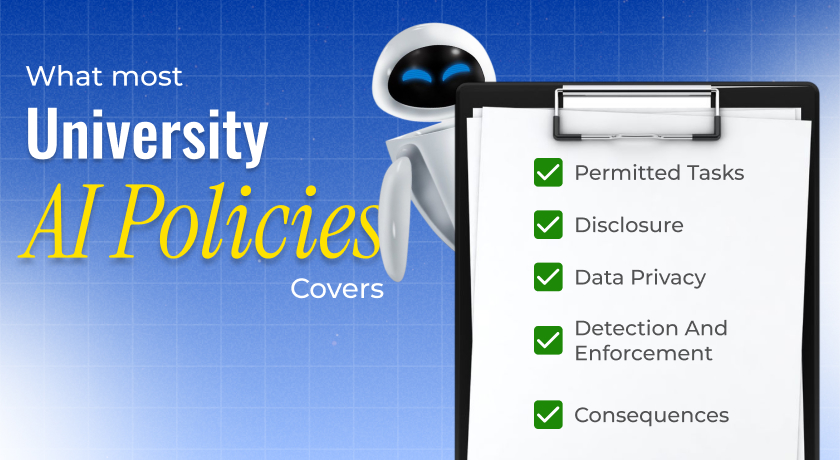
A university AI policy, across institutions, contains information about the following five things.
Permitted And Prohibited Uses
Many policies use tiered wording such as embrace, limit, or prohibit.
The R1 study found 55% of institutions offered example statements along these lines and 56% supplied sample syllabus language.
Brainstorming, grammar checking, and drafting usually fall under different categories. So read the task-level wording.
Disclosure And Citation
Where AI use is allowed, most policies expect you to say so.
A short note on which tool you used and for what is the common standard.
Data Privacy And Approved Tools
The OECD warns that without institutional tools, students and staff fall back on personal accounts with free consumer tools, raising privacy and integrity concerns.
Do not paste unpublished research, personal data, or other people’s work into a tool your university has not approved.
Detection And Enforcement
Some policies name an AI detector, but many now warn against relying on one.
You will understand why universities do not rely on using a single AI detector if you know how they function.
AI detectors work by assessing the perplexity of your text and trying to figure out how predictable the word choices are.
Also, they assess the variations in the sentence structure and variation to return a score.
The score offered by a standalone AI detector or a suite like Turnitin is a flag that needs review and not absolute proof.
This is the stage where an instructor needs to review the assignment using tools such as Canvas with integrated Turnitin and initiate conversations.
They must check the student drafts and assess the work trails before labeling an assignment as fair or rejecting it as AI-generated.
Consequences
Prohibited or undisclosed use normally comes under existing academic misconduct codes.
At Harvard, 25% of faculty who frequently receive AI-produced work referred students to the Honor Council, compared with about 5% of those who see it only occasionally.
Case Study: How AI Detector Doubts Are Reshaping Policy
The University of Waterloo discontinued Turnitin’s AI detection in September 2025.
It cited research on unreliability, bias against non-native English writers, and cases where human-written text was flagged as fully AI-generated.
It also said that the focus should be more on education than policing, and urged instructors toward assessment redesign and AI literacy.
Furthermore, Curtin University disabled the feature from 1 January 2026 while keeping originality checking, and Vanderbilt did so in 2023.
In August 2026, Southampton said it would not renew its Turnitin contract beyond 2026-27 over proposed changes that would have let student submissions train AI services.
It again denied the use of Turnitin to train its composition tool.
What This Means For Students
Reporting by Resultsense cites an Edinburgh Napier survey of more than 6,600 students at seven UK universities in which 32% admitted some unpermitted AI use.
Also, a HEPI finding showed that 42% of students were less likely to use AI for fear of false accusations.
Again, Judy Williams of Queen’s University Belfast said bluntly that “AI detection tools are not the solution.”
However, an AI detector proves nothing. If you self-check a draft, treat any score as a signal and not as proof.
What Experts Are Saying

Jules White, Vanderbilt’s senior advisor on generative AI, says “Generative AI will be integral to the future of education,” but that adoption demands careful consideration, as quoted by Coursera.
The same survey found 65% of respondents believe unregulated AI will diminish the credibility of university degrees. Clear, consistent policy is the common ask.
How To Find And Follow Your University’s AI Policy
| Step/Focus Area | Action to Take | Why It Matters |
| Course Rules | Read the syllabus and assignment brief. | Identifies the exact rules your work will be assessed against. |
| Department Norms | Check your department or programme handbook. | Clarifies discipline-specific expectations and standards. |
| University Policy | Visit the university’s academic integrity page and search the library or teaching-centre site for “generative AI”. | Ensures you follow broader institutional guidelines and approved practices. |
| Clarification | Ask your instructor in writing if any rule is silent or unclear, and save the reply. | Provides written proof of permission if questions arise later. |
| Process Evidence | Keep drafts, version history, notes, and any prompts you have used. | Demonstrates authentic authorship and documents your workflow. |
| Disclosure | Disclose any permitted AI use in the exact format required by your course. | Maintains transparency and fulfills academic citation standards. |
Reading Policy In Practice With Hypothetical Example
Maya takes a sociology essay module and a statistics module.
The sociology syllabus prohibits generative AI, but the statistics syllabus permits it for debugging code if disclosed.
Maya skips AI for the essay, saves her drafts, and adds a two-line disclosure to her statistics report.
This shows how, at the same university, in the same week, two different behaviours can be correct.
Overall, a university AI policy in 2026 is a patchwork, but it is readable once you know the layers. So, follow the course-level rule, disclose honestly, and keep evidence of your process.
University AI Policy: Frequently Asked Questions (FAQs)
Here are the frequently asked questions and answers about the university AI policy.
What If My Instructor Allows AI But The University Policy Seems Stricter?
If your instructor allows AI but the university policy seems stricter, ask for written clarification from the instructor or the academic integrity office before you submit.
Also, institution-wide integrity codes usually set the outer limit, so do not assume a verbal go-ahead protects you.
Do AI Policies Apply To Theses And Dissertations?
Yes, AI policies apply to theses and dissertations, and often the rules are stricter.
The rules are because graduate schools and supervisors add their own rules on authorship and research data. So, confirm requirements with your supervisor early.
Can I Use AI For Translation Or Grammar Correction?
Whether you can use AI for translation or grammar correction depends on your university’s AI policy.
Some treat grammar and translation tools differently from content-generating tools, and others do not.
So, ask your instructor and disclose the use if the policy requires it.


