| Quick Answer: You can find a multilingual AI detector online. However, the performance is mostly inconsistent. Also, most of the claims are made by vendors, and many independent researchers have raised questions about their accuracy or reliability. Nevertheless, as of today, officially, Turnitin can perform AI detection in English, Spanish, and Japanese. On the other hand, Copyleaks lists 30 languages on which it can perform AI detection. Furthermore, GPTZero claims that it can detect AI in English and more than 20 languages in total. Again, one thing that holds true is the concern regarding the accuracy of these AI detectors. Even in English, these detections are possibilities and probabilities, not a guarantee. That is an even more serious area for other languages. So, overall, be it English or any other language, take the AI detection as a lead or a flag and not a verdict. |
Key Takeaways
- Language support is real but uneven, and lists for the language detection change often.
- Most multilingual accuracy figures come from vendors, not independent testers.
- Non-native writers face documented false positive risk, although Turnitin disputes it for longer texts.
- Always combine a score with drafts and human review.
- Remember that a score is a lead and not absolute proof of a text being AI- or human-written.
What Does A Multilingual AI Detector Do?
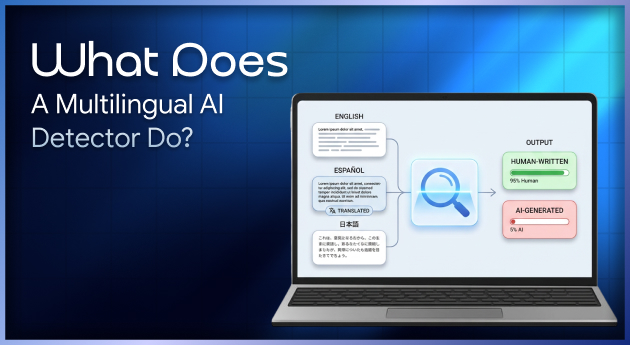
A multilingual AI detector can assess human and AI text in various languages, including English.
This is an important feature to have for an AI detector because the detection signals from the English text do not offer a clean result.
This is simply because an AI detector may fail to detect paraphrasing or translated text.
To perform these tasks, an AI detector must be built for multilingual detection.
The Fairness Problem
While discussing the fairness problem, I must refer to the Liang et al. (Patterns, 2023) test.
It assessed seven detectors that tested 91 TOEFL essays by non-native English speakers.
The result was shocking, with a false-positive rate of around 61.3%.
However, for the essays by U.S. eighth-graders, the false-positive rate was close to zero.
This explains why your human-written essay is getting flagged as AI.
Also, this test establishes how your language skills may get priority over the use of AI.
Why Is Non-English AI Detection A Major Problem?
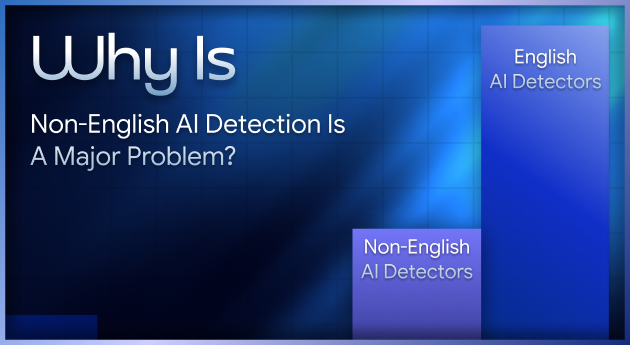
Be it Turnitin, Quillbot, or any other AI detector, they work on patterns from training data.
In other words, each tool has a statistical footprint of perplexity, or the predictability of word choices.
This is true for English and other languages.
So, a multilingual AI detector will need its own datasets, testing, and tuning for each language it offers AI detection.
Understanding The Uneven Training Coverage With A Real Example
GPTZero released an update on 31st October 2025, and it announced the launch of its new multilingual model.
It says,
“Today, we’re proud to announce the release of our new multilingual model, expanding AI detection coverage over nine of the world’s most prevalent languages and setting the stage for state-of-the-art detections on low-resource languages.”
So, while it published a list of 20+ languages in which it will perform AI detection, it also admitted that the resources for some languages were limited and that it questions the training part of the detector.
Also, it claimed an accuracy rate of 99% as a multilingual AI detector.
However, that figure is not beyond argument if the training resources are limited.
The Problem Of Detecting A Short Text
As I have also mentioned in my Turnitin guide, the accuracy of an AI detection score is impacted when a text is short.
Turnitin itself seeks a submission of a text of around 300 words for accurate AI detection.
Also, Turnitin admits that the false-positive rate of AI detection is higher in texts less than 300 words in length.
Comparing The Language Support Of Leading Multilingual AI Detectors
Here is a comparison of how multilingual AI detectors offer support in different languages.
However, the list keeps changing.
So, check the official page of each detector before trying it for any language other than English.
| Detectors | Languages | Notes |
| Turnitin | EnglishSpanishJapanese | Needs a Minimum of 300 Words Does Not Support a Document Written in Multiple Languages. Can Detect Paraphrasing and AI Bypassers Only for the English Language. |
| Copyleaks | 30 Languages | It Can Auto-Detect Languages It Includes Hebrew, Chinese, and Arabic. |
| GPTZero | English plus 20+ | Officially reports higher false positives outside English. |
| ZeroGPT | Advertises all languages | No per-language accuracy data published by ZeroGPT or in any independent research. |
The Evidence Of Accuracy And The Truth
Each multilingual AI detector has a specific claim to make about the accuracy rate.
However, these so-called vendor claims cannot be evidence of accuracy.
So, for tools like Turnitin and its integration with Canvas, educators and students now need to keep two things in mind.
As the score is not the final proof of accuracy, you have to understand how to use AI properly for studying.
Again, while submitting a project, you have to furnish a proper disclosure statement mentioning how you have used AI.
Here is a deep dive into how multilingual AI detectors work and their limitations.
Turnitin
The Japanese and Spanish models of Turnitin are different from the English model.
Its Japanese model was already trained to detect texts from GPT-4 and GPT-4o-family models.
Furthermore, in May 2026, it reported improving its Spanish model while keeping the false-positive rates low.
The release published on 5th May 2026 says,
“We have improved AI detection in our Spanish-language AI writing model while minimizing false positives.
No changes to your settings are required. There are no visual changes to the AI writing report or the highlighting within the report.
This release will not retroactively update previously-generated AI writing reports. To view the AI writing score generated by this update, existing submissions must be resubmitted.”
It announced a similar update for its English language detector in October 2026.
However, only the Turnitin English AI detector can flag the use of bypasser tools and paraphrasing.
GPTZero And Copyleaks
The benchmark report of GPTZero claims 99% accuracy in multilingual detection.
In the same assessment, it says that Copyleaks has an accuracy score of 78.3%.
However, I have a problem here.
If I trust these numbers, I have to accept that the multilingual AI detection rate of GPTZero is higher than its accuracy rate in English text detection.
Again, as a neutral entity, Fast.io finds that Copyleaks has an accuracy rate of 90-93% and GPTZero has an accuracy rate of 94-99%.
Having said that, at least for English text detection, Copyleaks has been the most reliable name for me after Turnitin.
Also, given that it allows me to check 5 texts for free every day, I find it more reliable.
How A Multilingual AI Detector Sets Its Benchmark (With GPTZero As The Example)
GPTZero published its per-language results.
You don’t need to trust this data completely, as it is vendor-run.
However, from this data, you can understand a pattern and also understand that the false-positive rates can vary by language.
| Linguistic Group | Language | False Positive Rate (%) | AI Recall (%) | Detection Profile |
| Asian and Middle Eastern | Arabic | 0.08 | 99.98 | Near-perfect recall, ultra-low false positives |
| Bahasa | 0.3 | 99.78 | Very high recall, low false positives | |
| Chinese | 0.6 | 100 | Perfect recall, slightly elevated false positives | |
| Korean | 0.1 | 99.79 | Very high recall, minimal false positives | |
| Vietnamese | 0.1 | 99.88 | Minimal false positives (recall data omitted) | |
| Romance Languages | Catalan | 0.01 | 99.60 | Near-zero false positives, very high recall |
| French | 0.1 | 99.73 | Minimal false positives, very high recall | |
| Portuguese | 0 | 98.89 | Zero recorded false positives, high recall | |
| Romanian | 0 | 98.8 | Zero recorded false positives, high recall | |
| Spanish | 0 | 98.88 | Zero recorded false positives, high recall | |
| Slavic Languages | Bulgarian | 0.08 | 97.97 | Ultra-low false positives, strong recall |
| Croatian | 0.2 | 99.41 | Low false positives, very high recall | |
| Czech | 0.1 | 96.4 | Minimal false positives, solid recall | |
| Polish | 0.1 | 98.56 | Minimal false positives, high recall | |
| Russian | 0.1 | 98.8 | Minimal false positives, high recall | |
| Slovak | 0.08 | 96.79 | Ultra-low false positives, solid recall | |
| Slovenian | 0.1 | 98.46 | Minimal false positives, high recall | |
| Ukrainian | 0 | 96 | Zero recorded false positives, solid recall | |
| Germanic and Hellenic | Dutch | 1 | 99.3 | Highest false positive rate in dataset, high recall |
| German | 0.3 | 98.29 | Low false positives, high recall | |
| Greek | 0.4 | 97.9 | Moderate-low false positives, strong recall |
(Source: GPTZero).
How To Evaluate And Choose A Multilingual AI Detector?
To choose a multilingual AI detector online, you must conduct the test as a team.
You must trust a tool only after multiple human authors have tested it.
Also, the testing should be done across multiple genres, various proficiency levels, and for at least one non-English language.
Follow these simple steps to evaluate and choose a multilingual AI detector.
- Confirm the language is officially supported, not merely implied by “all languages.”
- Run human-written samples in that language before trusting any result.
- Use at least 300 words of long-form prose.
- Avoid mixing languages in one document where the tool does not support it.
- Prefer independent benchmarks over vendor ones.
- Treat the score as one data point alongside drafts and conversation.
Choosing A Multilingual AI Detector By Use Case
The right choice of a multilingual AI detector depends on who is checking and why.
- Schools already using Turnitin: Stay within English, Spanish, and Japanese, and treat other languages as unsupported for AI scoring.
- Institutions needing broad coverage: Copyleaks advertises browser, Google Docs, and LMS integrations alongside 30 languages.
- Individuals checking non-English text: Use GPTZero or Copyleaks as a screening aid, test them on your own human writing first, and remember that vendors report their own results.
How To Interpret The Score Of A Multilingual AI Detector?
Once you use a multilingual AI detector and get the scores against your text, you need to develop certain habits as a student and educator.
Students
Keep dated drafts and version history, and disclose permitted AI help.
Where your course allows AI help, record which tool and language you used, because a score cannot explain to a reviewer why your text looks the way it does.
Educators
Treat scores below 20% as inconclusive, since Turnitin hides them behind an asterisk for that reason.
Also, never rely on a score as sole evidence.
Initiate conversations with your student and review the drafts before reaching any decision.
Multilingual AI Detector: Frequently Asked Questions (FAQs)
Here are the frequently asked questions and answers about a multilingual AI detector.
1. Which AI Detector Supports The Most Languages?
As of today, among the tools I have used, I have found Copyleaks to work with the highest number of languages.
According to its official statement, it works on 30 languages, and GPTZero is a close second, offering detection in 20 more languages along with English.
ZeroGPT claims that it offers AI detection across all languages.
However, there is no comprehensive independent or vendor data available to prove its efficacy.
2. Can Turnitin Detect AI In French And German Texts?
No, Turnitin cannot detect AI in French and German texts.
Along with English, it can only perform AI detection for texts in Spanish and Japanese.
Furthermore, Turnitin can only detect paraphrasing and AI-bypassers for English-language texts.
3. Are Multilingual Detectors Biased Against Non-Native Writers?
It is difficult to answer this question with a simple Yes or No.
Many independent research reports show evidence that AI detectors score significantly lower false positive rates for native writers.
However, Turnitin does not acknowledge this gap.