| At A Glance: If the title seems philosophical, we don’t want to preach anything to you. Having our own AI detector, we just want you to be ethical in the use of AI while studying, researching, essay writing, professional writing, or anything you do. Follow the AI policy of your particular syllabus, course, and institution. If your policy prohibits AI for an assignment, the only safe choice is not to use it. |
If the AI policy for your syllabus allows the use of ChatGPT, you must keep three things ready to defend your case.
- Permitted Use of AI
- Your Own Writing
- A Paper Trail
Use AI for brainstorming, understanding concepts, outlining your essay, and assessement/feedback of what you have written.
Write the sentences yourself in one Word file or Google Docs so that the version history is recorded.
Also, never run AI text through a “humanizer” tool, and it is a common breach of university AI policies.
Furthermore, despite a few inconsistencies, AI detectors can flag paraphrasing through AI bypassers.
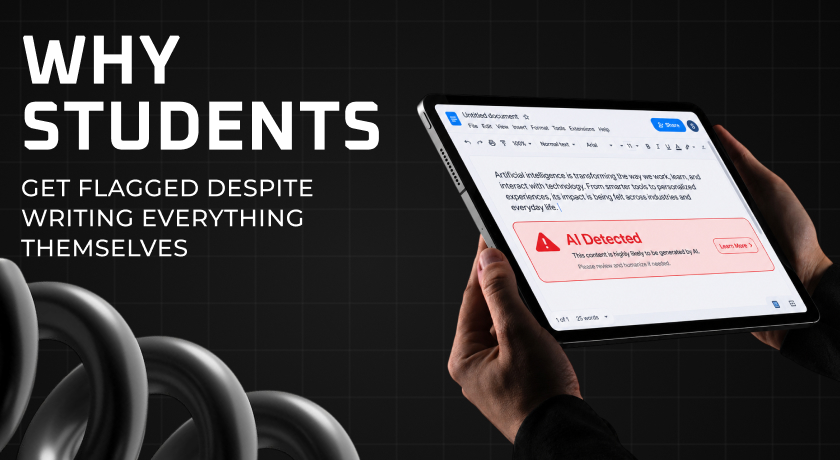
Again, a student may never use AI and still have their assignment flagged as AI.
Turnitin puts its sentence-level false positive rate at around 4%.
So, a documented process is the best method to prove your honesty when your human-written article is getting flagged as AI.
Why Do Students Get Flagged Even After Writing The Entire Work?
AI detectors work differently from paraphrasers, and that is why they do not check your text against a database.
Most AI detectors assess each sentence for how predictable the wording and structure look and then return a probability score.
So, what we get is a useful signal, but it is never the Gospel or a final verdict.
Have a look at some important facts and figures before we delve deeper.
| Finding | Figure |
|---|---|
| Turnitin document-level false positive rate (papers with 20%+ AI writing) | Under 1% |
| Turnitin sentence-level false positive rate | Around 4% |
| Seven detectors tested on human-written essays by non-native English writers | 61.3% flagged on average 97.8% flagged by at least one |
| OpenAI’s own AI text classifier | Caught 26% of AI text. Wrongly flagged 9% of human text. Withdrawn in July 2023. |
| Vanderbilt: 1% error on 75,000 papers a year | About 750 students wrongly flagged |
| The Higher Education Policy Institute (HEPI) UK undergraduates using generative AI for assessed work (2026) | 94% |
| The HEPI via The Star figure of students who put off using AI for fear of a cheating accusation | 42% |
How AI Detectors Read Your Writing
Turnitin launched its first model, AIW-1, in April 2023.
This model scores every sentence between 0 and 1 based on perplexity and burstiness.
The perplexity assessment tests how predictable or unique the word choices and burstiness shows how uniform or variant the sentence structures are.
Once the sentence-wise assessment is done, Turnitin combines the scores into a document percentage.
Here, you must remember the difference between the sentence-wise and document-wise false-positive results, as mentioned in the table above.
In addition, Turnitin has recorded a higher incidence of false positives when less than 20% of a paper is flagged.
This June 2023 report writes,
“Nearly two months after releasing an artificial intelligence writing detection feature, plagiarism detection service Turnitin has reported a “higher incidence of false positives” — or incorrectly identifying fully human-written text as AI-generated text — when less than 20% of AI writing is detected in a document.”
Also, the chances of false positives are higher for the first and last sentences of a document.
Who Gets Flagged Most Often?
Non-native English writers usually get flagged often despite submitting an honest paper.
So, vocabulary or language proficiency often defeats integrity.
In the Stanford study, detectors wrongly labeled over 61% of human-written TOEFL essays as AI, and all seven agreed on nearly 20% of them.
The authors traced the problem to perplexity-based scoring, which treats simpler, more predictable language as machine-like.
Turnitin was not among the seven tools tested.
Its chief product officer, Annie Chechitelli, told The Markup the tool was trained on multilingual student writing.
However, also acknowledged that Turnitin reads more complex writing as human.
This scenario or inconsistency has caused some serious implications in terms of how institutions now see the efficacy of AI detectors.
Yale’s Poorvu Center says it “doesn’t endorse the use of AI detection software,” and its Turnitin page notes the AI feature is switched off.
Moreover, Attorney Andrew Miltenberg, who represents accused students, has called these checkers “primitive” and prone to false positives.
Step Zero: Read Your AI Policy Before You Open ChatGPT
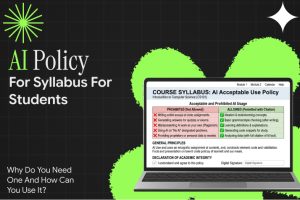
Along with understanding how AI detectors work, you also need to be aware of the AI policy of your syllabus.
You need to have absolute clarity about the permitted usage and things prohibited.
Moreover, if you have confusion about AI use, get clarification in writing from your instructor.
HEPI’s 2026 report argues that university AI policies need to be clearer, accessible, and assessment-specific.
Most AI policies usually have these three tiers.
| Policy Tier | What It Usually Means | Safe Approach |
| No AI permitted. | Any generative AI use on graded work counts as a violation. | Do not use it on that assignment. Ask whether study uses, such as explaining a concept, are allowed. |
| Limited or assisted use. | AI allowed for named tasks (brainstorming, outlining, language feedback), not for drafting. | Stay inside the listed tasks, keep records, and disclose your use. |
| Open use with disclosure. | AI allowed if you cite or disclose it. | Cite ChatGPT and add a disclosure statement exactly as instructed. |
What To Do If The Policy Is Silent Or Unclear?
Silence or the absence of an AI policy for the syllabus does not translate into permission automatically.
Email your instructor with the specific use you have in mind and save the reply.
For example, you can email, “May I use ChatGPT to generate counterarguments while brainstorming, with all drafting done by me?”
That email is also evidence if the authority questions your work.
How To Use ChatGPT Without Getting Flagged? The Safe-Use Playbook Or 8 Habits That Protect You
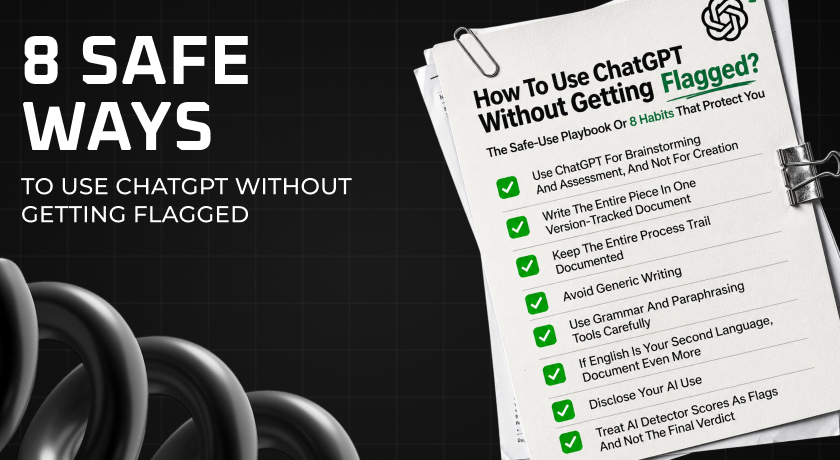
Assuming the policy of your syllabus allows the use of AI, you can develop these eight habits.
These are not tricks for hiding AI-written text.
These are just practices to establish your human authorship and reduce the chances of an unfair flag.
1. Use ChatGPT For Brainstorming And Assessment, And Not For Creation
You can take help from ChatGPT to brainstorm before you start writing the draft.
You can even test your thesis against counterarguments or explain a hard reading. Use it after drafting for feedback on clarity and structure.
However, the writing part must be completely done by yourself.
You cannot draft an essay or writing with AI and then make human edits.
Turnitin can easily detect AI text with surface-level changes.
2. Write The Entire Piece In One Version-Tracked Document
Draft in Google Docs or Word 365 with autosave on. Version history time-stamps your work as it grows.
UC San Diego graduate Ivan Ornelas told the Los Angeles Times he composed every paper in Google Docs for this reason.
However, you need to remember one caution.
Version history does not always persuade a review committee, so pair it with other evidence.
3. Keep The Entire Process Trail Documented
| Evidence | What it Shows | Tip |
|---|---|---|
| Version history | Gradual drafting over time | Do not write elsewhere and paste in at the end. |
| Notes and outlines | Your thinking before the draft | Date the notes. Photos of handwritten notes count. |
| Annotated sources | Real reading and selection | Keep PDFs with your highlights. |
| AI chat export (if allowed) | Exactly what the AI did, and nothing more | Export or screenshot after each session. |
| Instructor emails | Permission for your AI use | Save as PDF. |
4. Avoid Generic Writing
You must include the points from the class discussion and add page-specific citations from assigned readings.
You can also add your own examples and the reasoning to establish your argument,
When you use specific data or information in your writing and avoid generic prose, you can reduce predictability.
Also, when you use information from your class or syllabus, you can defend yourself better.
5. Use Grammar And Paraphrasing Tools Carefully
Tools like Grammarly offer grammar correction and rewriting options simultaneously.
You will obviously accept the grammar and spelling corrections.
However, don’t allow the tools to rewrite the whole paragraphs unless the policy of your syllabus allows it.
Turnitin launched detection aimed at AI paraphrasing in July 2024.
So, heavy automated rewriting can look like AI-paraphrased text.
If you are unsure whether your grammar assistant counts as AI, ask.
6. If English Is Your Second Language, Document Even More
Given the Stanford findings, keep every draft and consider telling your instructor early that you write in a version-tracked file.
Do not make your prose artificially complicated to “look human.”
Clear writing is not evidence of cheating.
7. Disclose Your AI Use
A brief AI use disclosure statement helps to establish that you have used AI only within the permitted capacity.
For example, you can disclose, “I used AI for better clarity on the outline and concept.”
8. Treat AI Detector Scores As Flags And Not The Final Verdict
If an AI detector highlights a passage as AI-written, you do not need to disguise it.
If possible, you can revise it and include more of your reasoning and sources.
Moreover, keep your draft history ready, as AI detectors disagree with one another and OpenAI itself withdrew its detector in 2023.
So, the score of a single AI detector does not prove anything.
Why “Humanizer” Tools Make Things Worse
As part of the Turnitin Originality add-on, Turnitin announced AI bypasser detection on 27th August 2025.
However, it only supports AI-written English text.
Turnitin also launched Turnitin Clarity in May 2025, a controlled writing environment.
AI detection and human review for submission is moving from judging the final text to observing the writing process, which is the one place a humanizer cannot help you.
There is an integrity problem too.
Running AI text through a humanizer to hide it from an instructor is concealment, and it cannot turn a prohibited use into a permitted one.
What To Do If You Are Flagged Anyway
| Step | Action | Key Details And How-To |
| 1. Preserve Evidence | Stay calm and delete nothing. | Keep all original drafts, notes, and version history intact as your primary defense. |
| 2. Request Details | Ask for specifics. | Ask which passages were flagged, which detection tool was used, what score was generated, and which policy clause applies. |
| 3. Gather Edit Logs | Pull your version history. | In Google Docs, go to File > Version history > See version history to capture your writing timeline. |
| 4. Build a Timeline | Assemble a chronological packet. | Organize your drafts, notes, annotated sources, instructor emails, and permitted AI chat exports in date order. |
| 5. Verify Authorship | Offer to talk through the paper. | Propose an in-person discussion to explain your arguments and sources directly. |
| 6. Escalate if Needed | Use the formal appeal process. | Note that Turnitin classifies its score as a review signal rather than definitive proof and provides guidance on false positives. |
Latest Updates (November 2026) And The Way Forward
| Dates | Updates |
| 12th February, 2026 | Turnitin updated its AI writing detection model to improve recall while keeping false positives low |
| 12th March 2026 | HEPI’s survey of 1,054 UK undergraduates found 12% included AI-generated text in assessed work, up from 8% in 2025 and 3% in 2024. |
| Early 2026 | A Coursera survey found only one in four lecturers felt confident they could spot AI-generated work. |
| 5th May 2026 | Turnitin improved its Spanish-language detection. Existing submissions must be resubmitted to get new scores. |
The most ethical and surest way to avoid an AI flag in your writing is to use AI only when your syllabus allows it.
Keep the writing yours and leave a visible trail of your draft.
Tricks that work today may not work tomorrow as AI detectors get updates.
However, following policy compliance and keeping your work well documented can never fail to establish that you have used AI ethically.