| Quick Answer: A standalone AI detector and Turnitin, despite assessing human- and AI-written texts, are different in terms of accessibility and common use. Turnitin is an institutional system. Your instructor can see the Turnitin report and initiate an academic integrity conversation. On the other hand, a standalone AI detector is a tool you control. You can use it to check your own draft before submission. Neither of these results is proof that all AI detectors work on perplexity, and what they offer is a probability score. Turnitin says its document-level false positive rate is under 1% for documents with 20% or more AI writing, but the sentence-level false positive rate is 4%. Again, a publication in the “International Journal for Educational Integrity” tested 12 publicly available detectors and two commercial detectors, PlagiarismCheck and Turnitin. The assessment showed that neither of these tools was accurate or reliable. So, you can use a standalone tool as a private early-warning check and treat Turnitin’s score as your instructor’s starting point. Also, keep your drafts as your real evidence and use AI as your syllabus policy says. |
What Makes Turnitin Different From A Standalone AI Detector?
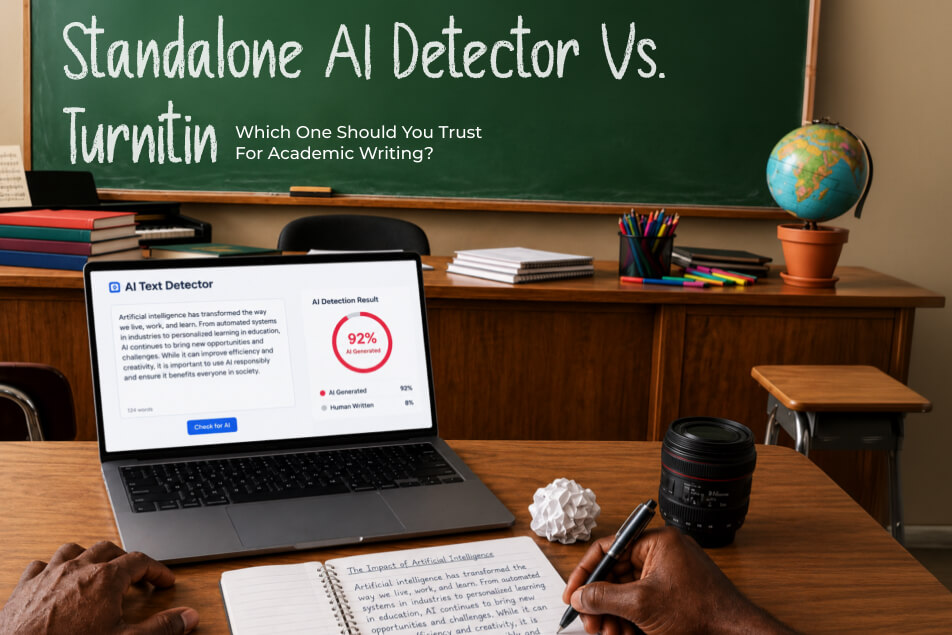
Turnitin and a standalone AI detector both estimate how likely a text is to be machine-generated.
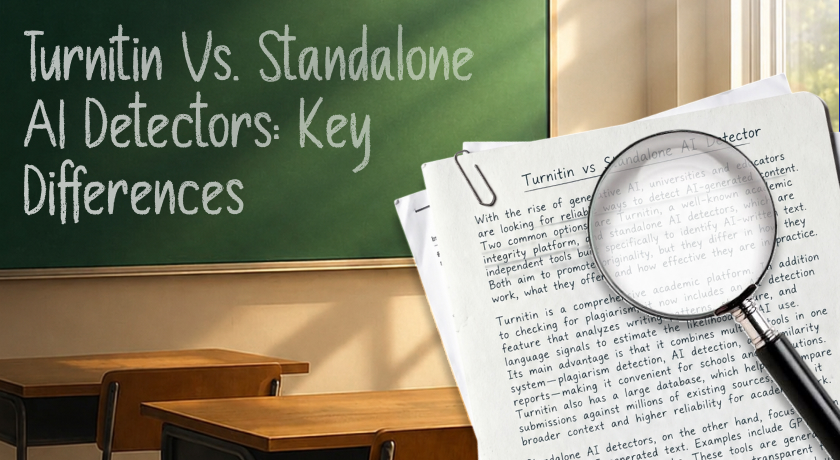
The difference is who runs the AI detector, who sees the result, and what other features/functions you get in a bundle.
Turnitin: An Institutional Workflow
Turnitin’s AI writing report sits inside the similarity workflow your school licenses.
At many universities, only instructors and administrators can open it.
The report highlights sentences, separating “AI-generated only” text from “AI-paraphrased” text.
Also, the release notes of Turnitin, the tool, have been effectively highlighting writing modified by AI bypasser tools since 6th December 2023.
“AI word spinners are sometimes used to avoid identification of AI-generated text.
We now detect likely AI -generated text even if it may have been paraphrased using an AI word spinner.
Our AI paraphrasing detection is incorporated into our AI writing detection capability and does not require any change to your settings.
There are no visual changes to the report or the highlighting in the report with this update.
Previous reports will need to be resubmitted to detect likely AI paraphrasing.”
Standalone Detectors: A Tool You Control
ZeroGPT, GPTZero, Originality.ai, and Pangram sell directly to students, writers, and institutions.
You have to paste the text, read a score, and decide what to do.
So, you can use these tools based on the advantage of your timing.
However, each detector trains its own model differently. So, the same text can get different scores and different flags in different tools.
I have discussed this in detail in the next-to-next section.
Having said that, the market is consolidating.
Superhuman, the company behind Grammarly, announced its acquisition of GPTZero in June 2026.
Standalone AI Detector Vs. Turnitin: A Side-by-Side Comparison
| Factor | Turnitin | Standalone AI Detector |
| Access | Through your institution’s license | Open to anyone, free or paid tiers. |
| Who Sees the Result | Instructor and administrators | You, unless you share it. |
| Best Use | Official review of submitted work. | Pre-submission self-check. |
| Score Display | Scores of 1-19% show an asterisk, not a number. | Score display is different. Most show a percentage. |
| Paraphrase Handling | Flags AI-paraphrased text and likely bypasser use. | Varies widely by vendor. |
| Languages | English, Spanish, and Japanese per its release notes. | Varies Some advertise 30+ languages. |
| Process Evidence | Turnitin Clarity add-on shows drafting history. | Some offer authorship replay, such as GPTZero’s Replay. |
Why Can The Same Essay Score Differently In Different AI Detectors?
The training data of each AI detection tool is different.
They also use different thresholds and sentence segmentation.
Turnitin hides scores from 1% to 19% because its own testing showed more false positives there, while many standalone tools display every percentage.
Therefore, the same essay can have an 18% score in a standalone AI detector and get an asterisk from Turnitin.
Standalone AI Detector Vs. Turnitin Accuracy: What The Evidence Says
“Useful signal but unreliable verdict.”
This is the direction or pattern we can notice by assessing the vendor claims, independent studies, and bias research.
Turnitin’s Own Numbers
Turnitin reports a document-level false positive rate below 1% for documents with at least 20% AI writing and a sentence-level rate of about 4%.
Its chief product officer has acknowledged that behind each error is a real student who may have put real effort into their original work.
In its first six weeks, Turnitin processed 38.5 million submissions, and 3.5% contained more than 80% AI-written text.
So most flags involve borderline cases.
Moreover, in error clusters, 54% of false-positive sentences sit directly beside genuinely AI-written text.
This makes the detection of mixed documents the hardest case.
Independent Testing
Turnitin was one of the two commercial systems in a 2023 test of 14 AI detectors.
Every tool scored below 80% accuracy, and results worsened on edited or paraphrased text.
The strongest recent benchmark is a University of Chicago working paper by Brian Jabarian and Alex Imas.
It tested Pangram, Originality.ai, GPTZero, and an open-source baseline, but not Turnitin.
Pangram showed essentially zero false positives and false negatives on medium and long passages.
GPTZero produced fewer false positives than Originality.ai, which separated AI from human text better.
However, GPTZero’s false negatives climbed to roughly 50% against humanizer tools.
The authors also argue that institutions should decide how many false accusations they can tolerate first, then choose a tool that meets that cap.
At a strict 0.5% false positive cap, Pangram kept detecting AI text effectively while the other tools degraded sharply.
The Bias Problem
The bias problem is real when you try to figure out why a detector flags a human-written article as AI.
A Stanford-led study found that seven standalone detectors labeled 61.22% of TOEFL essays by non-native English writers as AI-generated.
At the same time, they could handle US eighth-graders’ essays almost perfectly.
Senior author James Zou called such detectors “unreliable and easily gamed.”
If the vocabulary is simple, it reads more predictably.
A university teaching center cautions that error rates run higher for ESL writers, and our guide to multilingual AI detectors covers this further.
So, Standalone AI Detector Vs. Turnitin: Which One Is Better?
The better choice among the two depends on the purpose and timing of the tool.
When Turnitin Is the Better Reference
Because Turnitin is the primary tool your instructor uses, its reports directly shape any conversation you might have about your work.
Through features like Clarity, the platform displays your drafting history, pasted text, and typing patterns alongside its AI score.
It is specifically built to detect AI-paraphrased content and bypasser tools where standalone detectors often fall short.
It also publishes document- and sentence-level error rates so educators understand its limitations.
Furthermore, Turnitin’s workflow enables instructors to easily compare flagged submissions against their earlier writing.
It is a verification practice actively recommended by institutions like the University of Georgia.
When A Standalone Detector Is The Better Choice
Running a pre-submission check allows you to catch and revise issues.
You can also add an AI disclosure before turning in your final work.
Using an external tool for a second opinion helps highlight passages that sound overly mechanical.
It is especially important since several standalone detectors have been independently benchmarked in evaluations like the University of Chicago study, which did not include Turnitin.
Keep in mind, however, that these independent checks are purely for your own review and will never override the official report generated by your instructor.
Knowing The Recent Updates For Better Decision-Making
| Date | Entity / Platform | Key Milestone | Impact / Significance |
| July 15, 2025 | Turnitin | Made Clarity generally available. | Shows pasted vs. typed text alongside draft history. |
| August 27, 2025 | Turnitin | Added bypasser detection to AI reports. | Targets AI-paraphrased content and evasion tools. |
| October 2025 and February 2026 | Turnitin | Updated its AI detection model. | Improved recall rates while keeping false positives low. |
| January 1, 2026 | Curtin University | Switched off Turnitin’s AI detection. | Retained standard similarity checks while dropping AI scoring. |
| June 23, 2026 | Superhuman and GPTZero | Superhuman agreed to acquire GPTZero. | Consolidated major AI writing and detection capabilities. |
Where QuillBot Fits In: A Brief Comparison
QuillBot is different from Turnitin, though it also has an AI detector.
It is a writing suite with a paraphraser, grammar checker, summarizer, citation generator, plagiarism checker, AI humanizer, and AI detector.
So, detection is one feature among many, not the core product.
That matters twice.
First, there is no authoritative independent academic benchmark of QuillBot’s detector.
So, treat its score as a rough spot check.
Second, its paraphraser is exactly what Turnitin targets.
Since July 2024, Turnitin reports an “AI-paraphrased” category and names QuillBot as an example tool.
Paraphrased AI text may be flagged rather than hidden.
See ZeroGPT vs. QuillBot for a similar head-to-head.
In short, QuillBot suits paraphrasing, grammar, and citation help.
So, for a defensible detection signal, a dedicated detector or your institution’s Turnitin report is the stronger reference.
How To Use A Standalone Detector And Turnitin Both Without Getting Burned?
Treat each tool as one input, not an answer.
1. Read your syllabus first, and the AI policy for the syllabus explains what instructors usually specify.
2. Keep drafts and version history from the first paragraph.
3. Run one standalone check on the full draft, not isolated snippets.
4. Treat flagged sentences as editing prompts. Skip humanizer tools, as Turnitin now looks for them.
5. If flagged, ask for the sentence-level report and bring your drafts. Read how to use ChatGPT without getting flagged first to develop ethical practices.
Explaining The Selection With A Hypothetical Example
Amara, an international student, writes a formal 900-word essay entirely herself.
A standalone detector marks it 18% AI, while Turnitin shows only an asterisk.
So, her instructor sees no percentage and opens no case.
Weeks later, she submits an essay mixing her own paragraphs with AI-assisted ones her syllabus permitted with disclosure.
Turnitin reports 62%, with highlights clustered together.
Her version history, AI disclosure statement, and citation settle the matter.
So, the lesson here is that asterisk scores and mixed text are where numbers mislead most, and process evidence beats any score.