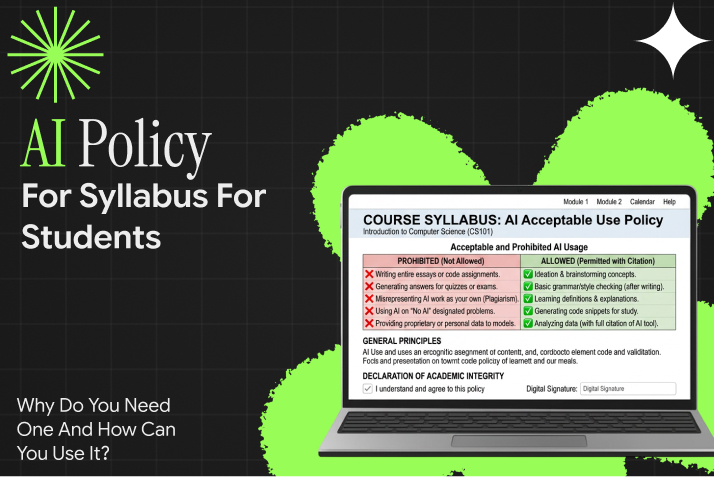
| Quick Answer: An AI policy for syllabus is a brief section that defines how, when, and whether you may use ChatGPT or any other tool for that specific course. An AI policy for a syllabus is important because every organization and guide follows a different set of rules. Also, the “I did not know” approach is slothful, and it is a weak defence in the matter of academic integrity. So, you need to read the AI section of each syllabus on day one. Then, you can sort the common tasks into three categories. AllowedNot AllowedNot Clear Next, you must ask your guide or instructor about the areas you are confused about to have a clear rulebook for every assignment. |
Key Takeaways
- A syllabus AI policy is your course-level rulebook, and the quality of your grade can depend on reading it correctly.
- Policies range from no AI to freely permitted, and they differ by course.
- More schools now require them, but surveys show students still lack practical guidance.
- Silence is not permission. Ask in writing and keep the answer.
- Document and disclose any allowed AI use, and verify everything the tool produces.
What Is An AI Policy In A Syllabus? Know The Levels
An AI policy in a syllabus is the instructor’s written rule about how to use AI in studying.
You will find it beside attendance, grading, and late-work rules.
Also, in many universities, the AI policy in a syllabus is more important than a campus-wide academic integrity code.
Furthermore, the AI policy in a syllabus turns general principles into more specific rules for your class.
For example, a report on Duke’s guidelines notes that it is up to each professor to decide whether AI may be used in their courses.
So, two classes you are attending for the same semester can have different AI policies for the syllabus.
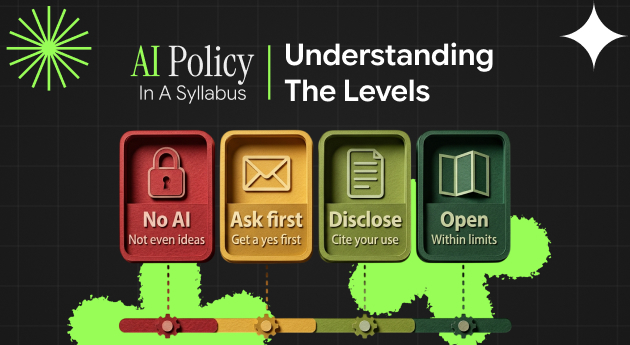
The Four Common Policy Levels
Universities and educational organizations may label their policy levels differently.
However, you will notice similarities across the patterns.
For example, Washington State University’s 2025 memo on AI expectations lists four versions.
- “AI Use Prohibited.”
- “AI Use Only with Prior Permission.”
- “AI Use Only with Acknowledgement.”
- “AI Use is Freely Permitted with No Acknowledgement.”
On the other hand, the recent recommendations of Buffalo State have three levels.
- Prohibited
- Permitted with Disclosure and Citation
- And Encouraged with Guardrails.
The recent statement also highlights another aspect of using AI.
It is regarding how students mostly seek support for the clarity of the AI policy.
It says, “The most requested form of support is clear, specific, and
enforceable policy guidance.”
| Policy Level | What It Means | What You Should Do |
| No AI | Work must be completed without AI assistance. | Do not use AI, even for brainstorming. Don’t use AI to draft or edit unless told otherwise. |
| Permission First | You can only use AI if the instructor approved the use of AI in advance. | Take permission in writing before every use and keep the reply handy. |
| Allowed with acknowledgement | You can use AI with a proper disclosure statement. | Record the AI tool you have used. Keep a record of the prompts used and how you have used the output. |
| Freely permitted or encouraged | AI use is open. However, there can be guardrails sometimes. | Verify the accuracy. Follow the stated limits set by your instructor. |
What Does A Good AI Policy For Syllabus Cover?
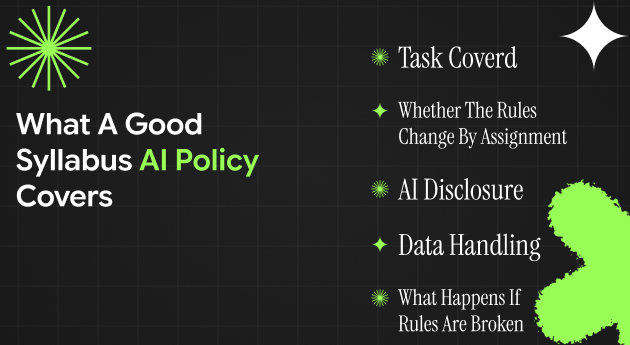
A well-crafted AI policy for a syllabus is not about a simple answer in Yes or No.
A clear policy will have the following elements.
| Elements in the AI Policy for Syllabus | Details |
| Tasks Covered | BrainstormingGrammar HelpDraftingCodingSummarizing |
| Whether the Rules Change by Assignment | For example, Duke’s guidance notes that instructors who allow AI may need to add specific guidelines to each assignment. |
| AI Disclosure | A Clear Guideline about the AI use disclosure statement. |
| What Happens if Rules Are Broken | The Consequence or Punishment. |
| Data Handling | It is about data you may or may not enter into AI tools. |
An example of a good AI policy for a syllabus is Brown University’s Sheridan Center.
It offers an AI Policy Explorer that lets instructors tick allowed and prohibited uses and generates a draft statement.
This shows how modern AI policies have become task-specific.
What You Must Understand About AI Policy For Syllabus
Syllabus AI policies are now formal and widespread. However, these are uneven.
All three elements affect your grade.
Policies Are Becoming Mandatory
The use of AI for studying is no longer a suggestion, and these are practical requirements.
Here, I must mention how Centre College’s faculty voted on May 11, 2026, to require an AI policy statement in every syllabus for 2026-27.
Furthermore, Longwood University’s Faculty Senate approved a policy requiring each syllabus to explain “if, when, and how AI may or may not be used.”
The Longwood policy even states,
“Faculty are encouraged to lead a conversation with students in each course to explain the rationale for the AI guidelines and the relationship to course learning outcomes.
Faculty are also encouraged to be transparent with students about how they use AI in the course themselves.”
Again, Oregon State circulated a draft in May 2026 proposing that every syllabus include an AI usage policy even if it was not scheduled for a vote at that meeting.
Moreover, in the Cal State system, a survey of more than 94,000 students and employees found that 68% of faculty include an explicit statement on AI use.
Students Still Get Mixed Signals With AI Policy For Syllabus
Having a policy in place is different than understanding it.
In this context, I can refer to the 2026 student survey of St. Olaf College.
The findings of the survey were:
- 90% of the respondents said that their professors included an AI policy statement.
- However, only 39% of the respondents said that their professors offered actual guidance regarding the use of AI in an assignment.
Also, remember that the survey had 529 responses, which made the response rate around 34%.
So, the numbers are pretty much a snapshot of how the campus responds.
Again, the Cal State survey found that 67% of students felt their professors do not teach them to use AI effectively.
In addition, there was a small student survey at Brandeis.
The outcome suggested the presence of confusion even after the university clarified the syllabus and offered four sample statements.
Building The Syllabus Through A Consistent Effort
Katie Sabourin of St. John Fisher University describes a five-semester effort to build a campus-wide syllabus policy.
This policy sets common expectations while allowing instructors to customize the AI discipline.
Also, in practice, the AI policy for the syllabus is where the campus rule becomes your rule with some necessary adjustments.
Silence Is Not The Permission For AI Use
Some courses do not have any AI statement.
A Cal Poly San Luis Obispo professor told KPBS he has none because neither his department nor the university provided one.
Furthermore, the University of San Diego’s AI steering committee has recommended a default institutional policy that applies when a syllabus is silent.
The lesson is that if your syllabus says nothing, look for a department or university default, then ask your instructor before using AI.
How To Use Your Syllabus AI Policy
The AI policy for a syllabus is not a formality, and it is a working tool.
Furthermore, in most situations, there are five steps to follow to use AI policy for syllabus for students.
Step 1: Read The AI Policy Strictly Before Your First Assignment
On day 1 itself, you have to read the AI policy carefully.
You will usually find the policy near the academic integrity or course policies.
Be careful about the policy levels, any assignment-specific exceptions, and the disclosure rules.
Check your university’s academic integrity code too, because the course rule usually sits on top of it rather than replacing it.
Add any assignment-specific AI exceptions to your calendar next to the due dates.
Step 2: Turn It Into A Task Checklist
Policies have general terms.
However, you need to translate the policies into daily tasks.
This will give you clarity about the things to do, things to avoid, and the areas you are confused about.
| Task | Question to answer from the policy | If it is unclear |
|---|---|---|
| Brainstorming topics | Does the policy cover idea generation? | Ask before using. |
| Grammar and spelling checks | Are editing tools counted as AI? | Ask. Some definitions exempt basic checkers unless the instructor says otherwise. |
| Drafting or rewriting text | Is AI-written or AI-paraphrased text allowed? | Assume no until confirmed. |
| Summarizing readings | Is AI allowed as study help only? | Use it for studying, not for submitted work. |
| Coding or data help | Are tools allowed for debugging? | Ask, and cite if allowed. |
Step 3: Ask In Writing When Anything Is Unclear
If you cannot understand any part of the instruction, you must email your instructor or teaching assistant.
You can send them a short message like this:
“Hi Professor [Name], in [course], may I use [tool] to [specific task] on [assignment]? If yes, how should I disclose it? Thank you.”
Keep a record of the reply, as a written answer protects you during review.
Also, ask questions about your confusion early in the project and before you start the actual work.
Step 4: Document And Disclose
If AI is allowed with acknowledgement, record the tool, the date, your prompts, and how you changed the output.
Here is one summary of eight universities’ policies.
It notes that disclosure templates ask students to explain which tools they used, the prompts provided, and how the output was integrated.
Moreover, follow your instructor’s format.
Step 5: Verify Output And Protect Your Data
Now, this is a more critical aspect of using AI for studying.
Suppose your guide has allowed the use of AI for writing an argumentative essay, narrative essay, or any other argument.
Still, there are risks in using AI.
Buffalo State’s recommendations call for open communication about AI’s known risks, including hallucinations and bias.
So, check every fact and citation yourself.
Furthermore, Columbia’s teaching center advises against entering confidential university data into tools that are not approved.
Also, keep your notes and drafts because how AI detectors work is not beyond argument.
As a result, organizations like Vanderbilt said they would disable Turnitin’s detection tool after testing it.
Moreover, if you want to conduct a self-check before submitting your paper, you can run your draft through a reliable AI detector.
Still, note that an AI detector may fail to detect paraphrasing, or your human-written text can get flagged as AI.
So, maintain your integrity, follow the policies, and keep the drafts ready to defend yourself.
AI Policy For Syllabus: Frequently Asked Questions (FAQs)
Here are the frequently asked questions and answers about the AI policy for the syllabus.
1. What If My Syllabus Has No AI Policy?
If your syllabus does not have an AI policy, you must refer to the default policy of your university or the integrity code.
Then, break the policies into categories like permitted and not permitted.
Also, identify the areas you are unsure about and seek written clarity or permission about them from your instructor.
Do not assume silence as permission to use AI.
2. Does The Syllabus Policy Override The University Policy?
Yes, at many schools and universities, the instructors set course-specific rules separately from the general guidelines.
However, even in such scenarios, the academic integrity rules remain applicable.
So, you will have to follow both.
3. Do I Have To Cite AI If The Policy Allows It?
You must follow the written instructions of your guide or instructor about citation.
Disclosure is a condition of use in policies that allow AI “with acknowledgement.”
Also, disclosing is the safest habit even when the rule is vague.