| Quick Answer:
No single AI detector is the best for academic writing in every situation. For academic writing, “best” means low false positives, reliable results on full essays, sentence-level highlights, and privacy for your text. The University of Chicago working paper is the independent academic benchmark that I referred to. It compared different commercial AI detector tools, such as GPTZero, Pangram, Originality.ai, and RoBERTa, directly and rated Pangram the strongest. Also, it labelled GPTZero as better at avoiding false positives among the rest, and Originality.ai as better at separating AI from human text. However, Turnitin is the reference tool mostly used by institutions. It assesses a “Qualifying Text” and highlights the use of AI at a sentence level and at a document level. Irrespective of the tool you use, any score it returns is a prompt to review your draft, and not a verdict about fairness and integrity. Having said that, you must only use AI for research and writing if the AI policy for your syllabus allows. |
What Makes An AI Detector Best For Academic Writing?
The training model of every AI detector is different, and even in everyday use, you can see the inconsistency in the tool results.
The difference is all the more visible in how the sentences are highlighted.
Though every AI detector assesses a text based on perplexity, it has a statistical footprint, and that is where the difference comes from.
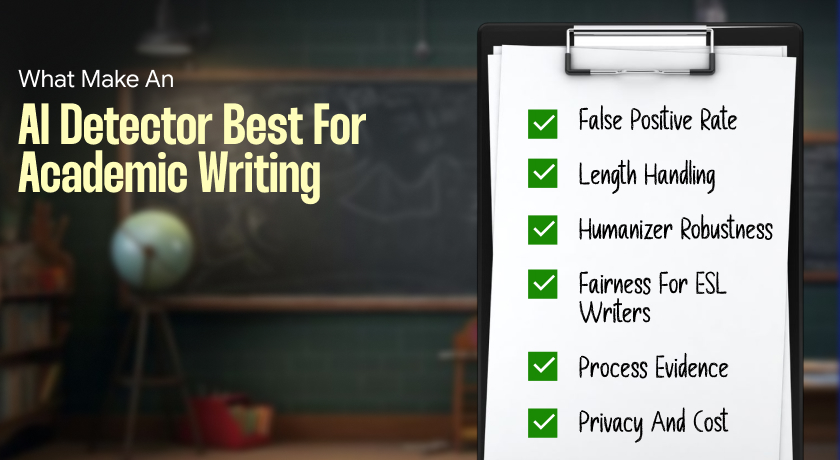
However, the best AI detector is the one with sound, independent evidence and the different criteria below.
| Criterion | Why It Matters | What to Look for |
| False positive rate | A wrong flag can trigger an integrity case. | Independent testing, not only vendor claims. |
| Length handling | Short passages give noisy scores. | Tools that state a minimum length. |
| Humanizer robustness | Edited or paraphrased AI text is common. | Results tested against humanizer tools. |
| Fairness for ESL writers | Plain vocabulary can look machine-made. | Published bias testing. |
| Process evidence | Drafts prove authorship better than scores. | Authorship or version replay. |
| Privacy and cost | Essays may be stored or used for training. |
|
Why Vendor Accuracy Claims Need Caution
Pangram says its false positive rate is about 1 in 10,000 in its own evaluation, and Copyleaks promotes a Business Insider test ranking it most accurate among eight tools.
However, both are vendor-reported.
The Chicago results are consistent with Pangram’s strength, but a single study with a defined set of texts cannot guarantee performance on your essays.
What The Chicago Benchmark Tested
Jabarian and Imas ran each detector on a large corpus of human and AI-generated text spanning topics, lengths, and AI models.
They then compared false positive and false negative rates under fixed policy caps rather than each vendor’s default threshold.
That design asks which tool performs best when the tolerance for false accusations is held constant.
However, the limitation of the test is the scope. It did not include Turnitin, Copyleaks, or QuillBot.
The Best AI Detectors For Academic Writing, Compared
| Detector | Best For | Evidence | Watch Out For |
| Pangram | Lowest-risk second opinion. | Near-zero errors on medium and long passages in the Chicago study.
Most robust against humanizers. |
Accuracy falls on very short text. |
| GPTZero | Students wanting low false positives and authorship replay. | Fewer false positives than Originality.ai in the same study. |
|
| Originality.ai | Separating AI from human text. | Better discrimination than GPTZero in the study. |
|
| Turnitin | Official institutional review. |
|
|
| Copyleaks | Multilingual submissions. | Advertises 30+ languages |
|
| QuillBot | Quick spot check inside a writing suite. | Bundled with paraphraser and grammar tools. | No independent benchmark found. |
Best AI Detector For Academic Writing: Tool-By-Tool Notes
Here is why I picked each AI detector on my list of the best ones for academic writing.
Pangram
Pangram performed the best in the Chicago Study, and its false-positive cap was just 0.5%.
This not only proves a strong detection rate but also reduces the chances of human-written texts getting detected as AI.
It also showed better performance in detecting paraphrasing using a humanizer.
The report mentions,
“Pangram’s false negative rate is robust to the use of current “humanizers” and remains low even when AI-generated passages are modified using tools such as StealthGPT.
The other detectors are less robust to humanizers, with GPTZero largely losing its capacity to detect AI-generated text, showing false negative rate scores around 50% and above across most genres and LLM models.”
However, Pangram is a paid tool, and its free tier does not always work despite showing that you have credits left.
Also, it is less efficient at detecting short passages.
The pricing of Pangram is $20 per month for Individual plans and $65 per month for Professional plans.
GPTZero
As a publicly accessible tool, GPTZero is sensible, and it helps to avoid false accusations.
Also, its Replay feature tracks authorship over time.
However, GPTZero shows limitations in detecting texts paraphrased by humanizers if heavy editing is done.
In addition, if you want to use the free version of the tool, you can check 10000 words at most.
The pricing for this tool is ₹599 per month, payable annually, or ₹1099 per month.
Originality.ai
It separated AI from human text better than GPTZero in the study. So, it is better for screening bulk content.
However, the false-positive rate of this detector is higher.
And that is a drawback, especially when assessing a student’s essay.
Its free plan allows you to check a text of a maximum 10000 words.
It also has a Pro Plan starting from $12.95 a month and an Enterprise plan starting from $136.58 a month.
Moreover, I faced a problem with Originality.AI as I checked a piece and it highlighted a prominent research report as AI.
In many similar cases, I have found the false-positive rate of Originality.AI to be higher.
Turnitin, Copyleaks And QuillBot
Turnitin is different from a standalone AI detector, as it is a suite and an institutionalized tool.
Also, its value is that it is the system your instructor already uses.
Copyleaks pitches multilingual coverage, though I could not verify its non-English accuracy independently.
QuillBot’s detector is a convenience inside a paraphrasing suite, best for a quick spot check.
However, I could not find any independent report to prove the efficacy of QuillBot as an academic AI detector.
Also, as Turnitin highlights, QuillBot being a writing suite has a human bypasser also and I am not convinced particularly about this part.
Best AI Detector By Situation
The choice of the best AI detector for academic writing also depends on the
If You Are A Student Checking Your Own Draft
Choose a tool with published independent testing, such as Pangram or GPTZero, and run it on the complete draft.
Mark flagged sentences, compare them with your notes, and revise them with more specific information to avoid generic text.
Generic texts have a chance of getting high AI scores due to low perplexity.
Also, do not run text through humanizers just because an AI detector has highlighted it.
Keep your drafts ready and defend your case if needed. Turnitin can easily detect the use of AI bypassers.
In addition, free-tier word limits and scan caps change often.
So, confirm them on the vendor’s page before relying on a free plan for a long essay.
If You Write In English As A Second Language
You have to be more careful about choosing the best AI detector for academic writing here.
A Stanford-led study found seven detectors labeled 61.22% of TOEFL essays by non-native writers as AI-generated.
Rely on version history over any single score, as vocabulary cannot be the parameter for authenticity to get an AI score for your writing.
If Your Draft Mixes Your Writing And AI-Assisted Text
An AI detector struggles most when detecting mixed writing.
Turnitin found that 54% of false positive sentences sat directly beside real AI writing.
So, errors cluster and the false-positive rates of the detection go up.
If You Rely On Paraphrasing Tools
A 2023 study of 14 detectors found accuracy worsened on edited, paraphrased, or machine-translated text.
Turnitin’s July 2024 notes add an “AI-paraphrased” category and name QuillBot as an example.
If you paraphrased your own sentences with a tool, expect a score and keep your original drafts.
Also, Turnitin added detection of AI bypasser tools to its release notes as of August 2025.
If You Are An Instructor Or Administrator
Decide your tolerance for false accusations first, as the Chicago authors recommend, then pick a tool that meets it.
Jabarian and Imas suggest a conservative cap so ordinary editing help, such as Grammarly, does not come under the scanner.
Also, use scores only to open a conversation, and if you want to go further, you can follow the example of Curtin University.
It switched off Turnitin’s AI detection in January 2026.
What To Avoid When Choosing The Best AI Detector For Academic Writing?
Do not use free tools built on open-source models.
In the Chicago study, the open-source baseline wrongly flagged 30% to 78% of human text, and Jabarian said such tools are not great at all.
Also avoid any tool that promotes humanizing text to beat detectors, and any with no published evaluation.
How To Run A Fair Self-Check?
A fair check is repeatable, and your draft must have a paper trail. So, use Google Docs or Microsoft Word files for drafting.
Also, use AI according to the policy of your syllabus and run two independently evaluated detectors on the full draft.
If you want to revise, you must work for specificity and not to achieve a 0% score.
Moreover, cite ChatGPT and add a disclosure to establish that the use of AI in your academic writing has been compliant with the policy.